Understanding Brucella Serology Testing in UK Healthcare
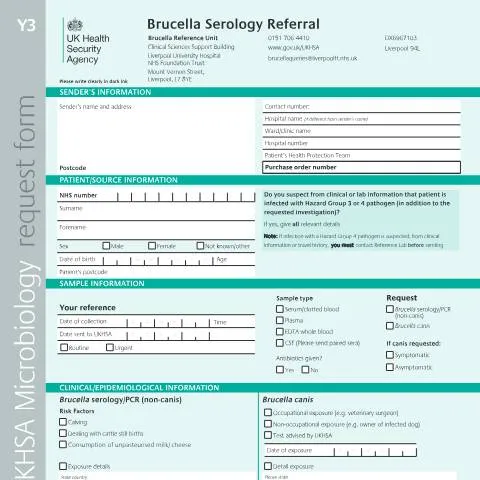
When a patient presents with mysterious symptoms that could indicate brucellosis—a bacterial infection that can devastate both human health and agricultural livelihoods—healthcare professionals turn to the UK Health Security Agency's specialised Brucella Reference Unit for definitive testing. The Brucella serology referral form serves as the critical gateway between clinical suspicion and laboratory confirmation, enabling the diagnosis of one of Britain's most carefully monitored zoonotic diseases.
Brucellosis remains a notifiable disease under the Health Protection (Notification) Regulations 2010, reflecting its serious public health implications. The condition can masquise as numerous other illnesses, from chronic fatigue syndrome to more serious conditions like endocarditis, making accurate laboratory diagnosis essential for both patient care and disease surveillance.
The Clinical Journey: From Suspicion to Specialist Testing
The referral process typically begins when healthcare providers encounter patients with unexplained fever patterns combined with specific risk factors. Unlike routine blood tests processed locally, brucella serology requires specialist expertise available only through the Reference Unit at Liverpool University Hospital NHS Foundation Trust.
Recognising the Clinical Picture
The form distinguishes between acute onset and insidious onset presentations, reflecting brucellosis's notorious ability to mimic other conditions. Acute presentations might feature sudden fever, headaches, and night sweats—symptoms easily mistaken for influenza or other viral infections. The insidious form proves more challenging, with patients experiencing gradual weight loss, fatigue, and arthralgia that can persist for months before diagnosis.
Healthcare professionals must document specific clinical features including:
- Constitutional symptoms: Fever patterns, night sweats, anorexia
- Neurological manifestations: Headaches, potential central nervous system involvement
- Musculoskeletal complications: Arthralgia, bone and joint involvement
- Systemic complications: Endocarditis, epididymo-orchitis in males
Laboratory Considerations and Sample Requirements
The form accommodates various sample types, each serving specific diagnostic purposes. Serum or clotted blood remains the standard for serological testing, while EDTA whole blood enables PCR analysis when rapid molecular diagnosis proves necessary. For suspected central nervous system involvement, cerebrospinal fluid samples require paired sera to establish definitive diagnosis.
Timing proves crucial—the form specifically requests both collection date and dispatch date to UKHSA, enabling laboratory staff to assess sample integrity and interpret results appropriately.
Risk Assessment and Exposure Documentation
The form's risk factor section reflects the epidemiological reality of brucellosis transmission in the UK. Despite Britain's official brucellosis-free status in cattle, sheep, and goats since the 1990s, exposure risks persist through various pathways requiring careful documentation.
Occupational Exposure Pathways
Veterinary surgeons, agricultural workers, and laboratory personnel face elevated risks through direct animal contact or handling of potentially contaminated materials. The form requires detailed exposure documentation, recognising that even brief contact with infected animals or their products can result in transmission.
Specific occupational scenarios include:
- Assistance with cattle births or dealing with stillbirths
- Veterinary procedures on imported animals
- Laboratory work with brucella cultures
- Meat processing involving imported livestock
Travel-Related and Dietary Exposures
International travel remains a significant risk factor, particularly to regions where brucellosis remains endemic. The form requires specific country documentation, enabling epidemiological tracking and risk assessment. Consumption of unpasteurised dairy products—especially soft cheeses and milk products from endemic regions—represents a well-documented transmission route that requires careful documentation.
Brucella Canis: A Distinct Diagnostic Challenge
The form separately addresses Brucella canis testing, reflecting this organism's unique epidemiological profile and diagnostic requirements. Unlike classical brucellosis, B. canis primarily affects dogs and their human contacts, requiring distinct serological approaches.
Canine-Associated Risk Factors
B. canis exposure typically occurs through contact with infected dogs, particularly during breeding, whelping, or veterinary procedures. The form distinguishes between symptomatic and asymptomatic testing requests, acknowledging that screening might be recommended for high-risk individuals even without clinical symptoms.
| Exposure Type | Risk Level | Testing Indication |
|---|---|---|
| Veterinary surgeon treating infected dogs | High | Symptomatic and screening |
| Dog breeder with infected kennel | Moderate | Based on symptoms and exposure |
| Pet owner of infected dog | Low-moderate | Usually symptomatic only |
| Laboratory worker handling cultures | High | Immediate screening recommended |
Completing the Referral: Technical Requirements and Best Practices
Accurate completion ensures appropriate testing and timely results. The form follows UKHSA's standardised format, requiring specific patient identifiers and clinical information to enable proper sample processing and result reporting.
Patient Identification and Demographics
The NHS number serves as the primary identifier, though the form accommodates situations where this might be unavailable. Hospital numbers provide secondary identification, particularly important for inpatients or patients transferred between facilities.
Patient postcode information enables the identification of appropriate Health Protection Teams, crucial for outbreak investigation and contact tracing if positive results emerge. This geographical data also supports epidemiological surveillance and risk assessment activities.
Clinical Information Requirements
The requesting clinician must provide comprehensive clinical details, including symptom onset dates and current antibiotic therapy. Antibiotic treatment can significantly impact serological results, potentially reducing sensitivity and complicating interpretation—information essential for laboratory assessment.
Complications documentation proves particularly important, as conditions like endocarditis or bone involvement influence both testing strategies and clinical management. Abnormal liver function tests, commonly associated with brucellosis, should be documented to support diagnostic interpretation.
Laboratory Processing and Result Interpretation
The Brucella Reference Unit operates under stringent biosafety protocols, given brucella's classification as a Hazard Group 3 pathogen. This classification requires enhanced laboratory containment and specialised handling procedures, explaining why testing cannot be performed in standard hospital laboratories.
Serological Testing Methodologies
The Reference Unit employs multiple serological approaches, including complement fixation tests, enzyme-linked immunosorbent assays, and agglutination tests. Each method offers specific advantages, and the combination provides comprehensive assessment of antibody responses to different brucella species.
For B. canis specifically, distinct antigenic preparations are required, as standard brucella serological tests may not detect B. canis infections reliably. This species-specific testing explains the separate documentation requirements on the referral form.
Molecular Diagnostic Capabilities
PCR testing enables direct pathogen detection, particularly valuable in acute presentations or when serological responses might be diminished. EDTA whole blood samples provide optimal material for molecular testing, though the Reference Unit can adapt protocols for various sample types when clinical circumstances require.
Biosafety Considerations and Hazard Group Classifications
The form includes specific warnings about Hazard Group 3 and 4 pathogens, reflecting the serious biosafety implications of brucella handling. This classification system, established under the Control of Substances Hazardous to Health Regulations 2002, determines laboratory containment requirements and handling protocols.
Pre-submission Risk Assessment
Healthcare providers must assess whether clinical or travel history suggests possible infection with higher hazard group pathogens. Hazard Group 4 pathogens require immediate contact with the Reference Laboratory before sample submission, ensuring appropriate containment and staff protection measures.
This requirement reflects lessons learned from laboratory-acquired infections and emphasises the collaborative approach between clinical and laboratory professionals in managing high-risk specimens.
Administrative Coordination and Result Management
The form facilitates coordination between multiple healthcare entities—requesting clinicians, hospital laboratories, the Reference Unit, and local Health Protection Teams. This multi-agency approach reflects brucellosis's public health significance and the need for comprehensive case management.
Health Protection Team Involvement
Patient postcode information enables automatic notification of appropriate regional Health Protection Teams, who coordinate outbreak investigation, contact tracing, and public health interventions when cases are confirmed. These teams work closely with veterinary authorities when animal sources are suspected.
Follow-up and Clinical Management
Results typically require clinical correlation and may necessitate follow-up testing. The Reference Unit provides interpretive guidance, recognising that brucella serology can be complex, particularly in chronic infections or following treatment.
Positive results trigger mandatory notification under the Health Protection (Notification) Regulations 2010, initiating formal public health investigation and case management processes that extend well beyond the initial diagnostic request.
Quality Assurance and Regulatory Compliance
The form operates within the framework established by the Data Protection Act 2018 and UK GDPR, ensuring patient information protection while enabling necessary public health functions. The January 2024 version reflects ongoing updates to maintain compliance with evolving regulatory requirements and clinical best practices.
All requests remain subject to UKHSA's standard terms and conditions, providing legal framework for sample handling, result reporting, and data management. This standardisation ensures consistent service delivery across England's diverse healthcare landscape while maintaining the specialist expertise essential for accurate brucellosis diagnosis.
Laboratory Processing Timelines and Result Interpretation
Understanding the laboratory processing workflow for Brucella serology helps set realistic expectations for patients and referring clinicians. Once your referral form reaches the reference laboratory, specimens typically undergo an initial screening phase within 48-72 hours of receipt, though this excludes weekends and bank holidays.
The standard Brucella serology panel includes the Rose Bengal Test (RBT) as a preliminary screening method, followed by confirmatory tests such as the Standard Agglutination Test (SAT) and complement fixation test when indicated. For acute presentations, laboratories may prioritise urgent specimens, particularly those from patients presenting with pyrexia of unknown origin or occupational exposure histories.
Initial screening results are usually available within 3-5 working days for routine referrals, though complex cases requiring additional testing may extend to 7-10 working days. If your referral form indicates clinical urgency—such as suspected acute brucellosis in pregnancy or immunocompromised patients—most reference laboratories will expedite processing and provide preliminary results within 24-48 hours.
Result interpretation requires careful consideration of both clinical context and serological findings. A single positive titre may not confirm active infection, particularly in patients with previous exposure or vaccination history. The laboratory will typically report both IgM and IgG antibody levels, with rising titres in paired sera (taken 2-4 weeks apart) providing stronger evidence of active infection.
Cross-reactivity can occur with other bacterial infections, including Francisella tularensis, Yersinia enterocolitica O:9, and Vibrio cholerae. Your referral form should therefore include any relevant travel history or potential exposure to these organisms to assist laboratory interpretation.
For patients in high-risk occupations, baseline serology results establish important reference points for future monitoring. Annual screening programmes in veterinary practices or agricultural settings often require batch processing of multiple specimens, and group referrals can be submitted using modified referral forms that capture occupational cohort data.
Special Populations and Modified Testing Protocols
Certain patient populations require modified approaches to Brucella serology testing, necessitating specific information on referral forms to ensure appropriate laboratory handling and interpretation.
Pregnant women suspected of brucellosis present particular challenges, as maternal infection can lead to spontaneous abortion, premature delivery, or congenital transmission. When completing referral forms for pregnant patients, include gestational age and any complications such as threatened miscarriage or intrauterine growth restriction. The laboratory may recommend additional testing methods, including PCR-based detection if acute infection is suspected, as serological responses can be attenuated during pregnancy.
Immunocompromised patients, including those receiving immunosuppressive therapy, undergoing chemotherapy, or with HIV infection, may exhibit reduced antibody responses. Your referral form should clearly indicate immunocompromised status and specify the underlying condition or treatment regimen. In these cases, laboratories may employ molecular diagnostic methods alongside serology or recommend extended incubation periods for culture-based confirmation.
Paediatric patients require age-appropriate reference ranges for serological interpretation. Children under 12 months may carry maternal antibodies, potentially confounding results. For infants born to mothers with known or suspected brucellosis, referral forms should include maternal serological status and delivery details to guide interpretation of neonatal results.
Patients with autoimmune conditions, particularly those with rheumatoid arthritis or systemic lupus erythematosus, may demonstrate false-positive reactions due to rheumatoid factor interference. Document any known autoimmune diagnoses on your referral form, as laboratories can employ specific techniques to minimise interference, such as rheumatoid factor absorption or alternative testing methodologies.
Healthcare workers and laboratory personnel exposed to Brucella cultures represent another special category requiring careful monitoring. Post-exposure surveillance typically involves baseline serology within 24-48 hours of exposure, followed by serial testing at 3, 6, and 12 weeks. Occupational health departments often maintain specific referral protocols for such incidents, and your form should reference any incident report numbers or occupational health case references.
Patients receiving antibiotic therapy at the time of specimen collection may show altered serological responses. Document current medications, particularly tetracyclines, quinolones, or aminoglycosides, which are active against Brucella species. Early treatment can suppress antibody development, potentially leading to false-negative results despite active infection.
Quality Assurance and Regulatory Compliance
Brucella serology referral forms must comply with stringent quality assurance standards and regulatory requirements, reflecting both the clinical importance of accurate diagnosis and the biosafety implications of handling potentially infectious specimens.
All NHS reference laboratories performing Brucella serology maintain accreditation under ISO 15189 medical laboratory standards, which mandate comprehensive quality management systems. Your completed referral forms become part of this quality framework, and incomplete or illegible forms can trigger non-conformance procedures that may delay testing or require specimen rejection.
Traceability requirements mean that every aspect of your referral—from patient identification to clinical justification—must be clearly documented and retained for specified periods. Digital referral systems maintain automatic audit trails, but paper-based forms require careful completion in permanent ink with clear, legible handwriting throughout.
Under the Health and Safety at Work Act 1974 and associated COSHH regulations, laboratories handling suspected Brucella specimens must implement appropriate containment measures. Your referral form serves as a critical risk assessment tool, alerting laboratory staff to potential biohazards and ensuring specimens receive appropriate handling in containment level 3 facilities where necessary.
Data protection compliance under UK GDPR requires that referral forms contain only information necessary for testing and clinical interpretation. Avoid including irrelevant personal details or clinical information unrelated to the suspected Brucella infection. Patient consent for testing is typically implied through the clinical referral process, but specific consent may be required for research applications or epidemiological studies.
Professional indemnity considerations apply to referral decisions, particularly in cases where delayed or inappropriate referral could impact patient outcomes. Maintain clear documentation of your clinical reasoning for requesting Brucella serology, especially in cases where the diagnosis is not immediately obvious. This supports both quality assurance reviews and potential medicolegal scrutiny.
Cross-border testing arrangements with laboratories in Scotland, Wales, or Northern Ireland may involve additional administrative requirements. Inter-jurisdictional referrals should include appropriate NHS numbers or equivalent patient identifiers and may require specific authorisation codes or cross-charging arrangements depending on patient residence and referring organisation.
Outbreak investigation protocols may override standard referral procedures when public health authorities identify potential Brucella clusters. During such investigations, your referral forms may require additional epidemiological information, including detailed exposure histories, contact tracing data, and links to other suspected cases. Public Health England (now UK Health Security Agency) maintains specific guidance for outbreak-related referrals that may supersede routine protocols.