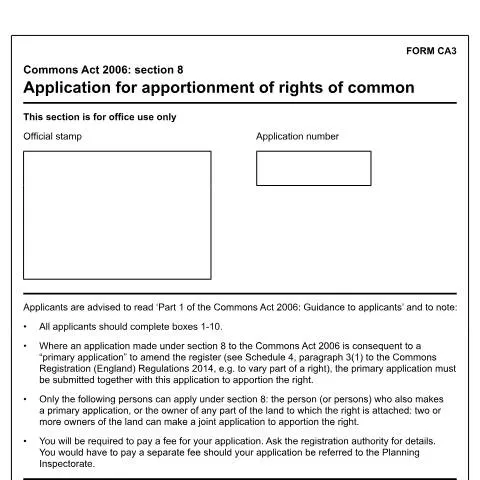
Understanding the Common Land and Greens: Sharing a Right of Common (CA3) Form
When navigating the complex world of land rights in England, the Common Land and Greens: Sharing a Right of Common (CA3) form plays a crucial role. This application is integral for individuals or groups seeking to apportion rights associated with common land. The purpose of this form transcends mere paperwork; it embodies the rights and responsibilities tied to land use, which can significantly impact local communities and landowners alike.
Who Needs to Complete the CA3 Form?
This form is primarily for individuals or bodies interested in sharing rights of common land. This may include:
- Landowners who have rights attached to their property
- Individuals or groups who wish to amend existing rights
- Joint applicants who share ownership of common land
In essence, if you have a stake in any common land, understanding this application is vital to exercising your rights legally and effectively.
Decoding the Application Process for the CA3 Form
The journey begins with understanding the necessary steps to complete the CA3 form accurately. This process can be divided into several key stages:
- Gather Necessary Information: Before diving into the form, collect documentation relating to your claim, including land ownership details and existing rights.
- Complete the Application: Each section of the form demands careful attention. Inaccuracies or omissions can lead to delays, so ensure that every detail is meticulously filled out.
- Submit the Application: Once completed, the form should be sent to the relevant registration authority, along with any applicable fees.
Dissecting the CA3 Form: Section-by-Section Analysis
The CA3 form comprises multiple sections, each designed to extract specific information critical to processing your application. Here's a detailed breakdown:
1. Applicant Information
This section requires the name and address of the applicant. If multiple applicants exist, all names must be included. Providing accurate contact details facilitates smooth communication throughout the application process.
2. Basis of Application
It's essential to specify under which capacity you are applying. The options include making a primary application or owning part of the land related to the rights. This distinction is crucial, as it determines your eligibility and the category in which your application will fall.
3. Identification of Rights
In this section, you must clearly define the rights you wish to apportion. This includes:
- The register unit number
- The description of the right to be apportioned
- Calculation of the rateable apportionment of the right
Failure to provide clear and precise information here may lead to complications or rejection of your application.
Essential Documentation: Gathering the Right Pieces
Submitting the CA3 form typically requires additional documentation, including:
- Proof of land ownership
- Documentation of existing rights
- Supporting statements or evidence from other stakeholders, if applicable
Ensure all documents are up-to-date and correctly formatted to avoid delays in processing. A well-prepared application not only speeds up the process but also enhances the likelihood of a successful outcome.
Understanding the Timeline: From Submission to Decision
Timing plays a pivotal role in the application process. After submitting the CA3 form, here's what to expect:
- Initial Review: The registration authority conducts a preliminary review to ensure all required information is present.
- Consultation Period: Depending on the complexity of your application and the presence of other stakeholders, a consultation period may follow. During this time, objections may be raised.
- Decision Notification: Once the review is complete, a decision is communicated to the applicant. This typically occurs within a set timeframe specific to the registration authority.
Handling Rejections or Additional Requests
In the event of rejection or requests for additional information, it's essential to know your options:
- Clarify the Reasons: Understanding the specific reasons for rejection can help you address the issues effectively.
- Gather Additional Information: If required, collect and submit the requested documents in a timely manner.
- Appeal Process: If you believe the decision was unjust, you may have the right to appeal. Consult the relevant guidelines for steps to take.
Tracking Your Application: Staying Informed
Once submitted, it's crucial to monitor the status of your application. Here are practical steps:
- Contact the Registration Authority: Regular communication can provide insights into the progress of your application.
- Document Everything: Keep records of all communications, submissions, and responses. This can be invaluable if disputes arise.
Distinguishing the CA3 Form from Other Applications
The CA3 form is often confused with other land-related applications. Understanding the distinctions can prevent unnecessary complications:
| Form | Purpose | Applicable Rights |
|---|---|---|
| CA3 | Apportionment of rights | Common land rights |
| Other Forms (e.g., CA1) | Registration of new rights | Varied, not limited to common land |
Clarifying these differences is vital to ensuring you complete the correct form for your needs.
The Broader Context: Where the CA3 Fits In
Understanding the CA3 form is just one piece of the larger puzzle of land rights in England. The application is part of a broader framework that includes:
- Commons Act 2006: Governs the management and apportionment of rights
- Consultative Bodies: Many stakeholders, including local councils and environmental agencies, may have a role in the process
- Legal Frameworks: Awareness of related laws and regulations can empower applicants and ensure compliance
Engaging with these frameworks enhances both understanding and application accuracy, ultimately fostering better outcomes for land management.
Fill in your form directly online
No printing: type your details into the boxes of the official form, tick, then download the PDF ready to send.
- 1Type into the form boxes
- 2Tick in one click
- 3Save and download the PDF
Understanding Common Land and Its Significance
Common land refers to areas where individuals have traditional rights to use the land, which typically include grazing animals, collecting firewood, and other community activities. This communal ownership promotes biodiversity and preserves the cultural heritage of rural communities. The rights to access and utilize common land can vary significantly, depending on local history and legal frameworks. Under the Countryside and Rights of Way Act 2000, there are specific provisions regarding access to common land, which aim to balance the rights of commoners with conservation efforts.
Common land is often associated with registered commoners who possess rights that can be traced back centuries. The registration of common land is managed by the Land Registry, and it is crucial for commoners to understand both their rights and responsibilities. Rights of common might include not just pasturing livestock, but also allowing public access for leisure activities. Nonetheless, common land is not without its challenges, particularly concerning disputes over boundaries and rights, which can lead to complex legal situations.
Rights of Common: Types and Implications
The concept of rights of common encompasses various specific rights that can be exercised on common land. These rights include, but are not limited to:
- Common Pasture: The right to graze animals on the common land is one of the most significant rights. It enables local farmers to sustain their livestock and maintain traditional farming practices.
- Common Turbary: This refers to the right to cut peat or turf for fuel from the common land, which historically has been vital for heating and cooking in rural households.
- Common of Estovers: This right allows individuals to take wood for fuel or for repairs from the common land, supporting sustainable living practices.
- Common of Pannage: This right permits the free-ranging of pigs, particularly important in woodlands, where pigs can feed on acorns and other natural food sources.
Each type of right comes with its own set of implications and responsibilities. For instance, commoners must ensure their activities do not harm the environment or infringe on the rights of others. Additionally, they should be aware of the rules imposed by the local authority and any conservation goals that may affect their usage of the land. Understanding these dynamics is essential for anyone intending to exercise a right to common.
Legal Framework and Management of Common Land
The management of common land in the UK is underpinned by a complex legal framework that includes various acts and regulations. The key legislation includes the Commons Act 2006, which modernised the way common land is managed and protected, and the Access to the Countryside Act 2000, which opened up access to many areas of common land for the purposes of recreation.
Local authorities play a critical role in the administration of common land. They are responsible for maintaining registers of common land and ensuring that the rights of commoners are respected. In addition, they assist in resolving disputes that may arise between commoners, landowners, and public access rights. It is advisable for those interested in common land to establish communication with their local council, as they can provide guidance, resources, and assistance in understanding rights and responsibilities.
Moreover, environmental management practices are increasingly essential in the stewardship of common land. The conservation of flora and fauna, habitat creation, and sustainable land management are important factors that commoners must consider. Collaborating with local conservation groups or engaging in stewardship agreements can help commoners balance their rights with environmental sustainability.