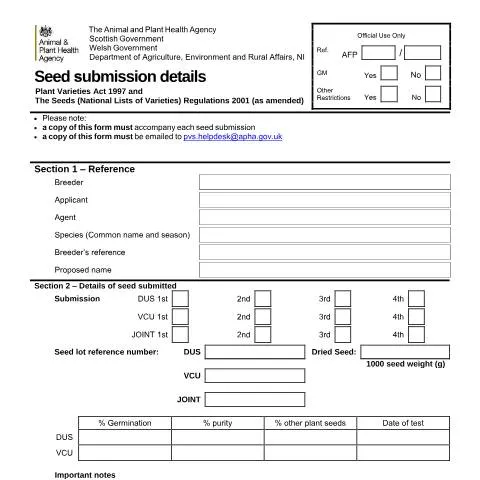
The Importance of Submitting Seeds to the Animal and Plant Health Agency
Submitting seeds for evaluation is a critical step for plant breeders looking to register new varieties in the UK. The Animal and Plant Health Agency (APHA) plays a vital role in ensuring that these seeds meet the necessary quality and regulatory standards. This process not only helps maintain agricultural biodiversity but also supports innovation in the agricultural sector.
Who is Required to Submit Seeds?
The submission of seeds to the APHA is primarily the responsibility of plant breeders, applicants, or their appointed agents. Understanding the specific circumstances under which different parties must submit seeds is crucial. Below are the various profiles of individuals involved in this process:
- Breeders: Individuals or organizations that develop new plant varieties.
- Applicants: Those who seek to register a variety, which may include breeders or representatives.
- Agents: Third-party entities authorized by breeders or applicants to act on their behalf.
Some variations may apply based on the type of seed or the intended use. For instance, breeders wishing to register a new variety of grass for fodder production must adhere to specific guidelines that differ from those for vegetable seeds.
Key Distinctions in Seed Submission Forms
While there are several forms associated with agricultural submissions, the Seed Submission Form for Variety List and Plant Breeders’ Rights is unique. Unlike general forms used for regulatory compliance, this form focuses specifically on:
- Distinctive Information: The submitted seeds must be categorized by their genetic characteristics, including tests for distinctness, uniformity, and stability (DUS).
- Variety Registration: This is essential for new varieties, which must undergo various testing phases before approval.
- Germination and Purity Tests: Detailed information regarding germination percentages and purity must be provided to ensure quality.
This form plays an integral role in protecting the intellectual property rights of breeders while maintaining high standards in seed production.
Step-by-Step Breakdown of the Submission Process
Understanding the submission process can demystify what may initially seem like a complex task. Below is a chronological outline of the stages involved in submitting seeds to the APHA:
- Preparation: Gather all necessary information, including the seed lot reference number, germination data, and any testing results.
- Completion of the Form: Accurately fill out the Seed Submission Form with all required details. Be meticulous, as any inaccuracies may delay the registration process.
- Submission: Submit the form alongside each seed lot. One form must accompany each seed submission, and an electronic copy must be emailed to [email protected].
- Review by APHA: The APHA will assess the submitted seeds for compliance with the regulatory framework and may request additional information.
- Testing: The seeds will undergo DUS tests in the first year, establishing them as the definitive stock of the variety.
- Outcome Notification: Applicants will receive communication regarding the outcome of their submission, whether successful or requiring additional action.
Navigating the Complexities: Special Cases and Exceptions
Certain unique scenarios may arise during the seed submission process, necessitating additional considerations. These include:
- International Breeders: Foreign breeders must comply with UK regulations, which may necessitate additional documentation proving the quality and genetic integrity of their seeds.
- Age Restrictions: Minors seeking to submit seeds must have a guardian or legal representative complete the form on their behalf.
- Urgent Submissions: In cases where rapid registration is needed (e.g., for disease-resistant crops), applicants may need to provide supplementary documentation or expedite their DUS testing.
Applicants facing these complexities should consult directly with the APHA or legal experts in plant breeders' rights to ensure adherence to all requirements.
Documenting Compliance: Preparing Your Justifications
When submitting seeds, documentation proving compliance with various standards is essential. Below is a checklist of required justifications based on differing situations:
| Situation | Required Documentation |
|---|---|
| Routine Seed Submission | Seed lot reference, DUS and VCU tests, germination and purity percentages. |
| Submission of Foreign Seeds | Certificates proving genetic integrity, compliance with UK regulations. |
| Submissions by Minors | Signed authorization from guardian, completed Seed Submission Form. |
| Expedited Submissions | Request for expedited processing, additional relevant supporting documents. |
After Submission: What to Expect
Once you have submitted your seeds and accompanying documentation, the APHA takes over to ensure thorough assessment and testing. Here's what typically follows:
- Initial Review: The APHA performs a preliminary assessment to ensure that all required documentation has been provided.
- Testing for DUS: The seeds will undergo detailed testing to evaluate their distinctiveness, uniformity, and stability.
- Communication: Applicants will receive updates on the progress of their submission and any additional requirements needed to proceed.
- Final Decision: A final decision is communicated, which may lead to the registration of the new variety or further action needed to rectify any issues identified during testing.
The Role of DUS Testing in Seed Quality Assurance
Distinctness, Uniformity, and Stability (DUS) testing is a cornerstone of the seed registration process. This rigorous assessment ensures that new varieties meet the necessary standards before entering the market.
- Distinctness: The variety must be clearly distinguishable from existing varieties.
- Uniformity: The seeds should produce plants with similar characteristics, ensuring consistency in the variety.
- Stability: The characteristics of the variety must remain consistent over generations.
Understanding these criteria can help breeders prepare their submissions more effectively, ensuring a smoother path to registration.
Conclusion: Empower Your Seed Submission Strategy
Successfully navigating the seed submission process with the APHA requires careful attention to detail, thorough documentation, and an understanding of the regulatory landscape. By being proactive and informed, breeders can enhance their chances of successfully registering new plant varieties, contributing to agricultural innovation and sustainability in the UK.
Understanding Plant Breeders' Rights in the UK
Plant Breeders' Rights (PBR) in the UK are a form of intellectual property protection aimed at encouraging innovation in plant breeding. Under the Plant Varieties Act 1997, breeders can protect new plant varieties by granting exclusive rights to propagate and market the variety for a defined period, typically up to 25 years, depending on the species. To qualify, a variety must be new, distinct, uniform, and stable, providing a clear incentive for breeders to invest in developing new plants that can benefit agriculture and horticulture.
When a breeder submits a variety for PBR, they must provide comprehensive information, including the denomination of the variety, its morphological characteristics, and the results of any relevant trials conducted. The process involves a rigorous examination by the UK Plant Variety Rights Office, ensuring that all submitted varieties meet the stringent criteria established under UK law.
Moreover, it is essential to note that the PBR system in the UK is aligned with the European Union's regulations, which may affect breeders looking to market their varieties in both the UK and the EU markets post-Brexit. This dual framework requires breeders to navigate both systems to protect their rights effectively, especially given the potential implications on trade and variety acceptance in different jurisdictions.
Submitting Seeds for Testing and Registration
To submit seeds for testing and registration in the UK, breeders must first ensure they have the appropriate documentation and comply with the necessary regulations laid out by the Animal and Plant Health Agency (APHA) and other governing bodies. The submission process typically starts with an application form where breeders declare intent and provide critical details about the seed variety being submitted.
One key aspect of the submission process is the conduct of official tests, which ascertain the variety's performance, disease resistance, and overall viability. These tests usually occur at designated testing sites and involve highly controlled conditions to ensure valid results. Breeders should be prepared for their seeds to undergo rigorous testing, which can take several months depending on the variety and the number of applications being processed.
It’s also important to consider that certain plant species may have specific testing requirements, particularly if they are considered economically significant or at risk of invasive species designation. Breeders should consult the APHA’s guidelines to understand the specific testing protocols applicable to their variety, which may include both laboratory analysis and field trials.
Once testing is complete, the results are compiled into a report, which forms a crucial part of the application for both variety registration and PBR. This report must be submitted alongside the application form to the relevant authorities, and the complete dossier will undergo further examination to determine the viability of the new variety.
The Role of the National Institute of Agricultural Botany (NIAB)
The National Institute of Agricultural Botany (NIAB) plays a pivotal role in the UK’s agricultural research landscape, particularly concerning the testing and approval of new plant varieties. Established to support crop improvement and the agricultural sector, NIAB offers a range of services that include conducting official trials of new varieties submitted for PBR and registration.
NIAB operates a dedicated testing programme that adheres to stringent protocols, ensuring that each new variety is thoroughly evaluated for its agronomic performance, stability, and marketability. This evaluation process is crucial as it provides breeders with invaluable insights into how their varieties will perform under UK climatic conditions and agricultural practices.
For breeders seeking to submit seeds, NIAB provides detailed guidance on the application process and the criteria required for testing. They also assist breeders in understanding the implications of their findings and how to navigate the complexities of the PBR application process. Additionally, NIAB collaborates closely with other research institutions and governmental bodies to ensure that the UK remains at the forefront of plant breeding innovation.
By leveraging the expertise and resources available through NIAB, breeders can enhance their chances of successfully registering their varieties and securing PBR, ultimately contributing to the diversity and sustainability of the UK’s agricultural sector.