Understanding the AM13 Document: A Crucial Step in Corporate Governance
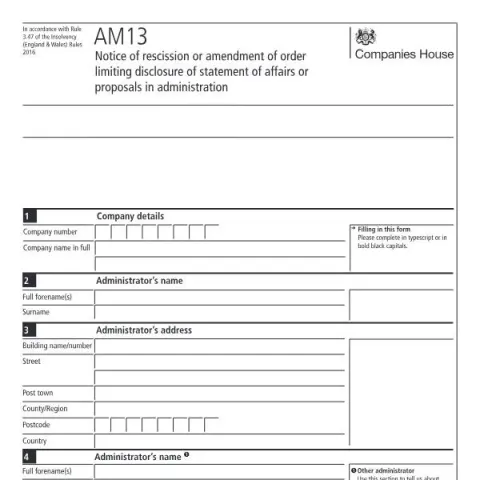
The AM13 document, formally known as the "Notice of rescission or amendment of order limiting disclosure of statement of affairs or proposals in administration," serves a vital function in the realm of corporate governance in the UK. When a company enters administrative proceedings, the Administrator may be tasked with providing critical information concerning the company’s affairs, which is subject to public disclosure restrictions. In certain cases, a court may issue an order that limits the disclosure of such statements. The AM13 document is the procedural instrument that notifies Companies House of any amendments or rescissions of these orders, ensuring transparency and compliance with statutory requirements.
The Role of the Administrator in the AM13 Process
At the heart of the AM13 process is the Administrator. This individual is responsible for managing the affairs of the company during its administration. Their duties include preparing the statement of affairs and proposals that outline the company’s financial status and plan for dealing with creditors. Understanding the role of the Administrator is essential for grasping the AM13 document's significance.
The Appointment of the Administrator
The Administrator is appointed by the court or, in some cases, by the company itself, typically in accordance with the Insolvency Act 1986. The Administrator’s name and address are required on the AM13 form, emphasizing accountability and traceability. This information allows interested parties to contact the Administrator for clarification or further information regarding the administration process.
Responsibilities of the Administrator
- Drafting the statement of affairs, which must outline the company’s financial position.
- Preparing proposals for how the company’s debts will be managed or settled.
- Ensuring compliance with the court order regarding disclosure limitations.
Key Components of the AM13 Document
The AM13 document is structured to facilitate clarity and accuracy. Each section corresponds to specific information required for processing the notice. Let's dissect its core components to understand what must be included and the significance of each.
Company and Administrator Details
At the top of the AM13 form, you'll find fields for the company’s name and registration number. It is crucial that this information matches the records held at Companies House to avoid processing delays.
Details of the Court Order
The document requires the date of the court order, which is pivotal in establishing the timeline of the proceedings. The Administrator must also indicate whether the order being rescinded or amended pertains to a statement of affairs or proposals.
Attachments Required
To ensure the completeness of the AM13 submission, the following documents should be attached:
- Copy of the court order.
- Statement of affairs.
- Statement of proposals.
- Statement of concurrence.
Failure to include these documents may result in the AM13 being returned, leading to unnecessary delays.
Utilizing the AM13 in Practice
Submitting the AM13 document is a procedural necessity that can significantly impact the administration process. Here’s how to effectively navigate this requirement.
Step-by-Step Submission Process
- Gather Necessary Information: Ensure all details about the company and the Administrator are up-to-date.
- Compile Court Orders and Statements: Collect the relevant documentation that will accompany the AM13 form.
- Complete the AM13 Form: Fill out the form clearly and legibly in typescript or bold black capitals.
- Review Before Submission: Double-check all entries to confirm that there are no errors or missing information.
- Send to Companies House: While you may return the form to any Companies House address, using the recommended address can expedite processing.
Avoiding Common Pitfalls
Understanding potential challenges associated with the AM13 process helps mitigate risks. Below are common pitfalls to be aware of and how to avoid them.
Matching Company Information
Ensure that the company name and registration number on the AM13 form exactly match the records at Companies House. Discrepancies can lead to the form being rejected.
Incomplete Attachments
One of the main reasons for delay in processing is the lack of required attachments. Always check that all relevant documentation is enclosed with the AM13 submission. It’s advisable to create a checklist before sending the documents.
Signature Requirements
The AM13 must be signed by the Administrator. A missing signature can result in immediate rejection, meaning that time and resources are wasted. Always ensure that the document is signed before submission.
Interplay with Other Documents in Administration
The AM13 does not exist in isolation; instead, it interacts with various other documents required during the administration process. Understanding these relationships is crucial for effective corporate governance.
Statement of Affairs vs. Statement of Proposals
While both documents are essential to the administration process, they serve different purposes.
| Document | Purpose | Required for AM13 |
|---|---|---|
| Statement of Affairs | Outlines the financial position of the company. | Yes |
| Statement of Proposals | Details how the company intends to deal with its debts. | Yes |
| Statement of Concurrence | Confirms that creditors agree with the proposals. | Yes |
Each of these documents complements the AM13 by providing a holistic view of the company’s financial standing and proposed recovery strategies.
Understanding the Legal Framework
The AM13 is governed by the Insolvency (England & Wales) Rules 2016, specifically under Rule 3.47. This legal framework is crucial for ensuring adherence to statutory obligations. Familiarity with these regulations enhances the understanding of why certain information is requested and how it protects both the company and its creditors.
Implications of Non-Compliance
Failure to adhere to the guidelines established by the Insolvency Act can result in serious repercussions, including potential legal action against the Administrator. Non-compliance may also undermine the transparency of the administration process, ultimately harming stakeholder trust.
Fill in your form directly online
No printing: type your details into the boxes of the official form, tick, then download the PDF ready to send.
- 1Type into the form boxes
- 2Tick in one click
- 3Save and download the PDF
Final Thoughts on the AM13 Document
In sum, the AM13 document serves a foundational role in corporate administration. It provides a mechanism for notifying Companies House regarding changes to the disclosure limitations imposed by a court order. By understanding the intricacies of the AM13 process—ranging from the responsibilities of the Administrator to the interplay with other critical documents—stakeholders can navigate the complexities of corporate governance with greater ease.
Careful attention to detail during the submission process, awareness of legal obligations, and understanding of the documentation requirements will enhance the efficiency and effectiveness of managing a company in administration. By taking these steps, companies can ensure that they maintain compliance with the law while striving for a successful resolution of their financial difficulties.
Understanding the AM13 Form: Purpose and Context
The AM13 form, officially titled "Notice of Rescission or Amendment of Order Limiting Disclosure", serves a vital role within the judicial framework of the United Kingdom. Primarily, it is designed for individuals or parties who wish to formally rescind or modify an existing court order that restricts the disclosure of certain information in legal proceedings. This could pertain to various contexts, such as family law, civil litigation, or public interest cases. Understanding the implications and processes surrounding the AM13 form is crucial for effective legal navigation.
The need for such a form often arises when circumstances change, necessitating a review of the confidentiality stipulations set forth by the original order. For instance, there may be new evidence or a significant change in the situation of the parties involved that justifies a reconsideration of disclosure limits. Furthermore, this form is essential in ensuring that all stakeholders are informed and can respond appropriately to changes in the order, thus upholding the principles of fairness and transparency inherent in the UK legal system.
Completing the AM13 Form: Step-by-Step Guide
Filing an AM13 form can be intricate, especially for those unfamiliar with legal terminology or procedures. Here’s a comprehensive guide to navigating the completion of the AM13 form:
- Gather Relevant Information: Before filling out the form, compile all necessary information related to the existing order. This includes the case number, details of the original order, and the specific reasons for the rescission or amendment. Make sure all parties involved are aware of the proposed changes.
- Access the Form: The AM13 form can be obtained from official court websites or legal resources. Ensure you have the latest version to avoid unnecessary rejections or delays.
- Filling Out the Form: The form consists of several sections. Carefully outline the details of the order you wish to amend or rescind, providing clear and concise information. It is crucial to articulate your reasons for the change as comprehensively as possible, as this will be assessed by the court. Any supporting documentation should be referenced and attached if applicable.
- Signature and Endorsements: Ensure that the form is signed and dated appropriately. If there are multiple parties involved, all necessary signatures should be obtained before submission.
- Submitting the Form: The completed form must be submitted to the relevant court either through mail or electronically, depending on the court’s requirements. Be mindful of any associated fees that may apply, and check the court's guidance on submission formats.
- Awaiting Response: After submission, monitor the case for any updates. The court may schedule a hearing to discuss the proposed changes further. Prepare to present your case, substantiating your reasons for the change with pertinent evidence.
Common Pitfalls When Filing AM13 and How to Avoid Them
Filing the AM13 form can be a straightforward process, but there are common pitfalls that individuals may encounter. Being aware of these can save significant time and potential legal complications:
- Incomplete Information: One of the most frequent issues is submitting an application with incomplete or incorrect information. Double-check all entries, especially case numbers, names, and dates, to ensure accuracy.
- Insufficient Justification: It is imperative to provide compelling reasoning for why the existing order should be rescinded or amended. Vague statements may lead to rejection. Therefore, ensure that your justification is well-structured and supported by evidence.
- Missing Signatures: Ensure that all required parties have signed the form if necessary. Lacking a signature can lead to delays and complications in the processing of your request.
- Failure to Follow Up: After submission, it is essential to follow up. Courts can be busy, and without proactive engagement, your request could unintentionally go unnoticed. Keep records of all communications and submissions for your reference.
By being mindful of these pitfalls and adhering to a systematic approach, you can increase the likelihood of a successful application regarding the AM13 form.