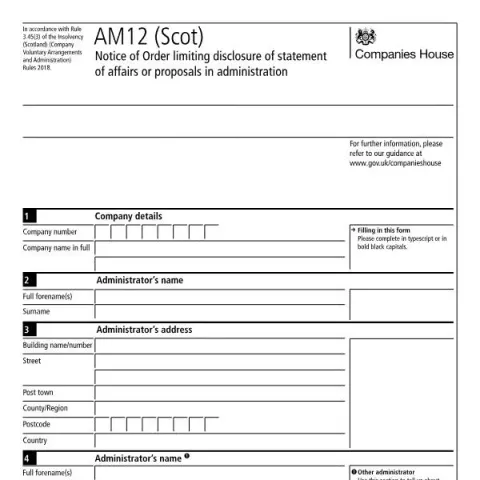
Navigating the AM12 (Scot): A Key Document for Scottish Companies in Administration
In the landscape of Scottish corporate law, understanding the nuances of the AM12 (Scot) form is crucial for administrators managing companies under administration. This document, officially titled "Notice of Order Limiting Disclosure of Statement of Affairs or Proposals in Administration," serves a distinct purpose in protecting sensitive information during the insolvency process. Let's delve into its intricacies, explore its relevance, and provide guidance on effectively using this important form.
Understanding the Context: Why the AM12 (Scot) Matters
In the wake of financial difficulties, companies may enter administration to safeguard their assets and attempt a turnaround. The AM12 (Scot) form comes into play when there is a court order limiting the disclosure of specific documents, such as the statement of affairs or proposals laid out by the administrator. This limitation is not arbitrary; it serves to protect confidential business information from being publicly accessible, thereby allowing companies to navigate their financial restructuring without undue exposure.
The Connection to the Insolvency (Scotland) Rules
The AM12 (Scot) is grounded in Rule 3.45(3) of the Insolvency (Scotland) (Company Voluntary Arrangements and Administration) Rules 2018. This regulation emphasizes the need for confidentiality in specific circumstances during the administration process. When a court recognizes that public disclosure of certain information could harm the company’s interests or the interests of its creditors, it may issue an order that necessitates the use of the AM12 (Scot).
Key Components of the AM12 (Scot) Document
To effectively utilize the AM12 (Scot), administrators must be familiar with its structure and the information required. The form consists of several sections that collect essential details about the company and the administration process. Here’s a breakdown of the main components:
- Company Details: This includes the full name of the company and its Companies House number, which must align with what is held in the public register.
- Administrator Information: Names and addresses of the appointed administrators need to be clearly outlined. If there are multiple administrators, this should be indicated.
- Nature of the Court Order: A clear statement of what the court order pertains to is necessary.
- Attachments: Key documents, such as the court order and statements of affairs, must be confirmed as attached when submitting the form.
- Signature and Date: The form must be signed and dated appropriately, confirming the information is correct.
Common Misinterpretations and Pitfalls
When dealing with the AM12 (Scot), administrators may encounter certain common misconceptions that can lead to complications. Awareness of these pitfalls can save time and avoid administrative errors:
- Assuming All Information is Public: While transparency is crucial, the AM12 (Scot) specifically limits what can be disclosed publicly. Understanding this can prevent unnecessary anxiety about confidentiality.
- Neglecting to Attach Required Documents: Incomplete submissions can lead to delays or even rejection of the form. Ensuring all necessary attachments are included is pivotal.
- Incorrect Company Information: The company name and number must match the Companies House records precisely. Any discrepancies can result in complications.
- Ignoring Court Orders: Failing to reference the specific court order can risk the validity of the AM12 (Scot), as it relies on the legitimacy of the court's directive.
Practical Steps for Using the AM12 (Scot)
For administrators preparing to file the AM12 (Scot), a methodical approach is essential. Here’s a step-by-step guide to ensure proper submission:
- Verify Company Information: Before starting, confirm that the company name and number are correct according to the public register.
- Complete the Form: Fill out the AM12 (Scot) in typescript or bold black capitals, ensuring legibility.
- Gather Required Attachments: Collect all necessary documents, including the court order and statements of affairs, and confirm their inclusion.
- Signature and Date: Ensure the form is signed by the administrator and dated correctly.
- Submission: Return the completed form to the appropriate Companies House address. While any address can be used, sending it to the registered office in Edinburgh is recommended for efficiency.
Who Should Utilize the AM12 (Scot)?
The AM12 (Scot) form is essential for administrators of Scottish companies facing insolvency. Particularly, it is used by:
- Licensed Insolvency Practitioners: These professionals are often appointed as administrators and must understand how to navigate the AM12 (Scot) to protect their clients’ interests.
- Company Directors: In some cases, directors may need to engage with the process, especially if they are involved in the administration directly.
- Creditors: Understanding the implications of the AM12 (Scot) can help creditors navigate their rights and expectations during the administration process.
Exploring Related Documents and Procedures
The AM12 (Scot) does not exist in isolation; it is part of a broader framework of documentation and procedures under Scottish insolvency law. Here are some key documents and forms that may accompany or relate to the AM12 (Scot):
- Statement of Affairs: This document provides a snapshot of the company's financial situation at the time of administration, outlining assets and liabilities.
- Statement of Proposals: This outlines the administrator's plans for the company, including how they intend to manage the administration process.
- Court Orders: Related court documents detailing the specifics of any restrictions or conditions imposed during the administration.
The Importance of Compliance and Accuracy
Filing the AM12 (Scot) accurately is not merely a bureaucratic step but a vital component of the administrative process that can significantly impact the outcome for the company in question. Compliance with the requirements established by Companies House and the insolvency rules ensures that the administration can proceed smoothly.
Additionally, understanding the implications of providing accurate and complete information reflects the administrator's commitment to transparency and integrity, which are essential during insolvency proceedings.
Conclusion: Mastering the AM12 (Scot) for Effective Administration
For those involved in managing a Scottish company in administration, the AM12 (Scot) is a critical document that requires careful attention. By understanding its purpose, structure, and the related procedural requirements, administrators can navigate the complexities of insolvency with confidence.
The AM12 (Scot) not only serves a functional role in protecting sensitive company information but also exemplifies the broader principles of good governance and transparency in the face of financial distress. As you engage with this document, approach each step with diligence and clarity to ensure the best possible outcomes for the company and its stakeholders.
Understanding the AM12 (Scot) Form: Key Components and Purpose
The AM12 (Scot) form serves a specific purpose within the Scottish legal framework, particularly for companies seeking to limit the disclosure of certain information. Understanding its components is essential for compliance and proper use. The form primarily deals with the specific order of the court that restricts the dissemination of particular documents or evidence during legal proceedings.
When completing the AM12 (Scot) form, users must ensure they provide accurate information regarding the nature of the order they are seeking. This may involve detailing the relevant sections of legislation under which the request is being made, as well as providing a clear justification for why disclosure should be limited. The accuracy of the information provided is vital, as it forms the basis upon which the court makes its decision.
Additionally, it is important to include any relevant case numbers, details of parties involved, and any previous orders relating to disclosure that may impact the current request. This thorough approach not only aids in the expeditious handling of the request but also mitigates the risk of complications arising during the legal process.
The Impact of Data Protection Legislation on the AM12 (Scot) Process
In the context of the AM12 (Scot) form, the principles established under the Data Protection Act 2018 and UK GDPR play a significant role. These regulations govern how personal information must be handled throughout the disclosure process. When filing for an order limiting disclosure, companies must carefully consider the implications of these regulations on their submission.
Fill in your form directly online
No printing: type your details into the boxes of the official form, tick, then download the PDF ready to send.
- 1Type into the form boxes
- 2Tick in one click
- 3Save and download the PDF
Particularly, if any personal data is included within the documents that are the subject of the disclosure order, the company must ensure that adequate safeguards are in place. This may involve redacting sensitive personal information or providing a justification for why certain data should remain protected. The balancing act between the need for transparency in legal proceedings and the protection of personal data is crucial, and failure to comply with data protection laws can result in serious repercussions, including fines or legal challenges.
Moreover, companies must be aware that the court may require additional information or documentation to ensure compliance with data protection requirements before granting the order. This necessitates an understanding of both legal requirements and the company’s obligations under data protection law, underscoring the importance of thorough preparation and legal guidance when submitting the AM12 (Scot) form.
Practical Steps for Completing and Submitting the AM12 (Scot) Form
Completing the AM12 (Scot) form involves a series of practical steps that are crucial to ensure your submission is error-free and compliant with legal expectations. Firstly, gather all necessary information and documentation required to support your request. This includes identifying the specific details of the disclosure order, relevant legislation, and any supporting evidence that outlines the necessity of limiting disclosure.
Next, carefully fill out the form, ensuring that all sections are completed in accordance with the guidance provided by the Scottish Courts and Tribunals Service. Pay meticulous attention to detail, as any inaccuracies or omissions can lead to delays or the rejection of your application.
Once the form is completed, it is advisable to seek legal counsel to review your submission. A legal professional can provide insight into the appropriateness of your request and help ensure that all legal requirements are met. After final checks, submit the AM12 (Scot) form to the appropriate court, ensuring you keep a copy for your records.
After submission, it is essential to monitor the progress of your request. Be prepared to respond to any court queries or provide additional documentation if required. Understanding the timeline associated with processing these requests can help manage expectations and ensure a smoother process.