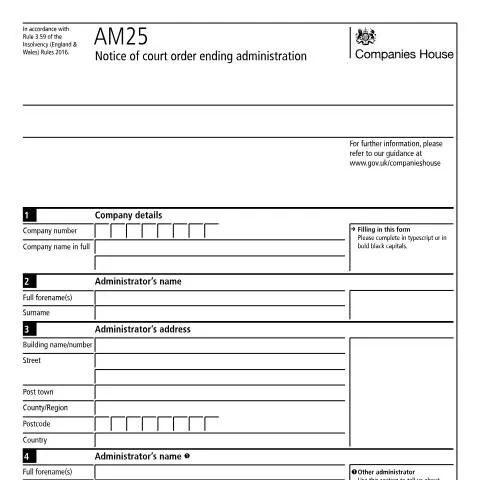
Understanding the AM25 Notice: A Crucial Step in Company Administration
The AM25 Notice of Court Order Ending Administration serves as an essential document for companies that have undergone an administration process. This notice signifies the official termination of the administration and outlines key details required by Companies House. For business owners and administrators navigating the often-complex waters of insolvency, this document plays a pivotal role in ensuring compliance with legal obligations and the smooth transition back to normal operations.
The Significance of the AM25 Notice in Insolvency Proceedings
When a company enters administration, it is typically to safeguard its assets while a suitable resolution is sought. The AM25 Notice is pivotal as it marks the end of this protective measure. Understanding its significance is crucial:
- Legal Compliance: Filing the AM25 is a legal requirement under the Insolvency (England & Wales) Rules 2016. Failure to submit it can lead to penalties or complications in future dealings.
- Public Record: Information contained within the AM25 is publicly accessible, ensuring transparency in corporate governance.
- Clarity for Stakeholders: By filing this notice, companies inform creditors, shareholders, and other stakeholders about the termination of the administration process, helping to rebuild trust and confidence.
Key Information Required on the AM25 Notice
Completing the AM25 Notice necessitates accurate and comprehensive details to avoid rejection by Companies House. Key information includes:
- Company Details: The full name and registration number of the company must match the records held by Companies House.
- Administrator’s Information: Names and addresses of the administrator(s) overseeing the process are required. This section is crucial, especially if multiple administrators are involved.
- Dates of Interest: The notice requires the date of the court order and the end date of the administration. These dates are integral for record-keeping and legal timelines.
- Attachments: A copy of the court order and the final progress report must be included to substantiate the notice. These attachments provide essential context and verification.
Exploring the Filing Process for the AM25 Notice
Filing the AM25 Notice can seem daunting, especially for those unfamiliar with the procedures involved. However, breaking this down into manageable steps can facilitate a smooth submission:
- Gather Required Information: Before filling out the notice, collect the necessary company details, administrator information, and any relevant attachments.
- Complete the Document: Fill in the AM25 Notice, ensuring all details are entered in typescript or bold black capitals, as specified by Companies House.
- Review for Accuracy: Double-check all information for accuracy against official records. This is a critical step to prevent any delays or rejections.
- Submit the Notice: The AM25 can be sent to any Companies House address; however, it is advisable to send it to the central office at:
- Retain a Copy: It's essential to keep a copy of the AM25 Notice and any attachments for your records.
| Address | Details |
|---|---|
| Companies House | Crown Way, Cardiff, Wales, CF14 3UZ |
Spotting Common Pitfalls in the AM25 Filing Process
While the AM25 Notice is straightforward, there are several common pitfalls that can lead to complications:
- Incorrect Information: Ensure that the company name and number are exactly as registered. A mismatch can lead to rejection.
- Missing Attachments: Failing to include the court order and final progress report could result in incomplete submissions.
- Signature Issues: The notice must be signed by the administrator. An unsigned document will not be processed.
Interconnections with Other Documents in Administration
The AM25 Notice does not operate in isolation but interacts with several other key documents during the administration process:
- Initial Notice of Appointment: This document informs Companies House about the appointment of an administrator, serving as a precursor to the AM25.
- Progress Reports: Throughout the administration, progress reports must be submitted to provide updates on the process, culminating in the final progress report attached to the AM25.
- Notice of Intention to Appoint Administrators: If this notice was filed, it should be cross-referenced with the AM25 to maintain a clear timeline of the proceedings.
Identifying the Target Audience for the AM25 Notice
The AM25 Notice is designed for a specific audience, primarily:
- Company Administrators: Those tasked with managing the administration process must understand the requirement to file this notice upon conclusion.
- Company Directors: Directors should be aware of this process as they hold ultimate responsibility for ensuring the company adheres to the relevant laws and regulations.
- Creditors: Creditors may wish to monitor the company's status and the completion of its administration, with the AM25 providing crucial information.
Real-World Scenarios Requiring the AM25 Notice
The need for an AM25 Notice arises in various situations, including:
- Successful Turnaround: If a company has successfully emerged from administration and is poised to return to normal trading operations.
- Restructuring Outcomes: When a restructuring plan has been implemented and the administration concluded, filing the AM25 is a necessary step.
- Judicial Mandate: If a court has issued an order terminating the administration, the AM25 must reflect this judicial determination.
Each of these scenarios underscores the AM25 Notice's importance in the corporate governance landscape, ensuring that all stakeholders remain informed of changes to the company's status.
Moving Forward: The AM25 Notice's Role in Corporate Governance
In navigating the complexities associated with company administration, understanding the AM25 Notice is paramount. It not only serves as a formal conclusion to the administration process but also signifies a company's commitment to transparency and compliance with legal requirements.
As administrators and company directors continue to strive for effective governance, the meticulous application of the AM25 Notice will play a crucial role in fostering trust, restoring operational capability, and laying the groundwork for future business activities.
The AM25 Notice stands as a testament to the resilience of businesses determined to overcome adversity while adhering to the UK's stringent legal frameworks. By recognising the significance of this document, stakeholders can better appreciate the processes that underpin corporate recovery and stability.
Understanding the Administration Process in the UK
Before diving into how to give notice of a court order ending administration using form AM25, it is crucial to understand the administration process itself. Administration is a formal insolvency procedure designed to rescue a company in financial distress. It allows a struggling business to continue trading while its affairs are restructured. Typically, an administrator is appointed, who takes control of the company's assets and makes decisions on behalf of the company to maximise returns to creditors. The goal is to either rehabilitate the company or, if that's not feasible, to ensure an orderly winding up of its affairs.
The process is initiated when the company boards recognise that they cannot pay their debts as they fall due, or when a creditor petitions for the company to be wound up. Importantly, the administration process is governed by the Insolvency Act 1986, which lays down the framework for how administrators must operate, including their duties to the company, its creditors, and other stakeholders.
Key Steps Following the End of Administration
Once the administration process concludes—whether through an exit strategy that salvages the business or a move towards winding it down—certain procedural steps must be followed. The court order that ends the administration typically signifies the completion of the administrator's role. Here's a closer look at what happens next:
Prepare Documentation: After the court order has been made, it is essential to prepare all necessary documentation that substantiates the conclusion of the administration. This includes financial statements that outline the dealings during the administration and any reports that detail the administrator's actions.
Notify Stakeholders: It's crucial to inform all stakeholders of the administration's conclusion. This includes the company's creditors, employees, shareholders, and any regulatory bodies involved, such as Companies House. Notification should be done promptly, as stakeholders have vested interests and responsibilities that may change following the end of administration.
File with Companies House: Depending on the outcome of the administration, you may need to file specific forms with Companies House. For example, if the company is returning to normal trading post-administration, you may need to submit an application to restore the company. The required forms may vary based on the company's specific situation, but keeping Companies House informed of the company's status is essential for legal compliance.
Legal Implications of Ending Administration
The cessation of administration has significant legal implications for the company and its stakeholders. Understanding these implications is vital for ensuring compliance and safeguarding the interests of all parties involved:
Reinstatement of Directors' Powers: Upon the conclusion of administration, the directors regain control over the company. They can make decisions on its future direction, but they must do so with due diligence to avoid any potential claims of mismanagement. Directors should be aware that they have fiduciary duties to act in the best interests of the company and its creditors, and these duties are even more scrutinised following a period of administration.
Creditor Claims: In cases where the administration has resulted in a distribution of assets to creditors, it is vital to address any outstanding claims. If a creditor believes that they have not received a fair share of the distribution, they may challenge the administrator's decisions or seek further legal recourse. It is important for the administrator and the company to document all communications and transactions to defend against such claims.
Impact on Future Financing: The end of administration can also have implications for future business operations, particularly in terms of securing financing. Lending institutions may view a recent administration as a red flag, which could complicate efforts to obtain credit lines or loans. Businesses should proactively work on restoring their creditworthiness, highlighting any restructuring measures taken to improve financial stability.