When Vessel Ownership Meets British Maritime Law
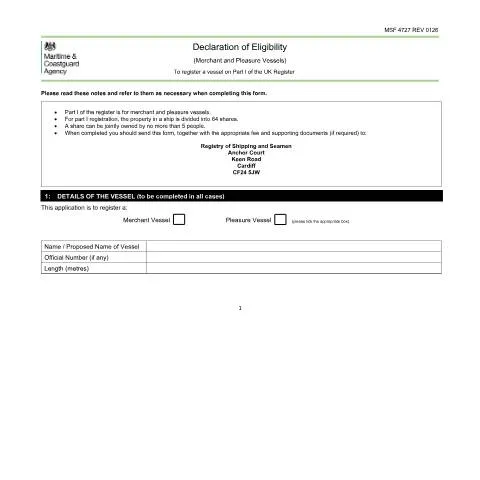
Acquiring a boat or yacht represents more than purchasing an asset—it marks entry into Britain's centuries-old maritime legal framework. The Declaration of Eligibility form MSF 4727 stands as the gateway to Part I registration of the UK Ship Register, determining whether your vessel qualifies for British flag status. This declaration process scrutinises ownership structures, nationality requirements, and legal entitlements that can make or break your registration application.
The stakes extend beyond paperwork. Part I registration grants access to British consular protection worldwide, recognised legal status in international waters, and compliance with international maritime conventions. Yet the eligibility criteria remain surprisingly complex, with ownership structures requiring precise documentation and nationality requirements that catch many applicants off-guard.
Decoding the 64-Share Ownership Structure
British maritime law divides vessel ownership into exactly 64 shares—a system rooted in historical precedent that continues to govern modern registrations. This fractional ownership model allows multiple parties to hold interests in a single vessel, but imposes strict rules on how these shares can be distributed and held.
Each share can be owned by up to five people jointly, creating potential ownership combinations of considerable complexity. For instance, a family yacht might see parents holding 32 shares outright, whilst their adult children hold the remaining 32 shares jointly. Alternatively, a commercial vessel might involve multiple investors each holding different share allocations.
Majority Interest Requirements
The critical threshold lies at 33 shares—representing majority ownership. British law mandates that persons qualified under the registration regulations must hold at least this majority interest for Part I registration eligibility. This requirement shapes ownership structures from the outset, often necessitating careful planning when multiple parties wish to invest in a vessel.
| Ownership Scenario | Qualified Shares Required | Registration Outcome |
|---|---|---|
| Single British citizen owner | 64 shares (100%) | Eligible for Part I |
| Mixed British/foreign ownership | Minimum 33 shares | Eligible if majority qualified |
| Foreign majority ownership | Less than 33 shares | Ineligible for Part I |
Navigating Qualified Owner Categories
The declaration form distinguishes between qualified and unqualified owners, with qualified status determining registration eligibility. Understanding these categories proves essential, particularly as British nationality law has evolved significantly since the original regulations.
Individual Qualified Owners
British citizens form the primary qualified category, but the definition extends considerably beyond straightforward UK passport holders. British Dependent Territories citizens and British Overseas citizens qualify, reflecting the UK's complex constitutional relationships with overseas territories.
Commonwealth citizenship provides another qualification route, encompassing nationals from countries including Canada, Australia, New Zealand, and numerous Caribbean and African nations. However, applicants must verify their specific country's Commonwealth status, as this can change over time.
Particularly noteworthy are non-UK nationals settled in the United Kingdom. This category includes individuals with indefinite leave to remain, settled status under the EU Settlement Scheme, and certain other immigration statuses. Documentation proving settled status becomes crucial for these applicants.
Corporate Qualified Owners
Bodies corporate face their own qualification criteria, primarily based on incorporation location. UK-incorporated companies automatically qualify, as do those incorporated in EEA states and Commonwealth countries.
The Schedule 6 countries present an interesting expansion of qualification, including major maritime nations like Panama, Liberia, and the Marshall Islands. This reflects practical recognition of international shipping patterns and reciprocal registration arrangements.
Representative Persons and Managing Owners
British maritime law mandates UK representation for registered vessels, creating mandatory appointment requirements that vary depending on owner residence patterns. These appointments carry ongoing legal responsibilities and communication obligations.
When Representative Appointment Becomes Mandatory
If no owner holding majority interest resides in the UK, a representative person must be appointed. This requirement applies even when all owners are qualified—residence and qualification represent separate criteria. The representative must be either an individual resident in the UK or a body corporate incorporated in an EEA country with a UK place of business.
Representative persons assume significant responsibilities, including receiving official correspondence from the Maritime and Coastguard Agency, responding to regulatory inquiries, and potentially representing the vessel in legal proceedings. Many boat owners underestimate these ongoing obligations when making appointments.
Managing Owner Designation
When multiple UK-resident owners exist within the majority interest, one must be designated as managing owner. This appointment concentrates communication and administrative responsibility, streamlining official interactions whilst maintaining clear accountability.
The managing owner receives all Registry correspondence unless alternative arrangements are specifically documented. This centralisation prevents confusion but requires careful consideration of which owner can effectively handle ongoing administrative requirements.
Documentation Requirements and Evidence Standards
The declaration form demands comprehensive supporting documentation to verify ownership claims and qualification status. Evidence requirements vary significantly depending on owner categories and vessel characteristics, creating potential complexity for multi-owner structures.
Nationality and Status Verification
Individual applicants must provide evidence of their qualified status, typically through passport copies, naturalisation certificates, or immigration status documentation. Commonwealth citizens may need to demonstrate their country's current Commonwealth membership, whilst those claiming settled status must provide Home Office documentation.
Corporate applicants face more complex requirements, needing certificate of incorporation, registered office confirmation, and evidence of UK business presence where applicable. Bodies corporate incorporated in Schedule 6 countries must demonstrate their incorporation status through certified documentation.
Ownership Documentation
Proving legal ownership requires bill of sale, builder's certificate, or previous registration documentation. Joint ownership arrangements need partnership agreements or trust documentation clarifying beneficial interests. Corporate ownership may require board resolutions authorising the purchase and registration application.
Processing Pathways Through Cardiff Registry
All completed declarations reach the Registry of Shipping and Seamen in Cardiff, where specialist staff assess eligibility against complex regulatory criteria. Understanding the processing approach helps applicants prepare more effectively and anticipate potential queries.
Initial Assessment Procedures
Registry staff first verify the mathematical accuracy of share allocations—ensuring the total equals exactly 64 shares with no fractional holdings. They then assess whether qualified owners hold the required majority interest, calculating percentages and checking ownership documentation.
Nationality verification follows, with staff checking passport copies against qualified categories and verifying Commonwealth status where claimed. Corporate qualifications undergo scrutiny through incorporation certificates and business address verification.
Common Processing Delays
Incomplete ownership documentation frequently delays processing, particularly when joint ownership arrangements lack clear beneficial interest documentation. Corporate applicants often face delays when UK business presence cannot be adequately demonstrated or when incorporation documentation proves insufficient.
Representative person appointments create processing complications when appointees lack proper UK residence documentation or when corporate representatives cannot demonstrate adequate EEA incorporation with UK business presence.
Beyond Registration: Ongoing Compliance Obligations
Successful declaration and registration create continuing legal obligations extending well beyond the initial application. These responsibilities affect both vessel operations and ownership management, with strict notification requirements for any changes.
Change Notification Requirements
The Registry must be informed within seven days of any changes to representative person or managing owner details. This tight timeframe reflects the importance of maintaining accurate contact information for regulatory and emergency purposes.
Ownership changes require formal documentation through additional forms, with share transfers needing Registry approval before becoming legally effective. These processes ensure the ownership structure continues meeting Part I eligibility criteria.
Public Register Implications
Registration creates a public record accessible to any person requesting transcripts. This transparency serves legitimate commercial and legal purposes but means ownership structures become matters of public record. Many private yacht owners find this publicity aspect unexpected, particularly when considering complex family trust arrangements.
The public nature of registration affects commercial confidentiality and personal privacy considerations, requiring careful thought about ownership structure design and representative appointments. Professional advice often proves valuable when balancing regulatory compliance with privacy preferences.
Strategic Considerations for Complex Ownership Structures
Modern vessel ownership frequently involves sophisticated arrangements requiring careful navigation of the 64-share system and qualification requirements. Strategic planning at the declaration stage can prevent future complications and optimise regulatory compliance.
Multi-National Ownership Planning
International ownership groups must carefully structure their holdings to maintain the required qualified majority whilst accommodating diverse investor requirements. This often involves creative share allocations and nominee arrangements within regulatory parameters.
Corporate structures may require establishment of UK-incorporated holding companies or appointment of qualified corporate trustees to satisfy registration requirements whilst preserving desired ownership economics.
Professional maritime lawyers frequently advise on optimal ownership structures, balancing registration eligibility with tax efficiency, liability management, and operational flexibility. The declaration form represents the culmination of this planning process, translating complex arrangements into the Registry's standardised format.
Successful Part I registration opens access to British flag benefits whilst imposing ongoing compliance obligations. The Declaration of Eligibility serves as both gateway and commitment—determining immediate registration prospects whilst establishing the framework for future vessel operations under British maritime law.
Vessel Documentation Requirements and Supporting Evidence
When establishing your eligibility to register a merchant or pleasure vessel, you'll need to provide comprehensive documentation that proves both your ownership status and the vessel's compliance with UK maritime standards. The Maritime and Coastguard Agency requires specific evidence packages depending on your registration category and vessel type.
For merchant vessels, you must submit a valid commercial vessel survey certificate issued by an MCA-approved surveyor or recognised organisation. This certificate confirms your vessel meets the construction standards outlined in the Merchant Shipping Act 1995 and relevant statutory instruments. The survey must be current and appropriate to your vessel's intended commercial use—cargo operations require different certification than passenger services or offshore support activities.
Pleasure craft owners face different documentation requirements. Vessels under 24 metres typically need an RCD (Recreational Craft Directive) certificate of conformity if built after June 1998, or evidence of compliance with equivalent safety standards for older craft. If your pleasure vessel exceeds 24 metres, you'll need to demonstrate compliance with the Large Yacht Code (LY3) or MGN 280(M) standards, depending on your vessel's commercial or private use classification.
Proof of ownership presents particular challenges for vessels with complex ownership histories. A bill of sale alone may not suffice—you might need to trace ownership back through multiple transactions, especially for older vessels or those imported from overseas. The MCA accepts various forms of ownership evidence: builder's certificates for new vessels, previous registration documents from recognised maritime authorities, or court orders in cases involving disputed ownership or marine salvage.
Import documentation becomes crucial for vessels purchased abroad. You'll need customs clearance papers, VAT payment evidence (or valid exemption certificates), and confirmation that any applicable import duties have been settled with HMRC. Vessels temporarily imported under specific circumstances may qualify for duty suspension, but this requires advance arrangement and doesn't automatically establish registration eligibility.
Insurance documentation, while not always mandatory for registration itself, often becomes a practical requirement. Many commercial operations require valid marine insurance before port authorities will grant operational permissions. Pleasure craft owners should note that some marinas and mooring authorities increasingly request proof of third-party liability cover as a condition of berthing agreements.
Registration Restrictions and Prohibited Circumstances
UK vessel registration operates under strict exclusionary criteria that can prevent otherwise eligible owners from completing their applications. Understanding these restrictions helps avoid costly delays and ensures you meet all necessary conditions before beginning the registration process.
Security interests and outstanding maritime liens create significant barriers to registration. If your vessel serves as collateral for financing arrangements, the lender may hold a legal interest that prevents you from registering independently. Similarly, unpaid port dues, salvage claims, or crew wages can result in maritime liens that must be resolved before registration proceeds. The MCA maintains liaison arrangements with major marine finance providers, but complex security arrangements may require legal resolution before your application can advance.
Vessels subject to foreign flag protection present another category of restriction. If your vessel remains registered under another nation's flag, you cannot simultaneously hold UK registration. The de-registration process varies significantly between maritime authorities—some nations process flag changes within days, while others require extensive paperwork and may impose administrative delays. You must provide evidence of successful de-registration from the previous flag state before UK registration can be completed.
Criminal sanctions and regulatory enforcement actions can temporarily or permanently bar vessel registration. Individuals convicted of serious maritime offences, including pollution violations, safety breaches, or customs fraud, may face registration restrictions. The MCA considers each case individually, but recent convictions involving vessel operations typically result in application refusal. Companies facing ongoing maritime enforcement actions may also encounter registration delays pending resolution of regulatory proceedings.
Age and condition restrictions apply particularly to commercial vessels. While pleasure craft face fewer age-related barriers, merchant vessels must demonstrate continued seaworthiness through regular surveys. Vessels approaching statutory age limits for commercial operations may require enhanced survey procedures or face restricted operational permissions that affect their registration status.
Financial standing requirements can also create registration barriers. Commercial vessel operators must demonstrate adequate financial resources to meet potential maritime liabilities, including pollution cleanup costs and crew repatriation expenses. The MCA may request financial guarantees or insurance arrangements that exceed standard requirements, particularly for high-risk operations or vessels trading in sensitive environmental areas.
Post-Registration Compliance and Ongoing Obligations
Successful vessel registration marks the beginning of ongoing compliance obligations that vessel owners must maintain throughout their registration period. These responsibilities extend beyond initial registration requirements and involve continuous monitoring of regulatory changes, renewal procedures, and operational compliance standards.
Annual renewal procedures vary significantly between merchant and pleasure vessel categories. Merchant vessel registrations typically require annual safety surveys and certification renewals, with specific timing requirements that vary according to vessel type and operational area. Pleasure craft owners face less frequent formal renewal requirements but must promptly notify the MCA of any material changes affecting their vessel's status, ownership, or operational use.
Change notification obligations require immediate attention when circumstances affecting your registration eligibility alter. Ownership transfers, even partial changes in company shareholding for corporate owners, must be reported within prescribed timeframes. Similarly, changes in vessel configuration, operational use, or flag state requirements trigger notification obligations that can affect your continuing registration validity.
Survey and certification maintenance creates ongoing financial and operational commitments. Commercial vessel owners must budget for regular survey costs, which can range from basic annual inspections to comprehensive five-yearly surveys involving dry-docking and detailed structural examination. Survey scheduling requires advance planning, as approved surveyors may have limited availability, particularly during peak seasons or in remote operational areas.
Record-keeping requirements extend throughout your vessel's registration period. The MCA expects owners to maintain comprehensive records of all surveys, modifications, incidents, and operational changes. These records become crucial during renewal applications, incident investigations, or regulatory inspections. Digital record-keeping systems can streamline compliance, but owners remain responsible for ensuring record completeness and accessibility during official inspections.
International operational compliance adds complexity for vessels trading overseas. While UK registration provides recognised flag state protection, individual port states may impose additional requirements for visiting vessels. Owners must stay informed about changing international regulations, port state control procedures, and bilateral agreements that might affect their vessel's ability to trade in specific regions. The MCA provides guidance on international compliance requirements, but owners bear ultimate responsibility for ensuring their vessels meet all applicable standards in operational areas.