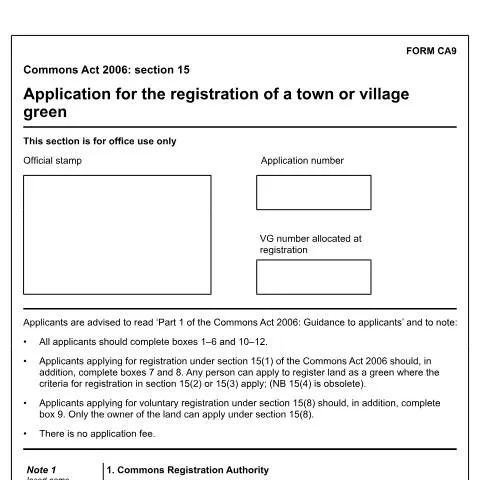
Navigating the Complexities of the Form CA9: A Guide to Registering a Town or Village Green
The journey to register a town or village green in the UK is crucial not only for community cohesion but also for ensuring public access to green spaces. The Form CA9, officially titled "Application for the registration of a town or village green," serves as the primary administrative tool for this process. This article explores the ins and outs of the CA9 form, breaking down its sections, highlighting potential pitfalls, and providing a comprehensive guide on how to successfully navigate this application.
Understanding the Context: Why Register a Town or Village Green?
Registering a town or village green is rooted in the Commons Act 2006, aimed at protecting spaces used by the public for recreation. These areas are often treasured by communities, symbolizing local heritage and identity. As urbanization increases, preserving such spaces becomes critical, making the CA9 form an essential document for any community member advocating for their local green.
Who Can Apply?
- Individuals: Any person who has lived in the locality can apply, highlighting the communal aspect of these spaces.
- Landowners: They can also voluntarily register their land as a green, providing a unique opportunity for land preservation.
- Community Groups: Unincorporated associations can submit an application to safeguard local greens on behalf of the community.
Diving into the Form: Analyzing the Sections of CA9
Completing the CA9 requires meticulous attention to detail. Here, we dissect each section to reveal critical information and common errors to avoid.
Section 1: Commons Registration Authority
In this opening section, you must insert the name of the appropriate commons registration authority. It is vital to ensure that you address the correct authority, as errors here can delay the application. Ensure you check local government resources or the Department for Environment, Food & Rural Affairs (DEFRA) website to find the correct authority.
Section 2: Name and Address of the Applicant
This is straightforward yet significant. If multiple applicants are involved, list each one comprehensively, as leaving out names can result in communication issues later. Keep in mind:
- Use full names and postal addresses.
- Include contact details like telephone and email for easier correspondence.
Section 3: Name and Address of Representative
If a representative (e.g., solicitor) is involved, their information must be provided here. This section ensures that all communications are sent to the right person. Make sure this box is filled out correctly; otherwise, your application might be stalled.
Section 4: Basis of Application for Registration
This section delves into the specifics of your claim. Applicants must indicate under which subsection of the Commons Act they are applying. Familiarize yourself with:
- Section 15(2): Applicable if the land has been used for recreation by the public for at least 20 years.
- Section 15(3): Used if the right to access was denied for a period during this time.
Incorrectly selecting a subsection can lead to the rejection of your application, so ensure that you consult the relevant legal texts or guidance notes from DEFRA.
Section 5: Description of the Area of Land
Clearly describe the land you wish to register. This section often trips applicants up, so bear in mind:
- Use the local name by which the land is known.
- Provide a precise location.
- Attach an Ordnance map showing the land's boundaries. Failure to do so can lead to automatic rejection.
The Timeline: When to Apply and What Happens Next
Understanding the timeline for registration is crucial for effective planning. The process begins when you submit your application using the CA9 form.
Application Submission
There is no application fee, making the process financially accessible. However, pay close attention to timing:
- Applications can be submitted at any time. However, community interest and seasonal patterns may influence timing.
- Once submitted, the commons registration authority will typically take a few months to process the application.
Post-Submission Process
After reviewing the application, the authority will either:
- Accept the application, leading to a public inquiry if objections arise.
- Reject the application, at which point you will typically receive a notification detailing the reasons.
Exploring the Channels of Submission: Paper vs. Digital
Submitting the CA9 form can be done through different channels, each with its pros and cons.
Paper Submission
Filling out a physical form requires mailing or delivering it to the appropriate authority. Advantages include:
- Physical records of submission can be kept.
- Some applicants may find it easier to complete a physical form.
Online Submission
Many authorities now accept online submissions, which can simplify the process. Consider the benefits:
- Immediate confirmation of receipt.
- Convenience allows for easy corrections and editing.
Evaluate the method that best suits your needs, and ensure that you check whether your local commons registration authority allows for online submissions.
Dealing with Challenges: What If Your Application Is Refused?
Receiving a refusal can be disheartening, but it's important to know the next steps. Addressing common issues can significantly improve your chances of success on a resubmission.
Reasons for Refusal
The authority usually provides detailed reasons for rejection. Common pitfalls include:
- Insufficient evidence of public use.
- Incomplete application sections.
- Failure to correctly identify the land.
Next Steps After Refusal
Should your application be refused:
- Review the feedback diligently.
- Make necessary amendments and resubmit the application.
- Consider consulting legal advice if the complexities of the Commons Act are beyond your understanding.
Special Considerations: Unique Circumstances in Applications
Certain situations may require additional attention when filling out the CA9 form. Understanding these nuances can prevent future complications.
Applying for Minors or Non-Residents
Special rules apply to minors and non-residents wishing to register land:
- For minors, a guardian or responsible adult must submit the application on their behalf.
- Non-residents should ensure they have local representation or support from community groups.
Urgent Situations
If there is an immediate threat to the land, quick action is necessary. In such cases:
Fill in your form directly online
No printing: type your details into the boxes of the official form, tick, then download the PDF ready to send.
- 1Type into the form boxes
- 2Tick in one click
- 3Save and download the PDF
- Gather as much evidence as possible, including photographs and witness statements.
- Submit applications as quickly as possible and consider contacting your local representative for assistance.
Conclusion: Empowering Communities Through Green Spaces
The CA9 form is more than just a piece of paperwork; it is your gateway to securing communal green spaces that enrich community life. By understanding its sections, aware of common pitfalls, and knowing the processes involved, you can bolster the chances of successful registration. Remember, each application contributes towards the preservation of accessible and vibrant public spaces, reinforcing the significance of community in the modern world.
Understanding the Legal Framework for Town and Village Greens
In the United Kingdom, the legal framework surrounding the registration of town or village greens is primarily governed by the Commons Act 2006, along with the earlier provisions from the Commons Registration Act 1965. These laws aim to protect areas of land that have historically been used by local communities for activities such as recreation, walking, and social gatherings. Understanding these legal parameters is crucial for anyone considering applying for registration as it sets out the requirements for eligibility and the processes involved in both application and objection.
The Commons Act 2006 established a clear definition of what constitutes a town or village green. To qualify, the land must be available for use by the local community, and it must have been used by the community for lawful sports and pastimes for at least 20 years without interruption. This "20-year rule" is a cornerstone of the application process, and prospective applicants must be able to demonstrate consistent community use of the land over this period. Evidence such as testimonies, photographs, and records of activities can be pivotal in substantiating claims of use.
Moreover, it’s essential to understand that the land must not have been registered for any other formal use, such as being designated for development, or otherwise restricted by statutory rights. If the land is already designated for a different purpose that conflicts with the criteria for town or village green registration, it may face significant legal hurdles. Local authorities, landowners, and other interested parties can challenge applications, making it imperative for applicants to prepare comprehensive documentation to support their case.
The Application Process for Registering a Town or Village Green
The application process for registering a town or village green is multi-faceted and may vary slightly depending on the local council’s procedures. Generally, the process can be broken down into several key stages:
- Gathering Evidence: Applicants must collate evidence of the community’s use of the land, demonstrating that it has been used for sports and pastimes without interruption for at least 20 years. This could include diary entries, photographs, maps, and witness statements from local residents.
- Completing the Application Form (CA9): The next step involves filling out the official application form known as the CA9. This form requires detailed information about the land in question, including its location, the nature of its use by the community, and any existing rights associated with it. Accuracy and thoroughness are vital, as any oversights could lead to delays or rejections.
- Submission to the Relevant Authority: Once completed, the application should be submitted to the appropriate local authority. Different councils may have specific requirements for submission, such as the number of copies needed or additional forms that must accompany the CA9.
- Public Consultation: After submission, a period of public consultation is typically scheduled. During this time, local residents and stakeholders are encouraged to comment on the application. This stage can be crucial as it allows for gathering support or addressing objections from landowners or other parties.
- Decision by the Local Authority: After considering all evidence and responses from the public consultation, the local authority will make a decision. This may involve a formal inquiry if there are significant objections. A decision will generally be reached within a few months, although complex cases may take longer.
It’s advisable for applicants to engage with local community groups during this process. Forming alliances can bolster the application, providing a stronger case for community use and illustrating wider support. Furthermore, attending local council meetings can offer insights into the procedural nuances and allow applicants to gauge potential opposition before it arises.
Challenges and Objections in the Registration Process
While successfully registering a town or village green can offer significant benefits to the community, the process is not without its challenges. Objections often arise from landowners who may fear restrictions on their ability to develop or manage the land in the future. Understanding common objections and preparing to counter them is a vital part of the application strategy.
Landowners may argue that the land was never used for recreational purposes or that usage has not been consistent over the 20-year period required for qualification. They might also assert that the land is subject to private rights or that it has been designated for other uses, such as housing or commercial developments. To navigate these challenges, applicants should focus on gathering robust evidence to refute such claims. This might involve compiling historical records of land use, engaging local historians, or even obtaining expert testimonies regarding local customs and historical practices associated with the land.
In cases where objections are raised, it’s not uncommon for the local authority to conduct a public inquiry. This can extend the application timeline significantly as all parties are given the opportunity to present evidence and arguments. Understanding the inquiry process and being prepared with a clear, evidence-based presentation can be the difference between success and failure in these circumstances. Engaging a legal representative who specializes in land and property law can also be beneficial, particularly if the case becomes contentious.
It's also worth noting that if an application is rejected, the applicant may appeal the local authority's decision. However, this too involves a formal process and may require additional evidence or legal arguments to be successful. Thus, applicants should be fully aware of the implications and prepare accordingly from the onset.