Navigating the Sustainable Lending Form: A Crucial Step for Exporters
When embarking on international trade projects that require financing backed by the UK government, exporters must complete the Sustainable Lending Form. This document is pivotal in ensuring that projects not only comply with financial regulations but also adhere to sustainability principles. Understanding the mechanics of this form and the surrounding context is essential for successful project financing.
The Underlying Framework: Why Sustainable Lending Matters
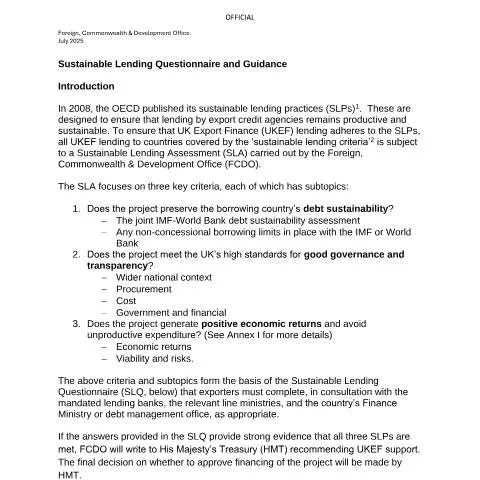
The Sustainable Lending Form is anchored in guidelines established by the OECD in 2008. These guidelines promote sustainable lending practices (SLPs) among export credit agencies, ensuring that the funds extend to projects that are economically viable and socially responsible. UK Export Finance (UKEF) incorporates these principles into its lending decisions, particularly for countries eligible under the sustainable lending criteria.
The implications of sustainable lending extend beyond mere compliance; they resonate deeply with the UK's economic and ethical commitments. The Foreign, Commonwealth & Development Office (FCDO) conducts a Sustainable Lending Assessment (SLA) based on three key criteria:
- Debt Sustainability: Ensuring that the borrowing country can manage its debt without jeopardizing its financial stability.
- Good Governance and Transparency: Evaluating the project's alignment with national standards and ethical practices.
- Positive Economic Returns: Assessing the project's capacity to generate economic value while avoiding unproductive expenditure.
These criteria form the foundation of the Sustainable Lending Questionnaire (SLQ), which exporters must complete in consultation with various stakeholders, including financial institutions and ministries.
Decoding the Sustainable Lending Form: Detailed Breakdown
Completing the Sustainable Lending Form requires attention to detail across various sections. Each segment demands specific information that collectively builds a case for financing. Below, we explore each part of the form, highlighting essential components and potential pitfalls.
Part A: Project Overview
This section sets the stage for the entire application process. Here, exporters must outline the project’s rationale, background, and timeline. Elements to include:
- Project Background: Describe the issue the project aims to address.
- Timeline: Provide a clear timeline, including key milestones.
- Total Cost: State the total cost of the contract and the anticipated UKEF loan amount.
- Contractor Details: List the contractors involved in project delivery.
Common errors in this section include vague descriptions and lack of supporting evidence. Be precise; instead of stating, “the project will improve transport,” detail which routes will be enhanced and the expected impact on commute times.
Part B: Assessing Debt Sustainability
The focus here is on understanding how the proposed project aligns with the borrowing country’s debt sustainability limits. Necessary steps include:
- Check Limits: Verify if the country has established limits on non-concessional borrowing.
- Gather Evidence: Obtain written confirmation from the country's finance ministry that the project won't breach these limits.
Be prepared for the FCDO to review the latest Debt Sustainability Assessment (DSA) conducted by the IMF and World Bank, so gather any relevant documentation that supports your position.
Part C: Good Governance and Transparency
This crucial section evaluates the project's adherence to governance standards. It is subdivided into three subsections:
Wider National Context
Detail how the project fits within the country's national development agenda. Evidence may include links to official documents that endorse the project’s alignment with national strategies.
Government and Financing
Clarify the nature of the borrower and buyer. For public sector buyers, provide proof of budget approval and parliamentary backing. In cases of private sector buyers, explain contingencies in the event of non-repayment.
Procurement Process
Document the process through which the contract was awarded. If it was through open tender, justify why your proposal was selected. If it was a direct appointment, detail the rationale for bypassing an open tender process.
Essential Documentation: What You Need to Prepare
Submitting the Sustainable Lending Form requires comprehensive documentation to support claims made in the questionnaire. Depending on the specific project circumstances, prepare the following:
| Document Type | Purpose | Where to Obtain |
|---|---|---|
| Feasibility Study | Proves project viability. | Consulting firms or internal project teams. |
| Cost-Benefit Analysis | Demonstrates financial soundness. | Financial analysts or external consultants. |
| Government Endorsements | Establishes project legitimacy. | Relevant government ministries. |
| Debt Sustainability Evidence | Affirms adherence to borrowing limits. | Finance Ministry of the borrowing country. |
Unique Scenarios: Tailoring Your Submission
Every exporter’s situation is distinct, which means that certain unique scenarios require tailored approaches when completing the Sustainable Lending Form. Here are a few examples:
For Exporters from High-Risk Countries
Exporters operating in countries deemed high-risk must provide extensive evidence to demonstrate that their projects will not exacerbate existing financial challenges. This includes additional documentation on the project’s alignment with international best practices and sustainable development goals.
Complex Multi-Partner Projects
In cases where multiple contractors are involved, it's crucial to clarify each party's role. This can complicate the governance aspect, so be explicit about the decision-making structure and responsibilities of each partner involved in the project.
Urgent Financing Needs
When time is of the essence, such as in emergency response projects, exporters must identify the specific urgency in their application. Clearly articulate the implications of delays, and provide robust evidence supporting the necessity of the project to avoid potential repercussions.
What to Expect After Submission: The Review Process
Once the Sustainable Lending Form is submitted, it enters a comprehensive review process overseen by the FCDO. Understanding this process helps exporters anticipate steps and prepare accordingly.
- Initial Review: The FCDO reviews submissions to ensure all necessary information is included.
- Detailed Assessment: A thorough analysis is conducted based on the sustainability criteria outlined earlier.
- Recommendation: If the project aligns with sustainable lending practices, the FCDO will recommend approval to His Majesty’s Treasury (HMT).
- Final Decision: Ultimately, the HMT decides whether to approve financing for the project.
Following Up on Your Application
Exporters should remain proactive in tracking the progression of their application. For inquiries about the status, direct communication with the relevant contact at the FCDO is highly encouraged. Be prepared to provide additional documentation or clarification if needed throughout the assessment process.
Navigating Challenges: Handling Refusals and Missing Documentation
In the eventuality of an application being declined or a request for more information, understanding the next steps is crucial. If you receive a refusal:
- Review Feedback: Carefully examine any feedback provided by the FCDO to understand the reasons for refusal.
- Address Concerns: Work on remedying any issues identified, whether they pertain to documentation completeness or project alignment with sustainability criteria.
- Resubmit: Once adjustments are made, you may resubmit the application, ensuring that all concerns are addressed.
For missing documentation, promptly gather the required materials and communicate with the FCDO to clarify what is needed and the timeframes for submission.
Beyond the Form: Commitment to Sustainable Practices
The filling out and submission of the Sustainable Lending Form represent only the beginning of a broader commitment to sustainability in international trade. Successful exporters recognize that their projects must align not only with financial criteria but also with ethical standards and environmental considerations.
By engaging in this form’s process, exporters contribute to a larger mission of promoting responsible lending practices and ensuring that their projects leave a positive impact on the global stage. This is not merely about securing financial backing; it is about fostering sustainable development in international markets.
Understanding Sustainable Lending in the UK
Sustainable lending has gained significant traction in the UK as part of a broader commitment to environmental, social, and governance (ESG) criteria. This type of lending focuses on financing projects that not only promise economic returns but also contribute positively to society and the environment. Lenders, including banks and credit unions, are increasingly considering the sustainability of the projects they fund, aligning with national and international climate goals.
The UK government, through various initiatives, is encouraging sustainable finance. For instance, the Green Finance Strategy aims to promote investments in projects that reduce carbon emissions and foster resilience against climate change. This shift is also reflected in the regulatory landscape, as the Financial Conduct Authority (FCA) and Prudential Regulation Authority (PRA) impose guidelines for lenders to integrate sustainability risks into their decision-making processes.
As a business or individual seeking sustainable lending options, it's essential to understand how to present your project or initiative. Lenders often look for detailed information demonstrating the environmental and social impacts of your proposal. This may include sustainability assessments, feasibility studies, and evidence of community engagement. Transparency and clear communication of potential benefits can positively influence your chances of securing funds.
The Role of the UK Green Finance Strategy
The UK Green Finance Strategy is pivotal in steering both public and private sector investments toward sustainable projects. Launched as part of the government's commitment to achieving net-zero greenhouse gas emissions by 2050, this strategy outlines measures to mobilize finance for green investments. It includes initiatives like the Green Home Finance Initiative, aimed at enhancing energy efficiency in homes, and the Clean Growth Strategy, promoting low-carbon technologies.
One of the critical aspects of the Green Finance Strategy is the establishment of the Green Taxonomy, still under development, which will classify economic activities based on their environmental sustainability. This classification aims to provide clarity for both investors and businesses regarding what constitutes a sustainable investment. By adhering to these guidelines, lenders can better assess the value of potential projects, ensuring that their portfolios align with broader climate objectives.
Businesses looking to apply for sustainable loans should familiarize themselves with the Green Finance Strategy and consider how their projects align with its goals. Highlighting how your project meets the criteria set forth by the strategy can bolster your application's attractiveness to potential lenders.
Key Considerations for Applicants
When applying for sustainable lending, applicants should bear in mind several key considerations to strengthen their case. First, potential borrowers should prepare comprehensive documentation that outlines the project's environmental impact, social benefits, and economic viability. This documentation should include data-driven evidence, as lenders are increasingly relying on quantifiable metrics to assess sustainability claims.
Second, engaging with stakeholders early in the process can enhance project credibility. For instance, seeking input from community members or environmental groups can demonstrate a commitment to social responsibility and stakeholder engagement. Furthermore, lenders are more inclined to support projects that have clear community backing, as this can mitigate risks and enhance project resilience.
Third, understanding the specific lending criteria of various financial institutions is crucial. Different lenders may have unique focuses, such as renewable energy, sustainable agriculture, or social housing, and tailoring your application to align with these focuses can improve your chances of securing funding.
Lastly, it is advisable to stay informed about the evolving landscape of sustainable finance regulations and incentives. Government policies can change, presenting new opportunities for funding or requirements for compliance that may impact your project. Subscribing to updates from relevant bodies, such as HM Treasury and the Department for Business, Energy & Industrial Strategy (BEIS), can keep you abreast of the latest developments.