When Your SFI Application Hits a Snag: Understanding the Query Process
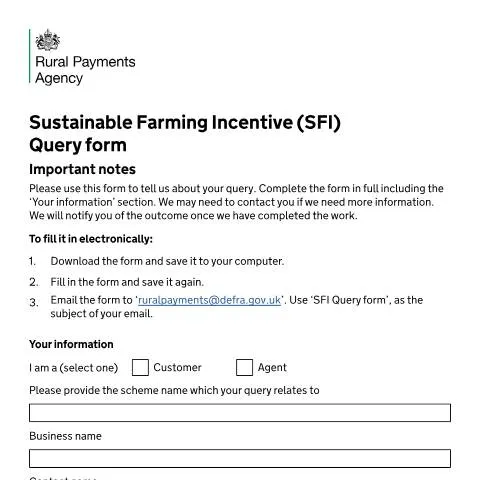
The Rural Payments Agency receives thousands of Sustainable Farming Incentive enquiries each month, ranging from straightforward payment queries to complex eligibility disputes. Whether you're a first-time applicant struggling with land parcel requirements or an experienced farmer questioning a payment calculation, the SFI query form (sfi01) serves as your formal channel to seek clarification and resolution from the Department for Environment, Food & Rural Affairs.
This electronic form, currently in version 5.0 as of March 2026, represents more than just another administrative hurdle. It's your documented pathway to resolve issues that could affect thousands of pounds in environmental land management payments, ensure compliance with scheme obligations, or clarify complex rotational requirements that vary significantly across different farming systems.
The Digital-First Approach: Why Email Submission Matters
Unlike many government forms that offer multiple submission routes, the SFI query form operates exclusively through electronic channels. This deliberate design choice reflects the Rural Payments Agency's commitment to faster processing times and improved traceability of farmer communications.
The process requires three specific steps that must be followed precisely. First, you download the form and save it locally to your computer – this isn't merely about convenience, but ensures you're working with the most current version. The form then needs completing and saving again before emailing to [email protected] with the exact subject line 'SFI Query form'.
This electronic-only approach serves multiple purposes beyond administrative efficiency. It creates an automatic audit trail for your query, enables the RPA to process attachments and supporting documentation more effectively, and allows for faster routing to specialist teams within DEFRA who handle different aspects of the SFI scheme.
Email Address Registration Requirements
A critical requirement often overlooked is that submissions must come from an email address registered on the Rural Payments service. This security measure prevents unauthorised third parties from submitting queries on behalf of farmers and ensures that responses reach the correct recipient. If you've recently changed your contact details or are using a different email address, you'll need to update your Rural Payments account before submitting any queries.
Navigating the Customer vs Agent Distinction
The form's opening section requires you to identify whether you're submitting as a Customer or Agent – a distinction that carries significant implications for how your query will be processed and who can receive responses.
Customers are the direct beneficiaries of SFI agreements – typically the farmers or landowners who have entered into environmental land management commitments. Agents, by contrast, include agricultural consultants, land agents, accountants, or family members who have been granted authority to act on behalf of the customer.
If you're submitting as an agent, the RPA will verify your authority to act before processing your query. This verification process can add several days to response times, particularly if your agent status isn't clearly recorded in the Rural Payments system. For urgent queries, it's often faster for the customer to submit directly, even if they typically rely on professional representatives for other farming business matters.
The Scheme Name Specification
While the form is specifically designed for SFI queries, the requirement to "provide the scheme name which your query relates to" acknowledges that environmental land management involves multiple interconnected programmes. Your query might relate to the core SFI scheme, but it could also involve interactions with Countryside Stewardship agreements, Basic Payment Scheme legacies, or emerging Local Nature Recovery schemes.
Essential Reference Information: Building Your Query Foundation
The form demands several key identifiers that serve as the foundation for processing your query effectively. Your SBI (Single Business Identifier) number acts as the primary key linking your query to your complete farming business profile within the Rural Payments system.
The Application/Agreement Reference field, marked as optional, becomes crucial when your query relates to specific SFI applications or active agreements. This reference number enables RPA staff to access the precise details of your environmental commitments, payment calculations, and compliance history without requiring additional verification steps.
| Information Type | When Required | Where to Find It |
|---|---|---|
| SBI Number | All queries | Rural Payments account, previous correspondence |
| Application Reference | Application-specific issues | Application confirmation emails, RPA portal |
| Agreement Reference | Active scheme queries | Agreement documents, payment statements |
Your business name and contact details must match exactly with information held in the Rural Payments system. Discrepancies can trigger additional verification requirements that delay query processing, particularly for sensitive matters involving payment disputes or compliance issues.
Categorising Your Query: The Checkbox Matrix Decoded
The form presents eight distinct query categories that can be selected individually or in combination. This categorisation system isn't merely administrative – it determines which specialist team within the RPA will handle your query and influences response timeframes.
Pre-Application queries typically involve eligibility questions, land parcel queries, or clarification of scheme requirements before formal application submission. These queries often receive faster responses as they don't require access to detailed application data or payment systems.
Agreement queries relate to active SFI commitments, including modifications to existing agreements, queries about specific environmental actions, or clarification of obligations following land use changes. These queries may require field visit reports or environmental assessment data to resolve effectively.
Payment and Declaration Categories
Payment queries encompass the broadest range of issues, from missing payments and calculation disputes to requests for payment breakdowns and advance payment queries. These queries often require the longest processing times as they may involve detailed financial reconciliation across multiple scheme years.
The Annual declaration and Rotational declaration categories reflect the ongoing compliance obligations that SFI participants face. Annual declarations require confirmation of continued compliance with environmental commitments, while rotational declarations involve the complex reporting requirements for farmers implementing rotational grazing or crop management systems.
Site Visits and Evidence Checks
Site visit queries might involve requests for visit scheduling, disputes over visit findings, or clarification of inspection requirements. The RPA conducts both planned compliance visits and investigative visits triggered by satellite monitoring or third-party reports.
Evidence checks queries relate to the documentation requirements that support SFI claims. This might involve questions about acceptable evidence formats, retention requirements, or disputes over evidence adequacy during compliance assessments.
Crafting Effective Query Descriptions: Beyond the Basics
The form's most critical section requires a "detailed description of the exact nature of your queries and/or concerns." This free-text field often determines whether your query receives a swift resolution or requires multiple rounds of correspondence for clarification.
Effective query descriptions include specific dates, payment amounts, field parcel numbers, and reference numbers for any previous correspondence. Rather than simply stating "my payment is wrong," a well-constructed description might read: "My SFI payment for agreement SFI2024-001234 received on 15 March 2026 shows £2,400 for herbal leys (action SAM2) but my application covered 12 hectares at £200 per hectare, which should total £2,400. However, I believe I should have received payment for 15 hectares based on my land parcel measurements."
For complex queries involving multiple issues, consider structuring your description with numbered points or clear paragraph breaks. This approach helps RPA staff identify all aspects of your query and reduces the likelihood of partial responses that require follow-up correspondence.
Supporting Information Strategy
While the form doesn't explicitly request attachments, you can include supporting documentation with your email submission. Relevant attachments might include payment statements, field maps, previous correspondence, or photographic evidence for compliance disputes. However, each attachment should be clearly referenced in your query description to ensure RPA staff understand its relevance.
Processing Pathways: What Happens After Submission
Once submitted, your query enters the RPA's tiered processing system where different categories receive varying priority levels. Payment queries typically receive the highest priority, particularly those involving missing payments or calculation errors that affect cash flow for farming businesses.
The RPA's commitment to "notify you of the outcome once we have completed the work" encompasses a range of possible responses. Simple clarification queries might receive definitive answers within 10-15 working days, while complex compliance disputes or payment reconciliations could require several weeks, particularly if they involve cross-referencing with other government databases or require input from technical specialists.
Escalation and Follow-up Procedures
The one-form-per-email restriction serves an important purpose in maintaining query tracking integrity. If you have multiple unrelated queries, submit separate forms rather than attempting to combine them into a single submission. This approach ensures each issue receives appropriate specialist attention and prevents delays caused by complex queries being passed between different RPA teams.
For urgent queries affecting immediate compliance deadlines or payment disputes with significant financial implications, consider indicating the urgency in your email subject line while maintaining the required "SFI Query form" format. However, remember that the RPA prioritises queries based on their category and complexity rather than claimed urgency levels.
Strategic Timing and Regulatory Context
The timing of your query submission can significantly affect processing speeds and outcomes. The RPA experiences predictable seasonal peaks in query volumes, particularly around annual declaration deadlines, payment processing periods, and the opening of new application windows.
Submitting queries during quieter periods – typically mid-summer and early winter – often results in faster responses and more detailed explanations. Conversely, queries submitted during peak periods may receive more standardised responses that address your immediate concern but provide less contextual guidance.
The March 2026 version date of the current form reflects ongoing refinements to the SFI scheme as it matures beyond its initial implementation phase. Regular form updates often incorporate lessons learned from common query types, improved categorisation systems, and enhanced integration with the broader Rural Payments infrastructure.
Understanding the SFI query form as part of the wider environmental land management framework helps farmers use it more effectively. Rather than viewing it as a last resort for problem-solving, consider it as a proactive tool for clarifying obligations, optimising payment outcomes, and ensuring compliance with evolving environmental standards that will shape sustainable farming for years to come.
Navigating Multi-Year Agreements and Payment Structures
The Sustainable Farming Incentive operates on a three-year agreement cycle, creating specific obligations and opportunities that require careful consideration when completing your query form. Understanding these multi-year commitments is crucial for both new applicants and existing participants looking to modify their arrangements.
When submitting queries about agreement modifications, you'll need to specify which year of your current agreement cycle you're addressing. First-year participants often query about the flexibility to add new actions during their initial 12 months, whilst those in years two or three typically ask about scaling up existing commitments or transitioning between different SFI levels.
Payment structures follow a quarterly schedule, with payments made in May, August, November, and February. However, your first payment timing depends on your agreement start date, which can create confusion about expected payment schedules. If you're querying payment delays or discrepancies, include your agreement reference number and specify which quarter you're enquiring about.
The Rural Payments Agency calculates payments based on your declared eligible land area, but this can change if you acquire or dispose of land during your agreement period. Such changes require formal notification through the query system, accompanied by updated land registration documents. You'll need to specify whether the land change affects your existing SFI actions or if you're seeking to extend actions to newly acquired areas.
Annual declarations remain mandatory throughout your three-year period, even if your land use hasn't changed. Many participants query whether they need to reconfirm unchanged information, and the answer is yes – the RPA requires active confirmation rather than assuming continuation. Late declarations can trigger payment delays or, in severe cases, agreement penalties.
For those approaching their agreement renewal period, the query form becomes particularly important for understanding transition options. You can express interest in upgrading to higher-tier actions, adding complementary schemes like Countryside Stewardship, or adjusting your commitment levels based on three years of practical experience.
Compliance Monitoring and Inspection Procedures
The Rural Payments Agency conducts both remote monitoring using satellite imagery and on-farm inspections to verify SFI compliance. Understanding these processes is essential for maintaining your agreement and avoiding penalties, making this a frequent subject of participant queries.
Remote monitoring occurs continuously throughout your agreement period, with satellite and aerial imagery analysed to track land use changes, crop rotations, and compliance with specific SFI actions. The system can detect changes in vegetation patterns, field boundaries, and land management practices. If anomalies are detected, you may receive a query from the RPA requesting clarification or evidence of compliance.
On-farm inspections are typically announced with at least 48 hours' notice, though unannounced visits can occur if non-compliance is suspected. Inspectors will verify that your land management practices align with your declared SFI actions, checking everything from soil management techniques to hedge maintenance and grassland management.
During inspections, you'll need to provide evidence of your management activities, including records of when actions were performed, photographs showing compliance, and any supporting documentation like soil test results or seed purchase receipts. Maintaining comprehensive records throughout your agreement period is crucial – many compliance issues arise from inadequate documentation rather than actual non-compliance.
If non-compliance is identified, the penalty system operates on a sliding scale. Minor infractions may result in warnings or reduced payments for the affected area, whilst serious or repeated non-compliance can lead to agreement termination and recovery of previous payments. The query form allows you to seek clarification on compliance requirements before issues arise, which is always preferable to addressing problems after detection.
Weather-related challenges can affect your ability to complete SFI actions within specified timeframes. The RPA recognises force majeure situations, but you must notify them promptly through the query system, providing evidence of exceptional circumstances like flooding, drought, or severe weather events that prevented compliance.
Cross-compliance obligations remain in effect alongside SFI requirements, creating layered compliance responsibilities. Environmental regulations, animal welfare standards, and Good Agricultural and Environmental Condition (GAEC) requirements all apply, and breaches in any area can affect your SFI payments.
Integration with Other Agricultural Support Schemes
The Sustainable Farming Incentive operates within a complex ecosystem of agricultural support mechanisms, and understanding how these schemes interact is crucial for maximising your farm's support potential whilst avoiding conflicts or double-funding issues.
Basic Payment Scheme (BPS) recipients transitioning to SFI face particular complexities as BPS phases out. Your SFI query should address how your chosen actions complement reducing BPS entitlements and whether your land use plans align with the transition timeline. Some SFI actions build upon existing BPS cross-compliance requirements, whilst others introduce entirely new management obligations.
Countryside Stewardship agreements can run concurrently with SFI, but careful coordination is essential to avoid claiming payments for the same activities on the same land. The query form should specify any existing Countryside Stewardship commitments, including Higher Level Stewardship or Environmental Stewardship agreements that may still be active. Some SFI actions are compatible with Countryside Stewardship options, whilst others create conflicts that could result in payment reductions or agreement breaches.
Woodland management presents particular integration challenges. If your holding includes woodland areas under existing Woodland Grant Scheme or Countryside Stewardship Woodland Creation agreements, you'll need to clarify how SFI actions on adjacent agricultural land might affect woodland management obligations or vice versa. Buffer strips, hedgerow management, and boundary features often span the interface between agricultural and woodland areas.
Area-based payment calculations become complex when multiple schemes apply to the same holding. SFI payments are calculated on eligible agricultural area, but some land parcels might be partially covered by other agreements. Your query should specify the exact area calculations for each scheme to ensure accurate payment calculations and avoid overpayment recovery issues.
Capital grant schemes, including Farming Equipment and Technology Fund or Farming Investment Fund applications, may complement SFI actions but require careful timing and documentation. Some SFI actions benefit from equipment or infrastructure investments that could be part-funded through capital grants, but you must declare these relationships to avoid State Aid complications.
Producer organisation membership, cooperative arrangements, and supply chain requirements may influence your ability to implement certain SFI actions. If you're contracted to supply specific crop varieties or follow particular production protocols, these commitments might conflict with SFI flexibility requirements. Early clarification through the query system can prevent later compliance issues.
Local authority environmental schemes, water company catchment management programmes, and wildlife trust partnerships may offer complementary support for SFI-type activities. However, you must declare any payments received from other sources for similar environmental outcomes to ensure compliance with State Aid regulations and avoid double-funding accusations.