When Your Business Handles Animal Remains: Navigating ABP Registration Requirements
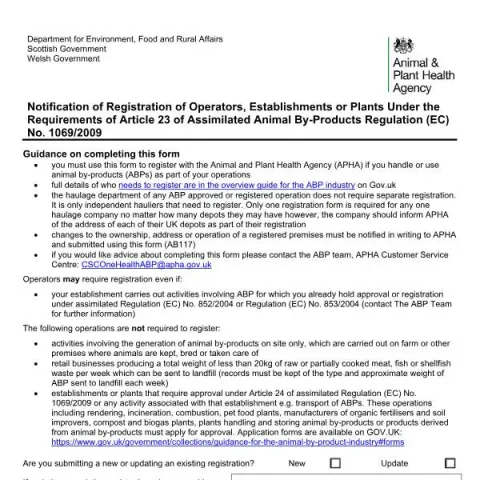
The moment your business begins handling animal by-products—whether processing fallen stock, manufacturing pet treats, or operating a biogas plant using organic waste—you enter a tightly regulated sector where registration with the Animal and Plant Health Agency (APHA) becomes mandatory. The AB117 registration form serves as your gateway into this compliance framework, but its seemingly straightforward appearance masks layers of regulatory complexity that can trip up even experienced operators.
Under the assimilated Animal By-Products Regulation (EC) No. 1069/2009, establishments handling ABPs must demonstrate they meet stringent hygiene and traceability standards. This registration system emerged from decades of food safety crises, including BSE outbreaks that fundamentally reshaped how animal-derived materials are managed across the food chain. Today's framework distinguishes between three risk categories of animal by-products, each carrying different handling requirements and business obligations.
The registration requirement applies even when your ABP activities represent just one aspect of a broader operation—a restaurant generating kitchen waste, a veterinary practice disposing of clinical materials, or a farm diversifying into organic fertiliser production all fall within scope, provided they exceed minimum thresholds.
Distinguishing Registration from Approval: Two Tiers of ABP Control
One of the most common misconceptions surrounding form AB117 concerns its relationship with ABP approval procedures. Registration and approval represent distinct regulatory tiers, each targeting different risk profiles within the animal by-products industry.
Registration under AB117 covers lower-risk operations that handle ABPs without fundamentally transforming them. This includes haulage companies transporting Category 3 materials, retailers generating small quantities of meat waste, and establishments storing ABPs temporarily before onward processing. The registration process focuses on demonstrating basic hygiene standards and establishing clear audit trails for materials handling.
Approval, conversely, applies to high-risk transformation activities covered under Article 24 of the same regulation. Rendering plants converting fallen stock into processed animal proteins, incinerators disposing of Category 1 materials, and pet food manufacturers processing raw ABPs all require full approval rather than simple registration. These operations undergo intensive pre-approval inspections and face ongoing compliance monitoring.
| Activity Type | Regulatory Requirement | Application Route |
|---|---|---|
| Independent ABP transport | Registration (AB117) | Single form per company |
| Temporary ABP storage | Registration (AB117) | Per establishment basis |
| Rendering operations | Approval (separate forms) | Detailed technical submission |
| Pet food manufacturing | Approval (separate forms) | HACCP-based assessment |
The boundary between registration and approval can blur in practice. A farm shop selling home-produced meat products might require only food hygiene registration under separate regulations, but if they begin processing ABPs from external sources—even for composting—AB117 registration becomes necessary. APHA's ABP team at [email protected] provides definitive guidance when classification remains unclear.
Category Classification: The Foundation of Your Registration Strategy
Section 13 of form AB117 requires operators to identify which categories of animal by-products they handle, but this classification system extends far beyond simple box-ticking. Category designation determines handling requirements, disposal routes, and inspection frequencies throughout your registration period.
Category 1 materials represent the highest-risk ABPs, including specified risk materials from TSE-susceptible species, animals containing veterinary drug residues above permitted levels, and wild animals suspected of carrying transmissible diseases. Establishments handling Category 1 materials face the strictest controls, with materials typically requiring incineration or burial as approved disposal routes.
Category 2 encompasses materials presenting significant but manageable risks, such as manure, digestive tract contents, and animals rejected for human consumption due to infectious diseases. These materials can undergo composting or biogas treatment under controlled conditions, making Category 2 handling attractive for agricultural diversification projects.
Category 3 covers the lowest-risk materials, including parts of slaughtered animals deemed fit for human consumption but not used for commercial reasons, former foodstuffs containing animal products, and catering waste from transport operations. Category 3 materials enjoy the widest range of permitted uses, from pet food production to organic fertiliser manufacturing.
Mixed-category operations face particular complexity when completing section 13. A veterinary practice might handle Category 1 materials from suspect disease cases, Category 2 materials from routine procedures, and Category 3 materials from healthy animals. Each category requires separate description and justification, with APHA expecting detailed protocols for preventing cross-contamination between categories.
Threshold Calculations and Exemption Boundaries
The AB117 guidance establishes specific exemptions that can significantly impact smaller operators, but these thresholds require careful interpretation to avoid compliance gaps. Retail businesses generating less than 20kg weekly of raw or partially cooked meat, fish, or shellfish waste qualify for exemption, provided materials go directly to landfill and detailed records demonstrate consistent compliance.
This 20kg threshold applies to combined waste streams from all meat, fish, and shellfish sources within the business. A high-street butcher shop might generate 15kg of meat trimmings and 8kg of fish waste weekly—exceeding the threshold despite neither individual stream reaching 20kg. The calculation becomes more complex for seasonal businesses where weekly averages fluctuate significantly throughout the year.
Record-keeping requirements for exempt businesses often prove more demanding than anticipated. APHA expects weekly documentation showing ABP types, approximate weights, and disposal routes to landfill operators. These records must remain available for inspection, creating administrative burdens that sometimes outweigh exemption benefits for borderline cases.
On-farm activities present another exemption category, but only where ABP generation occurs within the same premises where animals are kept, bred, or cared for. A dairy farm processing milk into cheese requires registration if using milk from external sources, even when the processing occurs on-farm. Similarly, a livestock farm accepting fallen stock from neighbouring properties moves beyond exemption scope, regardless of on-site processing capabilities.
Multi-Site Operations and Haulage Considerations
Section 10 of form AB117 addresses multi-site operations, but the guidance creates particular complexity for transport operators and businesses with distributed processing activities. Independent hauliers require only single registration per company, regardless of depot numbers, but must provide comprehensive details of all UK operational locations during the registration process.
The distinction between "independent hauliers" and "haulage departments" carries significant practical implications. A rendering company operating its own vehicle fleet for collecting ABPs from farms requires no separate haulage registration—transport activities fall under the rendering plant's approval. However, the same company contracting external hauliers for peak-season collections must ensure those operators hold valid AB117 registrations.
Multi-depot hauliers face ongoing notification obligations beyond initial registration. Opening new depots, relocating existing facilities, or changing operational scope requires written notification to APHA using updated AB117 submissions. These changes trigger inspection scheduling and fee assessments, making advance planning essential for expansion projects.
Franchise operations and management contracts add further complexity to multi-site considerations. A waste management company operating ABP collection services under franchise agreements might require separate registrations for each franchisee, depending on contractual arrangements and operational control structures. APHA evaluates these arrangements case-by-case, focusing on practical responsibility for ABP handling rather than formal ownership structures.
Financial Implications and Ongoing Fee Structures
While AB117 registration carries no application fees, section 11's fee guidance introduces ongoing financial obligations that registered operators must factor into business planning. APHA's inspection fees apply throughout the registration period, with charging structures varying according to business size, ABP categories handled, and compliance history.
The billing information requirements in section 11 demand particular attention to detail. Business names must appear exactly as they will on invoices, using full legal trading names rather than commonly used abbreviations or trading styles. A company registered as "Northern Counties Waste Management Limited" cannot use "NCWM Ltd" for billing purposes, even when this abbreviated form appears on everyday correspondence.
Government departments and public organisations receive different fee treatment, but qualification criteria extend beyond simple public sector status. Arms-length bodies, quasi-autonomous organisations, and public-private partnerships may face standard commercial rates depending on their specific constitutional arrangements and funding sources.
VAT registration numbers become particularly important for businesses operating across multiple jurisdictions or handling significant ABP volumes. APHA's charging system integrates with standard VAT procedures, but businesses changing VAT status during their registration period must notify updates promptly to avoid invoice processing delays.
Specialised Product Categories and Niche Applications
Section 14 of form AB117 addresses specialised ABP categories that often require additional clarification beyond standard tick-box responses. Blood and blood products for medical use (BLPT) face particularly stringent controls, with operators requiring detailed protocols for source verification, processing standards, and end-use documentation.
The distinction between horse blood products (SERE) and other animal blood reflects specific regulatory concerns around equine medicine use and food chain protection. Establishments handling horse blood must demonstrate complete segregation from food-producing animal materials, with separate storage, processing, and documentation systems throughout the handling chain.
Game trophy and taxidermy operations (GATRP) require commercial-scale activities for registration purposes, but the commercial threshold remains deliberately undefined in the guidance. A professional taxidermist operating from dedicated premises clearly requires registration, while occasional hobbyist activities typically fall outside scope. Border cases benefit from pre-application discussion with APHA's ABP team.
Apiculture by-products (API) present unique challenges given bees' special status within animal by-product regulations. Wax, propolis, and royal jelly handling may require registration depending on processing scale and end-use applications, but honey production alone typically remains outside ABP scope unless involving significant bee mortality or disease management activities.
Biogas digestion residues (DIGR) represent a rapidly growing category as renewable energy projects increasingly incorporate ABP feedstocks. These operations must demonstrate complete material traceability from ABP inputs through anaerobic digestion to final digestate application, with registration covering the entire process chain rather than isolated handling activities.
Submission Procedures and Post-Registration Compliance
Completing form AB117 represents only the initial step in a broader compliance relationship with APHA that extends throughout your operational period. Changes to ownership, address, or operational scope require written notification using fresh AB117 submissions, creating ongoing administrative obligations for dynamic businesses.
The submission process itself varies according to business circumstances and regional APHA office procedures. Electronic submission through designated email channels offers fastest processing for straightforward registrations, but complex operations involving multiple categories or specialised activities may benefit from preliminary telephone discussions before formal submission.
APHA's processing timescales fluctuate according to application complexity and seasonal inspection scheduling, but operators should anticipate minimum four-week processing periods for complete applications. Incomplete submissions face significant delays, particularly when supporting documentation requires clarification or additional technical information becomes necessary.
Post-registration compliance monitoring operates through risk-based inspection programmes that consider ABP categories handled, business compliance history, and operational scale. High-performing operators with consistent compliance records face reduced inspection frequencies, while businesses with compliance concerns or handling high-risk categories undergo more intensive monitoring.
Registration renewals follow streamlined procedures for established operators with unchanged circumstances, but businesses expanding into new ABP categories or significantly altering operational scale require fresh technical assessments similar to initial registration processes. This creates planning implications for growth-oriented businesses considering ABP market entry or expansion strategies.
Special Considerations for Different Animal By-Product Categories
The registration requirements vary significantly depending on which categories of animal by-products your site handles. Category 1 materials, considered the highest risk, include specified risk materials (SRM) from cattle, sheep and goats, as well as materials from animals suspected of having transmissible spongiform encephalopathies (TSEs). Sites handling Category 1 materials face the most stringent registration conditions and must demonstrate exceptional biosecurity measures.
Fill in your form directly online
No printing: type your details into the boxes of the official form, tick, then download the PDF ready to send.
- 1Type into the form boxes
- 2Tick in one click
- 3Save and download the PDF
If your facility processes fallen stock or animals that have died other than by slaughter for human consumption, you'll need to specify this clearly on your registration form. The Animal and Plant Health Agency requires detailed information about your collection routes, storage capacity, and processing timelines. For instance, if you operate a rendering plant that collects fallen stock from farms across multiple counties, you must provide comprehensive details about your transport vehicles, including their registration numbers and cleaning protocols.
Category 2 materials present their own complexities. These include manure, digestive tract contents, and materials from animals containing veterinary drug residues above permitted levels. Pet food manufacturers frequently work with Category 2 materials, and their registration must specify whether they're producing complete pet foods, treats, or raw materials for further processing. The registration form requires you to detail your heat treatment processes, as Category 2 materials must typically be processed at 133°C for 20 minutes at 3 bar pressure.
Category 3 materials, while lower risk, still require precise documentation. These include parts of slaughtered animals that are fit for human consumption but not intended for human food, such as hides, skins, and certain bones. Gelatin manufacturers, leather processors, and pharmaceutical companies often work exclusively with Category 3 materials. Your registration must specify whether you're receiving materials directly from approved slaughterhouses or through intermediate collection points.
Mixed category operations face additional scrutiny. If your site handles multiple categories of animal by-products, you must demonstrate complete segregation throughout your processes. This includes separate storage areas, processing lines, and waste streams. The registration form requires detailed site plans showing how different categories are kept apart, including physical barriers and procedural safeguards.
Compliance Monitoring and Inspection Protocols
Once registered, your site becomes subject to regular monitoring by the Animal and Plant Health Agency and local authority inspectors. Understanding these inspection protocols is crucial for maintaining your registration status. Inspections typically occur without prior notice, though initial compliance visits for newly registered sites may be scheduled in advance.
Inspectors will verify that your actual operations match the information provided in your registration form. They'll examine your premises layout against submitted site plans, check that processing equipment matches declared specifications, and review your records systems. Any discrepancies between your registration details and actual operations can result in enforcement action, including suspension of your registration.
Temperature monitoring represents a critical compliance area. If you declared specific heat treatment processes in your registration, inspectors will verify that your equipment consistently achieves these parameters. You must maintain calibrated temperature recording devices and preserve these records for inspection. The frequency of calibration depends on your processing methods, but quarterly calibration is typically expected for critical control point equipment.
Traceability systems face particular scrutiny during inspections. Your registration form should accurately reflect your record-keeping capabilities. If you declared that you can trace materials back to source farms within 24 hours, inspectors will test this claim by requesting trace-back information for randomly selected batches. Failure to provide complete traceability within declared timeframes can trigger formal warnings or registration reviews.
Biosecurity measures receive intensive examination. Inspectors assess whether your cleaning and disinfection procedures match those described in your registration. They'll check that staff follow declared protocols for changing protective clothing when moving between different risk areas. Vehicle cleaning facilities must operate according to registered specifications, with appropriate drainage systems and approved disinfectants.
Laboratory arrangements also undergo verification. If your registration indicates that you conduct specific testing regimes, inspectors will review your laboratory accreditation, testing frequencies, and result interpretation procedures. Sites that rely on external laboratories must demonstrate that these facilities hold appropriate accreditation for the tests being conducted.
Cross-Border Movement and Export Considerations
Sites involved in importing animal by-products from the European Union or exporting processed products face additional registration complexities. Post-Brexit arrangements have introduced new requirements that must be accurately reflected in your registration documentation. If your site receives materials from EU member states, you must hold appropriate import authorisations and demonstrate compliance with border control procedures.
Import-registered sites must specify their designated ports of entry and demonstrate arrangements with Border Control Posts (BCPs). The registration form requires details of your customs procedures, including any Authorised Economic Operator (AEO) status. If you import Category 1 or Category 2 materials, you must provide evidence of approved transport routes from the port to your facility, including details of sealed transport arrangements and escort procedures where required.
For sites exporting processed animal by-products, registration must include details of your quality assurance systems and any third-country approvals you hold. Export-oriented facilities often require additional certifications that must be maintained alongside their basic registration. The Animal and Plant Health Agency may impose specific conditions on export-registered sites, such as enhanced record-keeping requirements or additional sampling protocols.
Transit arrangements through your site require special attention in registration documentation. If materials pass through your premises en route to other destinations, this must be clearly declared. Transit operations are subject to specific rules regarding storage duration, handling procedures, and onward dispatch requirements. Some sites operate as consolidation points, combining shipments from multiple sources before onward transport – these arrangements need detailed explanation in your registration.
Northern Ireland presents unique considerations due to the Northern Ireland Protocol arrangements. Sites in Northern Ireland handling animal by-products that might enter EU markets must comply with EU requirements alongside UK regulations. This dual compliance obligation must be clearly addressed in registration documentation, including details of how you maintain segregation between products destined for different markets.
Documentation requirements for cross-border movements extend beyond basic commercial invoices. Your registration should specify your capacity to generate appropriate health certificates, commercial documents, and customs declarations. Sites handling high-value materials like pharmaceutical-grade gelatin or specialised pet food ingredients often require enhanced documentation systems that must be described in detail during registration.