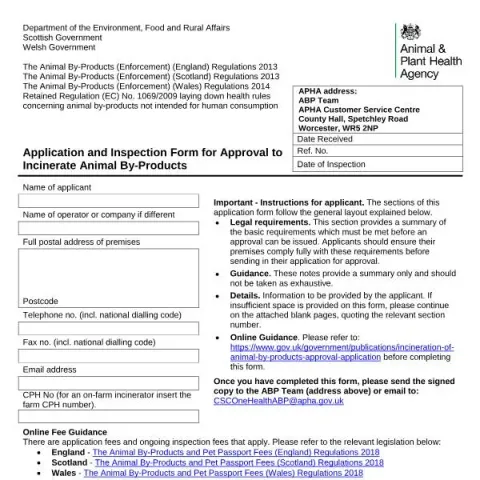
Regulatory Framework and Industry Need: The Critical Role of Approved Animal By-Product Incineration
The disposal of animal by-products represents one of the most heavily regulated aspects of the UK's agricultural and veterinary sectors. Following the BSE crisis and subsequent European regulatory overhaul, strict controls govern how materials ranging from fallen livestock to slaughterhouse waste must be handled. The Animal and Plant Health Agency's approval system for incineration facilities stands as a cornerstone of this biosecurity framework, ensuring that potentially hazardous biological materials are destroyed safely whilst protecting both public health and the environment.
Under the Animal By-Products (Enforcement) Regulations 2013 for England and Scotland, and the 2014 regulations for Wales, any operator seeking to incinerate animal by-products must obtain formal APHA approval before commencing operations. This requirement applies whether you're operating a small on-farm incinerator handling fallen stock from your own premises, or managing a large commercial facility processing materials from multiple sources across a region.
The regulatory landscape distinguishes clearly between different scales of operation. Incinerators with capacity below 50kg per hour fall under ABP Regulations and require APHA approval but not environmental permitting. However, facilities exceeding this threshold must navigate both APHA approval and environmental permit requirements under the Industrial Emissions Directive, creating a dual regulatory pathway that demands careful coordination.
Identifying Your Operational Category: From On-Farm Units to Commercial Processing Plants
The application form ABPR02 serves different categories of operators, each facing distinct regulatory requirements and operational constraints. On-farm incinerators typically handle fallen livestock, stillborn animals, and veterinary waste generated on the premises. These operators often choose incineration to maintain biosecurity and avoid the logistical complexities of off-site disposal, particularly in remote rural locations where collection services may be infrequent or costly.
Pet crematoriums represent another significant user group, processing companion animal remains under strict protocols that ensure dignified handling whilst meeting public health requirements. These facilities must demonstrate particular attention to emission controls and ash handling procedures, given their proximity to residential areas and the emotional sensitivities involved.
Commercial animal by-product processors operate at the largest scale, handling materials from multiple sources including slaughterhouses, food processing plants, and veterinary practices. These operations require sophisticated infrastructure to manage different categories of material safely, with segregated storage, handling systems, and comprehensive traceability protocols.
| Operator Type | Typical Capacity | Material Sources | Additional Requirements |
|---|---|---|---|
| On-farm incinerator | Under 50kg/hr | Own premises only | Planning permission may be required |
| Pet crematorium | Variable | Veterinary practices, pet owners | Emissions controls, ash protocols |
| Commercial processor | Over 50kg/hr typically | Multiple external sources | Environmental permit, transport approvals |
Navigating the Complex Material Classification System
The application's third section addresses one of the most technically demanding aspects of the approval process: correctly identifying and categorising the animal by-products you intend to incinerate. European Regulation 1069/2009 establishes three distinct categories, each reflecting different levels of risk to public and animal health.
Category 1 materials represent the highest risk, including animals suspected of TSE infections, animals containing veterinary drug residues, and wild animals suspected of being infected with diseases communicable to humans or animals. These materials require disposal in high-capacity incinerators and cannot be processed in low-capacity facilities.
Category 2 materials encompass manure, digestive tract contents, and animals that die other than by slaughter for human consumption but show no signs of infectious disease. Category 3 materials include parts of slaughtered animals that are fit for human consumption but not intended for such use, such as hides, bones, and certain organs.
The distinction between processing your own material versus accepting waste from other premises fundamentally alters your regulatory obligations. Operators handling only their own by-products face simpler approval requirements, whilst those accepting external materials must demonstrate comprehensive transport, storage, and traceability systems. This difference significantly impacts both the approval process timeline and ongoing compliance obligations.
Technical Specifications and Capacity Declarations: Getting the Engineering Details Right
Section 2 of the application demands precise technical information about your incineration equipment, and accuracy here proves crucial for both approval success and ongoing compliance. The capacity declaration must reflect the actual operational capability of your plant, not merely the manufacturer's theoretical maximum. APHA expects supporting documentation such as manufacturer specifications, commissioning reports, or independent capacity assessments.
For premises with multiple incinerators, the combined capacity calculation determines whether you require environmental permitting alongside APHA approval. However, the form notes an important exception: if your system allows operation of only one incinerator at a time, and each unit has capacity below 50kg per hour, you may qualify for low-capacity approval even if the combined theoretical capacity exceeds the threshold.
The make, model, and serial number requirements serve multiple purposes beyond mere identification. APHA maintains records of approved equipment types and their performance characteristics, enabling more efficient assessment of applications using proven technology. Additionally, these details facilitate future inspections and any necessary equipment modifications or replacements.
Independent confirmation of operating capacity often proves challenging for smaller operators, particularly those using older or modified equipment. Manufacturer data sheets may not reflect real-world operating conditions, whilst commissioning reports might not be available for legacy installations. In such cases, applicants should provide detailed operational logs or consider commissioning an independent assessment to support their capacity claims.
Administrative Prerequisites and Supporting Documentation
Beyond the technical aspects, successful applications depend on meticulous attention to administrative details. The form's emphasis on exact legal trading names reflects APHA's integration with other regulatory systems, including invoicing, inspection scheduling, and enforcement actions. Using abbreviated names, initials, or trading styles that don't match official company registration records can cause significant delays.
The distinction between government departments and commercial operators affects both application processing and ongoing fee structures. Public sector applicants may qualify for different fee arrangements, but must provide evidence of their status through appropriate documentation such as departmental confirmation letters or statutory body registration.
VAT registration details serve dual purposes, enabling APHA to issue properly formatted invoices whilst also providing additional verification of the applicant's commercial status and legitimacy. The separate billing address provision recognises that many applicants operate through management companies or centralised administrative functions that handle financial matters on behalf of multiple sites.
Contact information for invoicing must remain current throughout the approval period, as APHA issues both initial approval fees and ongoing inspection charges. Changes to billing contacts or addresses require prompt notification to avoid payment delays that could jeopardise your operational approval.
Planning Permission Coordination
The form's guidance regarding local authority planning permission highlights a frequent source of confusion and delay. Large incineration plants typically require planning permission under the Town and Country Planning Act, whilst smaller on-farm units may fall within permitted development rights. However, these determinations depend on multiple factors including location, capacity, building specifications, and local development plan policies.
APHA approval and planning permission represent separate regulatory processes with different criteria, timescales, and appeal mechanisms. Obtaining APHA approval doesn't guarantee planning permission, whilst planning approval doesn't satisfy APHA's biosecurity and technical requirements. Successful applicants typically coordinate both processes simultaneously, recognising that neither alone provides complete authorisation to operate.
Fee Structure and Payment Arrangements Across UK Jurisdictions
The application references different fee regulations for England, Scotland, and Wales, reflecting the devolved nature of animal health administration whilst maintaining consistent technical standards. These fee structures typically include both initial application charges and ongoing inspection fees, with amounts varying based on facility capacity, material types, and inspection frequency requirements.
Application fees generally become payable upon submission, regardless of the eventual approval decision. This reflects the administrative costs of technical assessment, site inspection, and documentation review that APHA incurs during the evaluation process. Ongoing inspection fees typically apply annually or following significant operational changes that trigger additional oversight.
The distinction between high and low capacity facilities significantly impacts fee levels, with larger operations facing higher charges reflecting their greater regulatory complexity and inspection requirements. Commercial processors handling multiple material categories typically incur the highest fees, whilst small on-farm incinerators benefit from reduced charges acknowledging their limited scale and risk profile.
Post-Submission Process and Inspection Scheduling
Following submission to the ABP Team at APHA's Worcester Customer Service Centre, applications enter a structured assessment process combining desktop technical review with mandatory site inspection. The inspection scheduling depends on current workload, geographical location, and seasonal factors affecting APHA inspector availability.
Pre-inspection preparation proves crucial for approval success. Inspectors expect to see fully commissioned and operational equipment, complete documentation systems, and staff trained in proper operating procedures. Attempting to demonstrate compliance using incomplete installations or theoretical procedures typically results in deferral pending completion of outstanding items.
The inspection covers multiple aspects beyond the incineration equipment itself, including material storage arrangements, ash disposal procedures, record-keeping systems, and staff competency. Inspectors verify that actual operations match the application descriptions and assess whether proposed procedures adequately address biosecurity and environmental protection requirements.
Conditional approvals may be issued where minor deficiencies are identified that don't compromise fundamental safety or biosecurity requirements. These typically include administrative improvements, minor equipment modifications, or additional staff training. Full approval follows confirmation that all conditions have been satisfactorily addressed.
Ongoing compliance monitoring continues throughout the approval period, with routine inspections scheduled based on risk assessment and operational history. Changes to equipment, materials handled, or operational procedures may require prior notification or amended approval, ensuring that APHA maintains current oversight of all approved facilities.
Environmental Impact Assessment and Monitoring Requirements
When applying for approval to incinerate animal by-products, operators must demonstrate comprehensive understanding of environmental implications and monitoring obligations. The Environmental Agency requires detailed environmental impact assessments for facilities processing significant volumes, particularly those handling Category 1 materials or operating at commercial scale.
Air quality monitoring forms a critical component of the approval process. Applicants must specify emission monitoring systems for key pollutants including particulate matter (PM10 and PM2.5), nitrogen oxides (NOx), sulphur dioxide (SO2), and carbon monoxide (CO). For facilities processing over 50 tonnes annually, continuous emission monitoring systems (CEMS) may be mandatory, requiring calibration certificates and maintenance schedules to be submitted with the application.
Stack height calculations must account for local topography and meteorological conditions. The Environment Agency's H1 guidance provides dispersion modelling requirements, with operators needing to demonstrate that ground-level concentrations remain within air quality standards. Wind rose data, typically covering three years of meteorological records, supports these calculations alongside details of surrounding sensitive receptors including residential areas, schools, and hospitals.
Ash disposal arrangements require particular attention, as animal by-product incineration generates both bottom ash and fly ash with distinct characteristics. Bottom ash from Category 1 material incineration must typically undergo hazardous waste assessment, with operators providing waste classification codes and disposal route confirmations. Fly ash, containing concentrated heavy metals and potentially dioxins, often requires treatment as hazardous waste regardless of input category.
Noise impact assessments become relevant for facilities in mixed-use areas or near residential properties. BS 4142 methodology guides noise predictions, with operators providing baseline surveys and predicted operational noise levels during different activities including material delivery, processing, and ash removal. Night-time operations may face stricter limits, particularly affecting 24-hour commercial facilities.
Fill in your form directly online
No printing: type your details into the boxes of the official form, tick, then download the PDF ready to send.
- 1Type into the form boxes
- 2Tick in one click
- 3Save and download the PDF
Water management plans address both process water and surface water runoff. Facilities must demonstrate adequate containment for firewater, with calculations based on fire brigade requirements and storage vessel capacity. Surface water drainage systems require oil interceptors and settlement ponds where appropriate, with discharge consents potentially needed for any water released to watercourses or sewers.
Record-Keeping and Compliance Documentation
Approved animal by-product incinerators face extensive record-keeping obligations extending beyond basic operational logs. The Animal and Plant Health Agency mandates specific documentation formats and retention periods, with electronic record systems requiring approval where paper alternatives are replaced.
Material acceptance records must capture detailed information for each consignment received. Commercial health certificates, transport documentation, and waste transfer notes require cross-referencing with internal acceptance procedures. Category 1 materials demand particularly rigorous documentation, including confirmation of appropriate transport vehicle cleaning and driver authorisation. Operators must maintain supplier approval lists, updating these when processing materials from new sources.
Incineration process records encompass temperature monitoring data, residence time calculations, and combustion efficiency measurements. Continuous temperature recording at multiple points within the combustion chamber provides evidence of regulatory compliance, with data loggers requiring calibration certificates and backup systems for critical measurements. Oxygen levels, CO concentrations, and other combustion parameters need recording at specified intervals.
Maintenance logs demonstrate equipment reliability and regulatory compliance. Planned maintenance schedules, emergency repair records, and equipment replacement documentation support renewal applications and regulatory inspections. Particular attention applies to pollution control equipment including baghouses, scrubbers, and monitoring systems, where maintenance failures could affect emission compliance.
Staff training records verify operator competence in animal by-product handling and incineration procedures. Initial training certification, annual refresher courses, and specific equipment training require documentation with individual staff files maintained throughout employment. Emergency response training, including fire procedures and equipment failure protocols, needs regular updates with drill records maintained.
Audit trail documentation supports regulatory inspections and compliance verification. Internal audit schedules, corrective action logs, and management review records demonstrate systematic approach to regulatory compliance. Non-conformance investigations, including root cause analysis and preventive measures, provide evidence of continuous improvement culture.
Annual return submissions to regulatory authorities require compilation of operational data including throughput volumes, emission measurements, and waste generation quantities. These returns often feed into national statistics and policy development, with accurate reporting supporting sector-wide regulatory frameworks.
Cross-Border Transport and International Considerations
Animal by-product incineration approvals intersect with international transport regulations, particularly affecting facilities near borders or processing materials from multiple countries. Post-Brexit arrangements have introduced additional complexities for facilities handling materials from EU member states or exporting processed outputs.
Import procedures for animal by-products destined for incineration require specific documentation and border inspection protocols. The Border Control Post system manages veterinary checks for certain categories, with facilities needing to demonstrate approved supplier status and appropriate transport arrangements. Category 1 materials face particular restrictions, with some imports prohibited entirely while others require specific authorisations.
Export considerations apply where incineration produces marketable outputs such as processed animal proteins (PAPs) or meat and bone meal for approved uses. These materials face complex export certification requirements, with destination country approvals needed alongside UK export permits. Facilities producing such outputs must maintain separate approval streams for both incineration operations and export activities.
Transit arrangements through third countries create additional regulatory layers, particularly for materials moving between Great Britain and Northern Ireland. The Northern Ireland Protocol arrangements affect certain animal by-products, with facilities needing to understand customs procedures and veterinary certification requirements for cross-border movements.
Traceability obligations extend across international boundaries, with operators required to maintain records linking imported materials to final disposal or processing outcomes. This creates particular challenges for mixed consignments or where materials undergo intermediate processing stages before final incineration.
Emergency procedures must account for international transport disruptions, including port closures, customs delays, or veterinary restrictions affecting material movements. Contingency storage arrangements and alternative disposal routes require pre-approval, with operators maintaining agreements for emergency situations that could affect normal processing schedules.
Currency fluctuations and international pricing mechanisms affect commercial viability assessments submitted with applications. Multi-year approval periods must account for changing economic conditions affecting cross-border trade in animal by-products and processed outputs.
Regulatory harmonisation efforts between UK authorities and international partners continue evolving, with facilities needing to monitor policy developments affecting future operations. Trade agreement provisions may introduce new opportunities or restrictions for animal by-product processing, requiring operators to maintain flexibility in operational planning and regulatory compliance approaches.