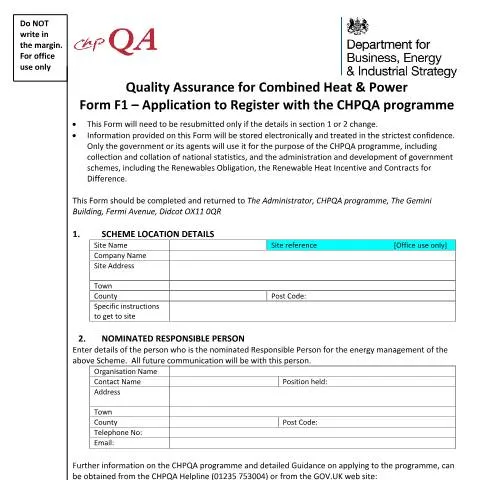
Navigating the CHPQA Registration Process: Your Essential Guide
When considering the establishment of a Combined Heat and Power (CHP) facility, understanding the registration process is crucial. This involves the CHPQA Registration Form F1, a document integral to ensuring your CHP system meets the necessary quality assurance standards. The CHPQA programme, governed by the Department for Business, Energy & Industrial Strategy (BEIS), aims to promote efficient energy use and support sustainable development in the UK.
Who Needs to Engage with the CHPQA Programme?
The CHPQA Registration Form F1 is primarily designed for energy management professionals and organisations operating CHP systems. However, the specifics can vary widely based on the type of user:
- Businesses: Companies across various sectors, from manufacturing to healthcare, that utilise CHP systems for energy efficiency.
- Public Sector Entities: Local councils, universities, and hospitals which are increasingly investing in sustainable energy solutions.
- Energy Managers: Individuals appointed as the Responsible Person, overseeing the CHP system's performance and compliance.
Each of these profiles has its unique considerations. For example, a large manufacturing plant may require a detailed analysis of energy output, while a university may focus on meeting sustainability targets.
Special Cases and Exceptions
While the form is needed for the majority of users, some exceptions may apply. In particular:
- Small-scale CHP systems under certain thresholds may not be required to register.
- Institutions that already possess certifications under other recognised energy management systems may have different compliance requirements.
- Organisations in Scotland, Wales, and Northern Ireland may follow different guidelines under local regulations.
The Submission Pathway: How and Where to Send Your Form
Completing the CHPQA Registration Form F1 involves selecting an appropriate submission channel. Understanding your options can save time and ensure compliance.
Online Registration
For many applicants, submitting the form online is the most efficient route. However, it is crucial to ensure that:
- You have all necessary information at hand, including company details and specific site information.
- You have a reliable internet connection to avoid disruptions during submission.
Postal Submission
If you prefer or require a physical submission, you can send the completed form via post to:
The Administrator, CHPQA programme, The Gemini Building, Fermi Avenue, Didcot OX11 0QR
Ensure you allow sufficient time for postal delays, as the registration must be completed by specific deadlines.
In-Person Submission
For those who wish to clarify queries or receive guidance, in-person submissions at designated agencies may be an option. This approach allows for direct interaction but may require an appointment.
Decoding the CHPQA Registration Form F1: A Comprehensive Breakdown
Completing the CHPQA Registration Form F1 requires careful attention to detail. Each section serves a distinct purpose, and understanding these can prevent common pitfalls.
Section 1: Scheme Location Details
This section demands precise information about your CHP installation:
- Site Name: The name of the facility where the CHP system operates.
- Company Name: The entity that manages the CHP installation.
- Site Address: Complete postal address, including town, county, and postcode.
Common mistakes in this section include typos in the address or an incorrect site reference. Ensure all details are double-checked against official documents.
Section 2: Nominated Responsible Person
Identifying the Responsible Person is a critical part of the application. This individual will be the primary contact for all communications regarding your application:
- Contact Information: Include their full name, position, and contact details.
- Organisation Name: The name of the organisation that the Responsible Person represents.
It’s essential to ensure that the nominated Responsible Person is adequately informed about the CHP system and capable of handling inquiries from the CHPQA programme administrators.
Key Timelines: Understanding the Calendar of the CHPQA Registration
Timelines are pivotal in the CHPQA registration process. Applicants must adhere to the following schedule:
- Application Period: Applications are accepted throughout the year, but early submission is advisable to avoid last-minute issues.
- Registration Approval: Once submitted, processing times may vary. Typically, you can expect confirmation within 4 to 6 weeks, depending on the volume of submissions and completeness of your application.
- Updating Information: If any details change (e.g., site address or Responsible Person), you must resubmit the form.
Filing your application well before these milestones can help ensure compliance with energy efficiency regulations and standards.
The Regulatory Framework: Historical Context and Evolution
The CHPQA programme has evolved over the years to meet the UK's energy efficiency and climate change commitments. Its roots trace back to the government's approach to sustainable energy use, driven by both environmental and economic considerations.
Legislative Background
Key legislation includes the Energy Act 2004, which introduced frameworks for promoting combined heat and power systems. The subsequent focus on improving energy efficiency and reducing carbon emissions has shaped the CHPQA programme.
Understanding this framework is pivotal for organisations aiming to align with government policies and secure funding through schemes like the Renewables Obligation and Contracts for Difference.
Preparing Your Documentation: Essential Justifications and Evidence
Alongside the registration form, there are several supporting documents that may need to be prepared:
Required Justifications
- Site Plan: A detailed layout of the CHP installation site.
- Operational Details: Documentation describing the operational capacity and output of the CHP system.
- Sustainability Reports: Any existing reports on energy savings or emissions reductions.
Specific Documentation Based on Profile
Depending on the applicant type, additional documents might be necessary:
- Businesses: Energy bills and past performance reports.
- Public Sector: Evidence of previous funding or compliance with sustainability targets.
Integrating CHPQA into Your Energy Strategy
Completing the CHPQA Registration Form F1 not only facilitates compliance but also enhances your organisation's commitment to sustainability. The information collected is crucial for national statistics and the development of future energy schemes.
Moreover, successful registration can unlock access to various incentives, supporting your investment in cleaner energy technologies. This aligns with broader UK goals to meet net-zero targets and create a more sustainable energy market.
Engaging with the CHPQA programme represents an opportunity to contribute positively to the environment while improving operational efficiencies within your organisation.
Understanding CHPQA Registration: Eligibility Criteria and Application Process
Before diving into the CHPQA (Combined Heat and Power Quality Assurance) Registration Form F1, it’s crucial to grasp the eligibility requirements for this scheme. The CHPQA scheme is designed to promote the uptake of Combined Heat and Power (CHP) systems in the UK, and only certain types of installations may qualify for registration.
Firstly, to be eligible, your CHP system must generate both electrical and thermal energy from a single fuel source. The efficiency of your system is also assessed, and it needs to meet specific performance standards set by the Department for Business, Energy & Industrial Strategy (BEIS). This typically involves demonstrating that your installation has a total efficiency of at least 80% for both thermal and electrical output combined.
Fill in your form directly online
No printing: type your details into the boxes of the official form, tick, then download the PDF ready to send.
- 1Type into the form boxes
- 2Tick in one click
- 3Save and download the PDF
Moreover, it’s essential that your installation is operational and meets safety regulations stipulated by the Health and Safety Executive (HSE). If your CHP system is still in the planning stage or hasn’t been commissioned yet, you will not be eligible to submit Form F1.
For businesses looking to register, understanding the application process is vital. Firstly, complete the CHPQA Registration Form F1 with accurate information about your CHP installation. This includes details about the fuel type used, the installed capacity, and performance data. Supporting documentation, such as operational data and maintenance records, may also be required to affirm compliance with the scheme's criteria.
Once you submit your application, it will be reviewed by BEIS, and they will either approve your registration or request additional information. The review process can take several weeks, depending on the completeness of your application and the volume of submissions being processed. Always ensure your application is thorough to avoid delays.
Benefits of CHPQA Registration for Businesses
CHPQA registration can provide several advantages for businesses operating a CHP installation. One of the primary benefits is eligibility for the Climate Change Levy (CCL) exemption. This tax relief can significantly reduce energy costs, allowing businesses to reinvest those savings into other areas of operation or expansion.
Additionally, registered systems gain access to the Enhanced Capital Allowance (ECA) scheme, which enables businesses to claim back a portion of their capital expenditure on energy-saving technologies. This can be a substantial financial incentive for companies looking to upgrade or install new CHP systems.
Furthermore, registration can enhance a business's sustainability credentials. By demonstrating compliance with CHPQA standards, companies can improve their corporate social responsibility (CSR) profile, attracting environmentally-conscious consumers and investors. It can also open doors to further funding opportunities from government and private sources aimed at promoting low-carbon technologies.
Moreover, businesses with CHPQA registration may experience a reduction in energy price volatility. By generating their own power and heat, companies can mitigate risks associated with fluctuating energy prices, thus providing a more stable operational cost structure.
Common Challenges in Completing the CHPQA Registration Form F1
While the CHPQA Registration Form F1 is designed to be straightforward, applicants often encounter several common challenges during the completion process. Understanding these challenges can help ensure a smoother application experience and increase the likelihood of approval.
One frequent issue relates to the accuracy of performance data. Many applicants struggle with the technical aspects of calculating total efficiency, which requires precise measurements of both electricity and heat output. It’s essential to ensure that all performance data is current and reflective of the system's operational state. This often necessitates the use of certified metering equipment to collect data and may involve consulting with energy specialists to verify calculations.
Another challenge is providing comprehensive supporting documentation. BEIS requires thorough evidence of compliance with efficiency and safety standards. Businesses may need to gather operational logs, maintenance records, and fuel consumption data, which can be time-consuming. It’s advisable to maintain meticulous records from the onset of operations to facilitate this process.
Additionally, applicants may encounter difficulties in understanding the regulatory terminology used in the application. The technical language can be daunting, and misinterpretations could lead to incomplete or inaccurate submissions. Seeking guidance from energy consultants or engaging with industry-specific support networks can provide valuable assistance in navigating these complexities.
Finally, the timelines involved in the application process can pose challenges. With a typical review period extending several weeks, businesses must plan accordingly, particularly if they are relying on the benefits associated with CHPQA registration. It can be helpful to submit applications well in advance of any financial or project deadlines to allow for any potential delays.