Navigating the Seed Potato Classification Scheme: An Essential Process
The Seed Potato Classification Scheme plays a crucial role in the regulation and movement of seed potatoes within the UK. This scheme ensures that seed potatoes are produced, marketed, and moved in accordance with strict guidelines, ensuring quality and traceability. As a grower, producer, or commercial seller, understanding how to effectively manage your application for official labels is paramount.
Who Needs to Submit the Application?
Individuals and organizations involved in the production and marketing of seed potatoes are required to apply for official labels. This includes:
- Commercial growers who wish to sell seed potatoes
- Producers looking to market potatoes intended for trials
- Any entity that is handling seed potatoes for approved stock movement
It's essential to note that those marketing varieties not yet listed nationally must follow additional guidelines. If you are applying for a variety that has not yet achieved national listing, you must have prior authorization to market small quantities for testing and trial purposes.
Step-by-Step Application Process
The journey from application submission to receiving your labels involves several key steps. Here’s a chronological breakdown:
- Prepare Your Information: Gather necessary details including stock numbers, varieties, and any relevant testing results.
- Complete the Application Form: Ensure all sections are filled out accurately, noting any specific requirements for label types.
- Submit Your Application: Send the completed form to the appropriate APHA office, allowing at least five working days for processing.
- Receive Labels: After approval, your labels will be dispatched to the address provided in your application.
Decoding the Application Form
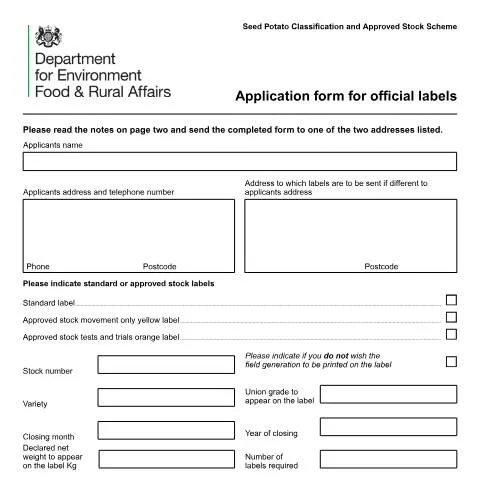
Completing the Seed Potato Classification Scheme application requires attention to detail. Here’s a closer look at the key sections of the form and common pitfalls to avoid:
Applicant Information
Ensure that your name, address, and contact number are accurate. If the labels are to be sent to a different address, provide that information clearly.
Label Type Selection
There are different labels available, such as:
- Standard Label: For general seed potatoes
- Approved Stock Movement Only Yellow Label: For approved stocks during their movement
- Approved Stock Tests and Trials Orange Label: For varieties undergoing testing
Indicating the correct label type is crucial as this determines how the seed potatoes can be marketed and moved.
Weight and Size Specifications
You need to declare the net weight and specify the upper and lower tuber sizes. Precision here is important to avoid delays in processing:
| Specification | Details Required |
|---|---|
| Declared Net Weight | Indicate in kilograms (Kg) |
| Lower Size of Tubers | Specify in millimeters (mm) |
| Upper Size of Tubers | Specify in millimeters (mm) |
Incorrect or vague figures can lead to non-compliance or delays.
The Importance of Compliance and Regulations
Adhering to the Seed Potatoes (England) Regulations 2015 and the Seed Potatoes (Wales) Regulations 2016 is not merely a bureaucratic formality. Compliance ensures the entire seed potato supply chain maintains its integrity, thus protecting buyers and market standards. It is essential to include accurate information as labels must be affixed to containers prior to leaving the producer’s premises and sealed appropriately.
Failure to comply can lead to penalties, including fines and restrictions on marketing your product.
What Happens After Submission?
Once your application has been submitted, it will be processed by the Animal and Plant Health Agency (APHA). Here’s what to expect:
- Your application will be reviewed for completeness and accuracy.
- Upon approval, your labels will be generated and sent to you.
- In case of any issues or required clarifications, APHA may contact you directly.
It’s advisable to maintain open lines of communication with APHA during this waiting period to address any potential issues promptly.
Dealing with Common Challenges Post-Submission
Situations can arise that might require you to take additional action post-submission:
What If My Application Is Refused?
If your application for labels is not approved, APHA will notify you of the reasons. Common reasons include:
- Inaccurate or incomplete information
- Non-compliance with the regulations
- Insufficient evidence of approved stock status
In such cases, you have the right to appeal the decision. Follow the guidelines provided in the rejection notice for the appeal process.
Handling Errors or Missing Information
If you realize there's an error after submission, contact APHA immediately. You may be able to amend your application if it’s within their processing timeline. Quick action can avoid delays in receiving your labels.
Exploring Alternatives: Do-It-Yourself Labels
In some circumstances, you might prefer to print your own labels. This is an option provided by the scheme, but it requires prior communication with your local inspector. Here are the steps:
- Contact your local Plant Health and Seeds Inspector for guidelines.
- Ensure you understand the requirements for label specifications.
- Follow the protocols to ensure compliance with APHA regulations.
While this can streamline processes, ensure that you understand the risks associated with printing your own labels, as any deviation from official standards can result in penalties.
Understanding Data Protection and Your Information
Under the Data Protection Act 2018 and the UK GDPR, any personal data provided in your application is protected. APHA will use your information strictly for processing your application and may use it for statistical purposes within the agency. However, in emergencies, such as pest outbreaks, your information might be shared with other governmental divisions.
Familiarizing yourself with how your data will be used can help alleviate concerns regarding privacy and confidentiality.
Conclusion: Embracing the Process for Success
Submitting your application for official seed potato labels is a vital part of engaging in the agricultural sector. Understanding the nuances of the application form, adhering to compliance regulations, and preparing for potential challenges will enhance your experience. The Seed Potato Classification Scheme is a gateway to ensuring that your product meets market standards while maintaining the integrity of the UK seed potato industry.
Understanding the Seed Potato Classification Scheme
The Seed Potato Classification Scheme in the UK is a critical framework designed to ensure the quality and reliability of seed potatoes produced and sold across the country. This scheme is managed by the Animal and Plant Health Agency (APHA) and is guided by stringent EU regulations, which may be subject to change post-Brexit. The classification process involves several stages that include inspection, sampling, and lab testing, all aimed at confirming that seed potatoes meet the necessary quality standards. There are multiple classifications, including certified seed, basic seed, and pre-basic seed, each with distinct criteria, which are crucial for growers and sellers alike.
Understanding these classifications helps potato growers select the right variety for their needs, ensuring robust crop yields and quality produce. Additionally, the classification scheme plays a vital role in maintaining biosecurity within the agricultural sector, helping to prevent the spread of pests and diseases. For instance, only seed potatoes classified under the scheme can be sold or exported, which underscores the importance of adhering to the established guidelines. Growers interested in classification should engage with the APHA early in the cultivation process, as it may involve several inspections throughout the growth cycle.
The Application Process for Official Seed Potato Labels
Applying for official labels under the Seed Potato Classification Scheme involves a well-defined process that consists of several key steps. Firstly, growers must ensure that their seed potatoes are sourced from certified seed stocks. The application must then be submitted to the APHA, along with the required documentation detailing the origin of the seed potatoes, previous cultivation history, and compliance with health standards. It is essential that all documentation is accurate and complete to avoid delays in processing.
Once the application is submitted, APHA will conduct a preliminary examination of the paperwork before arranging for physical inspection of the seed potatoes. This inspection checks for any visible signs of disease or pest infestation and assesses the general quality of the crop. Following a successful inspection, the seed potatoes may be sampled for laboratory testing to confirm the absence of specific pathogens—this is a non-negotiable part of the process. Only after passing both the visual inspection and lab tests will the seed potatoes be approved for certification, allowing the issuance of official labels.
It's important for applicants to be aware of timelines, as the entire process can take several weeks to months, depending on the volume of applications being processed by the APHA. Growers should plan accordingly and consider this timeline when scheduling their planting and harvesting activities to ensure that they can capitalize on the market opportunities presented by certified seed potatoes.
Challenges and Considerations in Seed Potato Classification
While the Seed Potato Classification Scheme is designed to promote quality and biosecurity, growers often face various challenges in navigating the application process. One significant issue is the complexity of adhering to all regulatory requirements, which can be overwhelming, particularly for new entrants to the market. The forms and documentation required can be detailed and may necessitate specific knowledge of agricultural standards and health regulations, making it advisable for growers to consult with experts or local agricultural advisors.
Moreover, growers must also consider the financial implications of the classification process. Fees may be associated with inspections and laboratory testing, creating an economic burden for those with limited resources. Understanding the potential for additional costs is essential, particularly for small-scale farmers. To mitigate these financial pressures, growers should budget for these expenses well in advance and explore any available grants or financial support from agricultural bodies.
Another challenge is the potential for delays in the application process. Various factors, including weather conditions, staffing levels at the APHA, and submission volumes, can lead to unexpected waiting times. Growers should maintain open lines of communication with the APHA and be proactive in checking the status of their applications. It's also beneficial to be aware of the peak application periods, which can exacerbate delays, allowing growers to time their applications strategically.