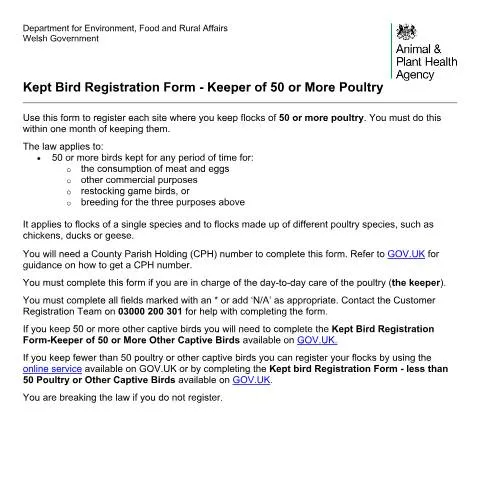
When Commercial Poultry Operations Cross the Legal Threshold
The moment your poultry flock reaches 50 birds, your hobby transforms into a legally regulated activity requiring formal registration with the Animal and Plant Health Agency (APHA). This threshold applies whether you're running a commercial egg operation, breeding game birds for shooting estates, or maintaining heritage breeds for conservation purposes. The registration requirement exists to enable rapid response during disease outbreaks, particularly avian influenza, which can devastate both commercial and wild bird populations.
Form IRA81 serves as your gateway into the official poultry keeper database, capturing essential details about your operation that authorities need for disease surveillance, movement controls, and emergency response planning. Unlike smaller-scale registrations that can be completed online, operations with 50 or more birds require this comprehensive paper form, reflecting the increased regulatory complexity and biosecurity responsibilities that come with larger flocks.
Navigating the Legal Framework Behind Poultry Registration
The registration requirement stems from EU retained legislation that remains in force post-Brexit, specifically targeting commercial-scale operations that pose higher disease transmission risks. The 50-bird threshold isn't arbitrary—it reflects scientific evidence about flock dynamics and disease spread patterns that inform veterinary surveillance strategies.
Your legal obligation begins the moment you reach 50 birds, regardless of whether this happens gradually or through a single acquisition. You have one month from reaching this threshold to submit your registration, and failure to comply constitutes a criminal offence. This strict timeline reflects the urgency of maintaining accurate disease surveillance data, particularly given the rapid transmission potential of notifiable diseases like avian influenza.
The legislation covers diverse scenarios beyond traditional farming. Game bird operations releasing pheasants or partridges for shooting, breeding programmes supplying other keepers, and even educational establishments maintaining demonstration flocks all fall within scope. The key factor is the commercial or semi-commercial nature of the activity, distinguishing it from purely domestic pet-keeping.
Understanding Your Keeper Responsibilities
As the registered keeper, you assume legal responsibility for day-to-day bird welfare and compliance with movement restrictions during disease outbreaks. This role carries specific obligations:
- Daily health monitoring and reporting suspicious symptoms to your veterinary practice
- Biosecurity maintenance including visitor logs and equipment disinfection
- Movement record keeping for birds entering or leaving your premises
- Immediate notification of increased mortality or unusual behaviour patterns
Decoding the County Parish Holding Number Requirement
Before completing form IRA81, you must obtain a County Parish Holding (CPH) number from the Rural Payments Agency. This unique identifier links your premises to the national agricultural database and enables cross-referencing with other regulatory schemes including livestock movement controls and rural payment programmes.
The CPH application process typically takes 10-15 working days, so factor this into your registration timeline. You'll need to provide detailed land ownership or tenancy documentation, Ordnance Survey grid references for your site boundaries, and evidence of your legal right to keep livestock on the premises. Temporary sites or seasonal operations may require additional documentation proving the duration and nature of your occupancy rights.
Each distinct geographical site requires its own CPH number, even if you operate multiple locations under a single business entity. This granular approach enables precise disease control measures, allowing authorities to impose targeted movement restrictions without unnecessarily affecting your entire operation.
Site Location Details and Mapping Requirements
Section 4 of the form demands precise geographical information that enables rapid emergency response. The Ordnance Survey grid reference must pinpoint your actual bird housing locations, not just your postal address. This precision matters during disease outbreaks when veterinary inspectors need to locate specific premises quickly, often in rural areas where postal codes cover large geographical areas.
Professional poultry operations often maintain birds across multiple sites within a single CPH area. Each housing location requires separate identification, including mobile housing units that rotate across different fields. The form accommodates these complex arrangements by capturing the relationship between site owners, occupiers, and bird owners—distinctions that become crucial during legal enforcement or compensation claims following disease outbreaks.
| Location Category | Required Documentation | Regulatory Significance |
|---|---|---|
| Owned premises | Land registry details | Primary liability for compliance |
| Rented/leased sites | Tenancy agreement | Shared responsibility with landowner |
| Contract farming | Service agreement | Bird owner remains liable |
| Temporary sites | Written permission | Limited duration registration |
Species Classification and Production System Complexity
Section 5 requires detailed classification of your birds according to species, production purpose, and husbandry system. This granular data enables targeted disease surveillance strategies, as different species exhibit varying susceptibility patterns to notifiable diseases. Waterfowl, for example, often carry avian influenza asymptomatically while remaining highly infectious to terrestrial poultry.
The production classification system distinguishes between commercial egg laying, meat production, breeding operations, and game bird management. Each category carries different regulatory implications during disease outbreaks. Commercial laying operations face immediate movement restrictions due to their high-density housing and frequent egg collection activities, while breeding operations may receive priority access to vaccination programmes to protect genetic resources.
Husbandry System Definitions and Compliance
The five husbandry categories reflect both animal welfare standards and disease transmission risks. Indoor systems with controlled access present lower wildlife interaction risks but higher internal transmission potential. Free-range systems face elevated wild bird contact risks, particularly during migration seasons when disease pressure intensifies.
Your chosen classification must align with marketing claims and assurance scheme requirements. Registering as "free-range" while operating indoor systems constitutes false registration and may invalidate insurance coverage or premium payments from processors. The definitions reference specific stocking densities and access requirements that must be maintained consistently, not just during inspection visits.
Seasonal Variations and Stocking Arrangement Documentation
Game bird operations typically exhibit dramatic seasonal variation, with breeding stock maintained year-round but release birds present only during specific periods. Section 6 captures these cyclical patterns that significantly impact disease surveillance requirements and emergency response planning.
Shooting estates commonly operate with minimal winter stocks, increasing to tens of thousands of birds during spring breeding and summer rearing phases. This pattern creates specific vulnerability windows when high-density populations coincide with wild bird migration periods. Accurate seasonal data enables APHA to adjust surveillance intensity and implement targeted biosecurity measures during high-risk periods.
The monthly breakdown must reflect your typical operational cycle, not exceptional years affected by disease outbreaks or market disruption. Authorities use this baseline data to identify unusual patterns that might indicate unreported mortality or illegal movements during restriction periods.
Managing Multi-Site Operations
Large-scale operators maintaining birds across multiple locations must complete separate forms for each CPH number while ensuring consistent classification approaches. Cross-contamination between sites poses significant disease amplification risks, making accurate registration essential for implementing effective movement controls.
Form Submission Channels and Processing Timelines
Form IRA81 accepts only paper submission via post or email to APHA's Customer Registration Team. This contrasts with smaller-scale registrations available through GOV.UK's online portal, reflecting the complexity and verification requirements associated with commercial operations. The postal submission requirement enables attachment of supporting documentation including CPH certificates, land tenure agreements, and veterinary practice confirmations.
Processing typically takes 10-15 working days from receipt, during which APHA may contact you for clarification or additional information. Incomplete submissions receive rejection notices requiring resubmission, potentially extending your registration beyond the legal deadline. Common deficiencies include missing CPH numbers, unclear grid references, or inconsistent contact details between different form sections.
The Customer Registration Team (03000 200 301) provides telephone support for complex situations including corporate structures, partnership arrangements, and cross-border operations. Their expertise proves particularly valuable for operators transitioning from smaller-scale registrations or establishing new commercial ventures.
Post-Registration Obligations and Updates
Registration creates ongoing obligations to maintain accurate records and notify changes promptly. Significant alterations including site relocations, ownership transfers, or production system changes require formal updates within specified timeframes. Failure to maintain current registration details may result in missed disease outbreak notifications or inappropriate emergency response measures affecting your operation's viability.
Understanding Different Bird Categories and Registration Requirements
The registration system distinguishes between various types of captive birds, each with specific requirements that keepers must understand. Commercial poultry operations typically include chickens, ducks, geese, turkeys, guinea fowl, and quail kept for egg or meat production. These birds are subject to the most stringent monitoring requirements due to their economic importance and disease transmission risks.
Ornamental waterfowl present unique challenges, as they often have access to natural water sources where wild birds congregate. Keepers of ornamental ducks, swans, or geese must implement additional biosecurity measures, particularly regarding water management and wild bird contact prevention. The registration process requires detailed information about water sources, drainage systems, and measures to prevent wild bird access to feed and water supplies.
Game birds, including pheasants, partridges, and other species raised for shooting or conservation purposes, fall under specific regulatory frameworks. These operations often involve seasonal breeding cycles and temporary housing arrangements that must be accurately reported during registration. Keepers must specify whether birds are kept permanently in captivity or released periodically, as this affects disease monitoring requirements and movement restrictions.
Racing pigeons and other competitive birds require registration when kept in flocks exceeding 50 birds. The transient nature of pigeon racing, with birds frequently travelling between locations, necessitates detailed record-keeping of movements and contacts with other flocks. Keepers must maintain comprehensive logs of racing activities, training flights, and any temporary housing arrangements at different venues.
Pet bird collections, while less common in large numbers, occasionally exceed the 50-bird threshold, particularly in breeding establishments or rescue facilities. These operations must demonstrate adequate housing standards, veterinary care arrangements, and contingency plans for emergency situations. The registration process examines the keeper's experience with avian care and their capacity to manage disease outbreaks effectively.
Biosecurity Planning and Implementation Requirements
Effective biosecurity forms the cornerstone of responsible bird keeping and represents a critical component of the registration assessment. APHA evaluators examine biosecurity plans not merely as documentation exercises but as practical, implementable strategies that demonstrate the keeper's understanding of disease prevention principles.
Physical barriers constitute the first line of defence against disease introduction. Registration requires detailed site plans showing perimeter fencing, building layouts, and access control measures. Fencing must prevent both unauthorised human access and wild bird entry, with specific attention to overhead protection in high-risk areas. Double-entry systems, including disinfection facilities and changing areas, must be clearly documented with maintenance schedules and monitoring procedures.
Feed and water management protocols require comprehensive documentation during registration. Keepers must demonstrate secure storage facilities that prevent contamination from wild birds, rodents, and other potential disease vectors. Water sources require regular testing schedules, with backup systems in place for emergency situations. The registration process examines feed supplier relationships, delivery protocols, and storage rotation systems to ensure continuous quality control.
Visitor management protocols extend beyond simple access control to encompass comprehensive risk assessment procedures. Registration documentation must detail visitor categories, from essential service providers to casual visitors, with appropriate biosecurity measures for each group. Vehicle disinfection procedures, including wheel washing and cargo area treatment, require specific protocols with monitoring and record-keeping requirements.
Waste management systems demand particular attention during registration, as improper disposal can create significant disease risks. Keepers must document mortality disposal procedures, manure management systems, and contaminated material handling protocols. Composting operations require temperature monitoring, turning schedules, and pathogen reduction verification procedures that demonstrate effective treatment of potentially infectious materials.
Emergency response procedures form an integral part of biosecurity planning, requiring detailed protocols for suspected disease outbreaks, natural disasters, and supply chain disruptions. Registration assessors examine contingency plans for emergency slaughter, quarantine procedures, and communication protocols with veterinary authorities. These plans must demonstrate realistic resource allocation and clear decision-making hierarchies for crisis situations.
Ongoing Compliance and Regulatory Changes
Registration represents the beginning rather than the conclusion of regulatory compliance, establishing ongoing obligations that evolve with changing circumstances and regulatory updates. Keepers must maintain continuous awareness of legislative changes, particularly those affecting animal health, environmental protection, and food safety standards.
Annual compliance reviews require systematic evaluation of all operational aspects, from biosecurity effectiveness to record-keeping accuracy. These internal assessments should identify potential compliance gaps before they become regulatory violations. Keepers must maintain documentation demonstrating regular review processes, corrective action implementations, and continuous improvement initiatives that exceed minimum regulatory requirements.
Staff training programs require ongoing development to address changing regulations, emerging disease threats, and operational modifications. Registration establishes baseline competency requirements, but keepers must implement continuing education programs that maintain and enhance staff capabilities. Training records must demonstrate regular updates covering new biosecurity protocols, emergency procedures, and regulatory changes affecting daily operations.
Veterinary relationships extend beyond basic health monitoring to encompass comprehensive herd health management and regulatory compliance support. Registered keepers must maintain current veterinary service agreements that provide adequate coverage for routine monitoring, emergency situations, and regulatory inspections. These relationships should include regular health planning sessions, vaccination program reviews, and biosecurity assessment updates.
Technology integration increasingly supports compliance monitoring, with digital record-keeping systems, automated monitoring equipment, and electronic reporting capabilities enhancing accuracy and efficiency. Keepers should evaluate technological solutions that streamline compliance while improving operational effectiveness. However, technology implementations must include backup systems and manual procedures for equipment failures or system malfunctions.
Industry networking provides valuable insights into best practices, regulatory interpretations, and emerging challenges affecting bird keepers. Professional associations, producer groups, and veterinary networks offer resources that supplement official guidance and provide practical implementation strategies. Registered keepers benefit from participating in industry forums that share experiences and develop collective approaches to regulatory challenges.
Environmental monitoring requirements continue expanding, with increasing emphasis on water quality, soil contamination, and air quality impacts. Registered operations must demonstrate environmental stewardship that exceeds minimum compliance standards, incorporating sustainable practices that protect local ecosystems while maintaining productive operations. These efforts require ongoing monitoring, documentation, and adaptive management strategies that respond to changing environmental conditions.