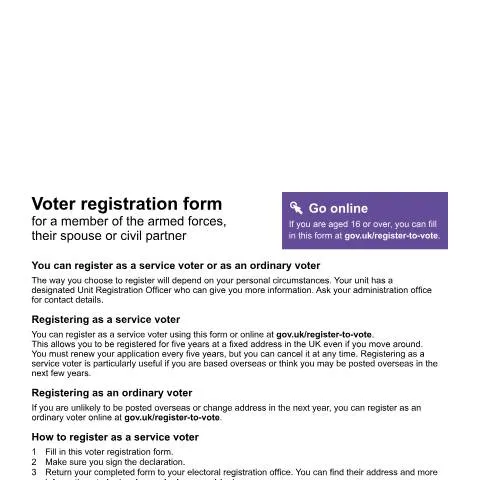
Understanding the Importance of the Armed Forces Voter Registration Form
When you are a member of the armed forces, your voting rights are an essential aspect of your civic duties, even when you're stationed far from home. The Register to vote as a member of the armed forces - paper form is a crucial document that helps facilitate your participation in the democratic process. Filling out this form correctly ensures that you remain engaged with your home country's political landscape, even while serving abroad or at various bases within the UK.
Who Needs to Use This Form? A Closer Look
The armed forces voter registration form is specifically designed for:
- Members of the armed forces: This includes individuals serving in the Royal Navy, Army, and Royal Air Force.
- Spouses and civil partners: Family members of service personnel who wish to register alongside them are also eligible to use this form.
Your eligibility to register as a service voter or an ordinary voter will depend on your current circumstances, such as whether you are likely to move overseas or change your residential address in the near future.
The Distinction Between Service Voter and Ordinary Voter Registration
Understanding the difference between these two voter registration types is vital for making an informed decision:
| Type of Registration | Description | Duration | Best for |
|---|---|---|---|
| Service Voter | Allows registration at a fixed UK address for service personnel. | Five years, renewable. | Those who will be posted overseas or may frequently move. |
| Ordinary Voter | Standard registration for residents. | Indefinite until a change of address or status. | Those who are settled and unlikely to change their residence soon. |
Choosing the correct registration type is essential as it impacts your ability to vote in upcoming elections, especially if you anticipate being abroad.
Preparing to Fill Out the Form: What You Need
When preparing to complete the armed forces voter registration form, gather the following information and documentation:
- Personal details: Full name, current UK address, and correspondence address if different.
- Service information: Rank or rating, service number, and regiment or corps details.
- Nationality and immigration status: Ensure you understand your nationality and any relevant immigration status, especially if you are an EU citizen.
- Date of birth: This is essential for verifying your eligibility.
- National Insurance number: This may be found on payslips or official correspondence regarding tax or benefits.
Having these details at hand will streamline the registration process and minimize errors.
Step-by-Step Guide to Completing the Form
Follow these detailed steps to ensure your voter registration form is filled out accurately:
- Section One: Begin by entering your name and current address. This is crucial for establishing your eligibility.
- Section Two: State your nationality, including all if you hold multiple.
- Section Three: If applicable, complete the immigration status section, particularly if you are an EU citizen.
- Section Four: If you have changed your name, provide your previous name and the date of the change.
- Section Five: Indicate if you have lived at any other address in the past year.
- Section Six: Fill in your service details, including your rank and service number.
- Section Seven: Provide your date of birth.
- Section Eight: Enter your National Insurance number.
- Section Nine: Include your contact number and email to facilitate communication regarding your application.
- Final Step: Sign and date the declaration to confirm that all information provided is accurate.
Double-check all entries for accuracy and completeness before submission.
Submitting the Form: Your Options Explained
Once your form is completed, you have several options for submission, each with its own set of considerations:
- By Mail: Send your completed form directly to your local electoral registration office. Ensure that you have the correct address and postage to avoid delays.
- In-Person: If you prefer, you can deliver the form directly to your local electoral office. This option allows for immediate confirmation that your application has been received.
- Online Alternative: If you are eligible, consider applying online at gov.uk/register-to-vote. This method is quick and often expedites processing times.
Timelines: Key Dates and What to Expect Next
Understanding the timeline for voter registration is crucial to ensure your participation in upcoming elections:
- Registration Deadlines: You must register before the deadline set by the electoral commission for the upcoming election. This is typically a few weeks before the election date.
- Processing Time: Once submitted, it can take a few weeks for your application to be processed. Check with your local electoral office for specific timelines.
- Notification: You will receive confirmation of your registration by mail. If there are any issues, the electoral office will contact you for clarification.
Be proactive—submit your application as soon as possible to ensure your eligibility to vote.
Special Considerations: Handling Complex Situations
Every service member's situation is unique, and certain circumstances may require special attention:
- Overseas Service: If stationed abroad, register as a service voter to maintain a fixed address for voting purposes.
- Changing Addresses: If you move frequently, ensure that you update your registration to reflect your current details; otherwise, it may affect your voting eligibility.
- Spouses of Service Members: Spouses may register using the same form; however, they must include their partner's service details.
- Age Considerations: If under 18, you can still register but will not be eligible to vote until you reach voting age.
In complex situations, don't hesitate to reach out to your Unit Registration Officer for assistance.
The Path Ahead: After Registration
Once your application is submitted and processed, here’s what comes next:
- Voting Information: You will receive information regarding upcoming elections and how to cast your vote, whether by mail or in person.
- Staying Informed: Keep abreast of any changes to registration rules or electoral processes, especially as they pertain to military personnel.
- Renewal Period: Remember to renew your service voter registration every five years to maintain your eligibility.
Your engagement in the voting process strengthens democracy and gives you a voice in the issues that matter most.
Understanding Your Eligibility to Vote as a Member of the Armed Forces
Before registering to vote, it’s essential to establish your eligibility, particularly as a member of the armed forces. In the UK, you are eligible to register if you are:
- A British citizen, a citizen of the Republic of Ireland, or a Commonwealth citizen who has leave to remain in the UK or does not require leave to remain.
- At least 16 years old (or 14 in Scotland), but you can only vote when you are 18 or over.
- Serving in the regular armed forces or in a reserve force.
If you're currently deployed or stationed abroad, you still retain your right to vote. However, you will need to complete the special provisions set for military personnel. This includes registering at your home address or using the address of your unit if you have no permanent address.
It’s also important to note that while you can register from abroad, the voting process may differ if you are stationed outside the UK. You will need to apply for an overseas voter registration, which can be done through the local diplomatic mission or using the appropriate form from GOV.UK.
Completing the Paper Form for Registration
The paper form for registering to vote is straightforward but requires attention to detail. You can request a paper form through your unit or download it from the Electoral Commission website. Here’s a step-by-step guide to filling it out:
- Personal Information: This includes your name, address, date of birth, and National Insurance number. Ensure the information matches official records.
- Service Details: You should indicate your service branch (Army, Navy, or Air Force) and, if applicable, your service number. This information helps electoral officials verify your identity.
- Address Confirmation: If you are registering from a service address, clearly state this. If unsure, consult your unit administration about where you should register.
- Signature: Don’t forget to sign the form to validate your registration. An unsigned form may be rejected.
Once you have completed the form, return it to your local Electoral Registration Office (ERO). You can find the address on the GOV.UK website.
Deadlines and Special Considerations for Armed Forces Members
When registering to vote, be mindful of deadlines, especially for armed forces members. The general deadline for voter registration is typically set around a few weeks before an election. However, for military personnel, there are additional considerations:
- When stationed abroad, you may have different timelines. To ensure that you are registered in time to vote from overseas, it’s best to submit your application as soon as elections are announced.
- If you are deployed during an election period, your unit may have provisions to help you register and vote, including postal voting arrangements.
- Changes in your service status (e.g., re-deployment, change of unit) should be communicated to your local ERO to ensure your registration remains current.
Always check the latest updates on election dates and registration deadlines through the GOV.UK site, as these can occasionally change due to political or administrative reasons.