Commercial Keepers of Protected Wild Birds: The Schedule 4 Registration Process
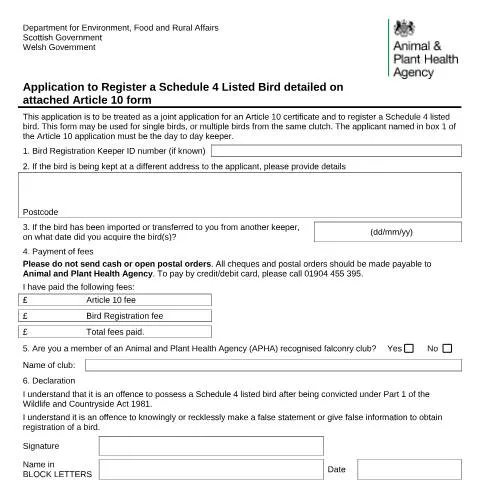
In the specialist world of falconry and raptor breeding, the distinction between lawful commercial keeping and illegal wildlife possession hinges on proper registration with the Animal and Plant Health Agency. The Schedule 4 bird registration system represents a dual-purpose framework that simultaneously grants Article 10 certification under CITES regulations whilst establishing legitimate keeper credentials for some of Britain's most protected wild bird species.
This registration process affects a relatively narrow but commercially significant segment of the wildlife keeping community. Unlike basic pet bird ownership or casual wildlife rehabilitation, Schedule 4 registration specifically targets those who maintain protected species for commercial purposes – whether that involves breeding programmes, educational displays, falconry training services, or conservation breeding initiatives.
The regulatory framework draws its authority from the Wildlife and Countryside Act 1981, which designates certain bird species as requiring special protection due to their conservation status, rarity, or vulnerability to exploitation. These Schedule 4 species cannot simply be kept by anyone; they demand formal recognition of keeper competency and legitimate purpose.
The Intersection of CITES and Domestic Wildlife Law
What makes this registration particularly complex is its dual nature as both a CITES Article 10 certificate application and a domestic Schedule 4 registration. This convergence reflects the reality that many protected British birds also fall under international trade regulations, requiring documentation that satisfies both domestic wildlife protection laws and international conservation treaties.
The Article 10 certificate serves as proof that specimens were legally acquired and may be lawfully kept, bred, or in some cases traded. For commercial keepers, this becomes essential documentation when dealing with breeding stock, offspring sales, or even temporary transfers between facilities. Without proper Article 10 certification, possession of many Schedule 4 species constitutes a criminal offence regardless of the keeper's intentions or expertise.
APHA processes these applications as joint submissions, recognising that commercial keepers typically require both forms of authorisation simultaneously. This streamlined approach prevents the administrative burden and potential confusion of separate application processes, though it does mean that applicants must satisfy the requirements of both regulatory frameworks from the outset.
Keeper Qualifications and Recognition Pathways
The registration system acknowledges different levels of keeper expertise and institutional affiliation. APHA-recognised falconry clubs represent one pathway to demonstrating competency, with membership serving as evidence of ongoing training, peer oversight, and adherence to established keeping standards.
However, club membership isn't mandatory. The system also accommodates independent commercial keepers who can demonstrate appropriate facilities, experience, and legitimate commercial purpose through other means. This flexibility recognises that commercial wildlife keeping encompasses various models, from traditional falconry centres to modern conservation breeding facilities.
The requirement that the applicant must be the "day to day keeper" establishes clear accountability. This prevents situations where registration might be obtained by one party whilst actual bird care responsibilities rest elsewhere. For commercial operations, this means that the person signing the application must have direct, ongoing responsibility for the birds' welfare and management.
| Keeper Category | Recognition Method | Additional Requirements |
|---|---|---|
| Club-affiliated falconers | APHA-recognised club membership | Club training standards compliance |
| Independent commercial keepers | Demonstrated expertise and facilities | Business purpose documentation |
| Conservation breeding facilities | Scientific or conservation credentials | Breeding programme documentation |
Financial Obligations and Payment Processing
The fee structure reflects the dual nature of this registration, with separate charges for the Article 10 certificate and the Schedule 4 registration itself. Applicants must pay both fees as part of their submission, though the specific amounts aren't detailed on the form itself – these vary depending on species, number of birds, and other factors determined by current APHA fee schedules.
Payment processing follows standard government protocols: no cash or open postal orders accepted, with cheques made payable to the Animal and Plant Health Agency. For those preferring electronic payment, a dedicated telephone line (01904 455 395) handles credit and debit card transactions. This payment method often proves more convenient for commercial operations managing multiple registrations or regular renewals.
The requirement to declare total fees paid serves both administrative and verification purposes. It ensures applicants understand the full cost of their submission whilst providing APHA with a cross-reference against payments received. Incomplete payment typically results in application delays or rejection, making accurate fee calculation essential before submission.
Transfer Documentation and Acquisition Records
Section 3 of the registration form addresses a critical aspect of commercial bird keeping: the chain of custody for protected species. When birds are imported or transferred between keepers, precise documentation of acquisition dates becomes legally significant. This information helps establish the legitimacy of possession whilst creating an audit trail for regulatory compliance.
For commercial operations, transfer documentation often involves complex scenarios. Imported birds may require additional CITES import permits and health certificates, whilst domestic transfers between registered keepers must maintain continuous legal possession status. The date format requirement (dd/mm/yy) follows standard UK conventions, avoiding potential confusion in international contexts.
Birds acquired from multiple sources or at different times may require separate documentation, though the form allows for multiple birds from the same clutch to be processed together. This accommodation recognises the realities of breeding operations where clutch-mates are typically managed as a group whilst maintaining distinct individual identities for registration purposes.
Geographic Variations and Multi-Location Operations
The registration system accommodates the reality that commercial keeping operations may span multiple locations. Section 2 specifically addresses situations where birds are kept at addresses different from the applicant's registered location. This flexibility proves essential for operations involving multiple facilities, temporary housing arrangements, or partnership agreements.
However, this flexibility comes with accountability requirements. Different keeping locations must still meet appropriate housing and security standards, and the registered keeper remains responsible for bird welfare regardless of physical location. For insurance and inspection purposes, accurate address information becomes crucial for both the keeper and APHA.
The postcode requirement reflects the importance of precise location identification for enforcement and inspection purposes. Rural locations, in particular, may present addressing challenges that postcodes help resolve. Commercial operations should ensure that keeping locations are accessible to APHA inspectors and clearly identifiable from provided address information.
Legal Declarations and Compliance Responsibilities
The declaration section establishes clear understanding of legal responsibilities and potential consequences. Two specific acknowledgments are required: understanding that Schedule 4 bird possession becomes illegal following conviction under the Wildlife and Countryside Act 1981, and recognition that false statements or information constitute criminal offences.
These declarations aren't mere formalities. They establish legal knowledge and intent, potentially relevant in any future enforcement proceedings. For commercial keepers, understanding these responsibilities extends beyond personal compliance to staff training and operational procedures. Conviction under wildlife protection legislation can effectively end a commercial keeping career, making compliance systems essential for business continuity.
The requirement for signature, printed name, and date creates a formal legal record. For corporate applications, this typically requires signature by an authorised representative with appropriate authority to bind the organisation. Partnership operations may need to clarify which partner holds ultimate responsibility for compliance obligations.
Submission Procedures and Processing Expectations
Applications are processed through APHA's Centre for International Trade in Bristol, reflecting the international trade dimensions of many Schedule 4 species. The specific address (Horizon House, Deanery Road, Bristol BS1 5AH) handles all Schedule 4 registrations regardless of the applicant's location within the UK.
Before submission, applicants must complete "box 4 of the Article 10 form" – additional documentation requirements that vary depending on species and circumstances. The guidance reference to gov.uk/bird-registration provides current information on these variable requirements, though applicants should verify current guidance at the time of application rather than relying on cached or outdated information.
Processing times aren't specified on the form, reflecting the variable complexity of different applications. Simple registrations for common Schedule 4 species with clear documentation may process relatively quickly, whilst complex cases involving rare species, unusual circumstances, or incomplete documentation can take considerably longer. Commercial operations planning breeding programmes or seasonal activities should factor potential processing delays into their operational timelines.
The data protection notice acknowledges that multiple government departments may access application information, reflecting the cross-departmental nature of wildlife regulation. For commercial keepers, this means that registration information may be shared between DEFRA, Scottish Government, Welsh Government, and Food Standards Agency as appropriate for regulatory purposes. This information sharing facilitates coordinated enforcement and policy development but also means that registration creates a comprehensive regulatory footprint extending beyond APHA alone.
Schedule 4 Registration Requirements by Bird Category
The Schedule 4 classification system operates on a tiered approach, with different registration requirements depending on the specific species and your intended commercial activities. Category A birds, which include certain birds of prey like peregrine falcons and goshawks, require the most stringent documentation and often need individual ring registration with detailed provenance records.
For Category B species, such as some owl varieties used in falconry displays, you'll need to demonstrate lawful acquisition through breeding records or import certificates. The Animal and Plant Health Agency (APHA) may request veterinary health certificates dating back to the bird's hatching or import, particularly if you're planning educational displays or breeding programmes.
Commercial breeders working with multiple Schedule 4 species face additional complexity. You must maintain separate registration documentation for each species category, even if housed in the same facility. Cross-breeding between different Schedule 4 species requires advance notification to APHA, as offspring may inherit different classification requirements depending on the parent species' conservation status.
Seasonal considerations also affect registration validity. Birds used for seasonal falconry demonstrations during summer months may require temporary registration amendments if you're transporting them to different counties for shows or educational events. Each venue change exceeding 30 days typically requires notification to your local APHA office, particularly if crossing into Scotland or Wales where additional devolved regulations may apply.
The microchipping requirement varies significantly between species. Smaller Schedule 4 birds like certain finch species may be exempt from microchipping due to size constraints, but require closed-ring identification instead. Larger species, particularly raptors, must be microchipped using ISO-compliant chips readable by standard veterinary scanners. The microchip number becomes your primary reference for all future correspondence with APHA.
Commercial Activity Restrictions and Permitted Uses
Schedule 4 registration doesn't grant blanket commercial permissions – your activities remain constrained by specific use categories defined in your application. Educational demonstrations represent the most common commercial use, but require advance booking confirmations and public liability insurance details when applying. Schools and wildlife centres booking your services may request copies of your Schedule 4 certificates before confirming educational visits.
Breeding for commercial sale operates under stricter oversight. You must notify APHA within 14 days of any successful breeding, providing parent bird registration numbers and expected hatching dates. Offspring inherit Schedule 4 status automatically, but require individual registration before reaching 12 weeks of age or before any commercial transaction, whichever occurs first.
Photography and film work presents unique challenges for Schedule 4 bird keepers. Media productions often require birds to work in unfamiliar environments, potentially causing stress that could impact welfare standards. Your registration may include specific conditions about transport duration, working hours, and mandatory rest periods between filming sessions. Location shoots exceeding three days typically require advance notification to APHA, including veterinary contact details for the filming location.
Falconry training services represent a growing commercial sector, but Schedule 4 birds used for training novice falconers must meet additional temperament assessments. Birds showing signs of stress or aggression during training sessions may have their commercial use suspended pending welfare evaluation. You're required to maintain detailed logs of training sessions, including participant details and any incidents involving bird behaviour or handling.
International exhibition participation requires separate CITES documentation alongside your Schedule 4 registration. European Union events may need additional health certificates issued within 10 days of travel, while exhibitions in non-EU countries often require quarantine arrangements upon return. The complexity of international regulations means many commercial keepers limit activities to domestic venues to avoid bureaucratic complications.
Retail sales of Schedule 4 birds operate under particularly strict conditions. Buyers must demonstrate appropriate facilities and experience before purchase completion. You're legally required to verify purchaser credentials, including relevant licences and insurance coverage, before transferring ownership. Failed sales due to inadequate buyer preparation can result in extended housing costs, making thorough pre-sale screening essential for commercial viability.
Ongoing Compliance and Inspection Protocols
Schedule 4 registration triggers ongoing inspection obligations that extend far beyond initial approval. Routine inspections typically occur annually but can increase to quarterly intervals if previous inspections identified compliance concerns. APHA inspectors have legal authority to examine birds, facilities, and records without prior appointment, though they usually provide 24-48 hours' notice for routine visits.
Your record-keeping obligations encompass daily welfare logs, veterinary treatment records, and detailed movement documentation. Daily logs must include feeding schedules, behavioural observations, and environmental conditions like temperature and humidity readings. Any deviation from normal behaviour patterns requires immediate documentation, with veterinary consultation recommended for symptoms persisting beyond 48 hours.
Veterinary relationships prove crucial for maintaining compliance standards. Your nominated veterinary practice should have exotic bird expertise and availability for emergency consultations outside normal hours. Annual health assessments are mandatory for most Schedule 4 species, with additional examinations required following any illness or injury. Veterinary reports become part of your permanent compliance record and may be requested during inspections.
Facility modifications require advance approval through APHA's variation application process. Simple improvements like additional perching or shelter additions typically receive approval within 14 days, but structural changes affecting flight space or security measures may require site re-inspection before approval. Planning permission for commercial aviaries often runs parallel to Schedule 4 requirements but operates under separate local authority procedures.
Insurance coverage extends beyond basic public liability to include specialist exotic animal coverage. Your policy should cover veterinary treatment costs, facility damage, and potential compensation for bird loss or injury. Some insurers require annual facility inspections by approved assessors, adding another layer of compliance monitoring to your operational calendar.
Staff training requirements become particularly relevant for larger commercial operations. Anyone handling Schedule 4 birds must demonstrate competency through recognised training programmes or documented experience with similar species. Staff turnover can disrupt compliance if replacement handlers lack appropriate qualifications, making ongoing training investment essential for operational continuity.
Technology integration increasingly supports compliance monitoring. Digital record-keeping systems can streamline daily logging requirements, while environmental monitoring equipment provides continuous data for temperature, humidity, and lighting conditions. However, backup paper systems remain necessary as inspectors may not accept purely digital records without verified backup procedures.