Schedule 4 Birds: The Regulatory Framework Behind Registration
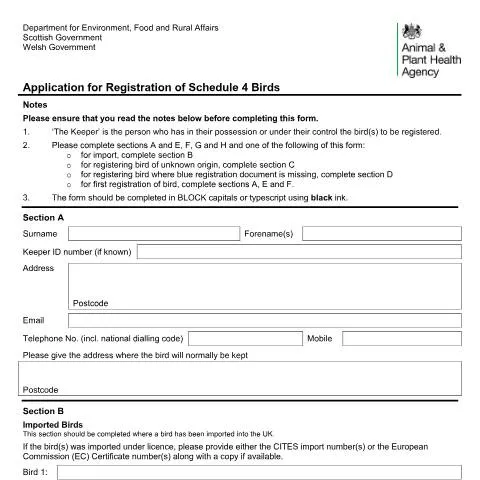
The Wildlife and Countryside Act 1981 establishes a strict licensing regime for certain bird species, with Schedule 4 containing those requiring individual registration. This Application for Registration of Schedule 4 Birds form (REG01) represents a crucial legal requirement for anyone keeping birds such as barn owls, peregrine falcons, goshawks, or other protected raptors. The Animal and Plant Health Agency administers this system to monitor captive populations of species that face conservation pressures or have been subject to illegal trade.
Unlike general pet licensing, Schedule 4 registration creates a permanent record linking each individual bird to its keeper through detailed identification markers. The system serves multiple purposes: preventing the laundering of wild-caught birds into captivity, maintaining genetic records for conservation breeding programmes, and providing authorities with oversight of species that could impact wild populations if released or escaped.
The form's reference REG01 (Rev. 05/18) indicates regular updates to reflect evolving conservation needs and enforcement priorities. Each registration generates a unique identification that follows the bird throughout its captive life, creating an unbroken chain of custody essential for legal compliance.
Navigating the Multi-Path Application Structure
The form's sophisticated branching structure accommodates four distinct scenarios, each requiring specific sections to be completed. This design reflects the complex realities of Schedule 4 bird keeping, where birds may enter captivity through various legal channels or require registration due to changing circumstances.
| Scenario | Required Sections | Key Documentation |
|---|---|---|
| Imported birds | A, B, E, F, G, H | CITES permit or EC Certificate |
| Unknown origin | A, C, E, F, G, H | Detailed provenance statement |
| Lost registration document | A, D, E, F, G, H | Previous keeper details, EC Certificate copy |
| First-time registration | A, E, F, G, H | Breeding records or acquisition proof |
Section A captures the keeper's identity and contact details, including the critical distinction between the keeper's address and where the bird will normally be kept. This separation acknowledges that many Schedule 4 birds are housed in specialised facilities rather than domestic premises. The Keeper ID number field links to existing registrations, streamlining the process for experienced keepers adding birds to their collection.
The requirement for both landline and mobile telephone numbers reflects APHA's need for immediate contact during inspections or emergency situations. Email provision has become increasingly important for routine correspondence and renewal notifications.
Import Documentation and CITES Compliance
Section B addresses imported birds, requiring either CITES import numbers or European Commission Certificate numbers with accompanying copies. This section recognises that many Schedule 4 species are internationally protected, making their legal import status fundamental to domestic registration eligibility.
The provision for up to four birds per application reflects commercial breeding operations and conservation programmes that may import multiple specimens simultaneously. Each bird entry must be supported by individual documentation, creating a comprehensive audit trail from international movement through to domestic registration.
CITES import numbers follow specific formatting conventions that APHA staff verify against international databases. Applicants must ensure these numbers correspond exactly to those on official import permits, as discrepancies trigger detailed investigations that can delay registration for months.
European Commission Certificate numbers serve a similar function for movements within the EU framework, though post-Brexit arrangements have modified some procedural aspects. The requirement to provide copies ensures APHA maintains permanent records even if original documents are subsequently lost or damaged.
Unsourced Birds and the Provenance Challenge
Section C confronts one of the most complex aspects of Schedule 4 enforcement: birds of unknown or uncertain origin. This section becomes necessary when keepers cannot provide clear documentation of legal acquisition, often arising from informal transfers, inheritance situations, or long-term captive birds predating current record-keeping requirements.
The open text field asking "How did the bird come into your possession?" requires careful completion, as APHA investigators scrutinise these explanations for consistency and plausibility. Vague or contradictory statements can trigger enforcement action, while detailed, honest accounts often receive sympathetic consideration.
Common scenarios include birds inherited from deceased relatives, acquired through rescue organisations without proper documentation, or obtained during periods when registration requirements were less stringent. The form's instruction to provide more details on a separate sheet if necessary acknowledges that complex histories may require extensive explanation.
APHA may conduct additional investigations for unsourced birds, including site visits, interviews with previous keepers, and consultation with conservation organisations. This process can extend registration timescales significantly, making thorough initial documentation essential.
Documentation Strategies for Complex Cases
- Gather witness statements from individuals familiar with the bird's history
- Compile photographic evidence showing the bird's development in captivity
- Obtain veterinary records demonstrating ongoing care and captive status
- Research historical breeding records that might establish legitimate origins
Transfer of Ownership Protocols
Section D manages ownership transfers where the blue registration document has been misplaced, creating a gap in the custody chain that requires careful reconstruction. This situation frequently arises in private sales where sellers fail to transfer documents properly or in emergency rehoming situations.
The section captures comprehensive details about the previous keeper, including their Keeper ID number if known. This information enables APHA to cross-reference existing records and verify the legitimacy of the transfer. The checkbox system for acquisition method—Sale, Hire, Loan, Barter, Exchange, Gift, Return—ensures precise documentation of the transfer mechanism.
Each acquisition method carries different legal implications. Sales require evidence of payment and often trigger questions about the seller's authority to dispose of the bird. Loans maintain the original keeper's ultimate responsibility, while gifts may face scrutiny regarding the giver's motivations and the recipient's suitability.
The requirement for EC Certificate numbers in transfer situations reflects APHA's need to maintain continuity with international movement records. Even domestic transfers must demonstrate connection to legally imported birds, preventing the introduction of illegally acquired specimens into the registered population.
Bird Identification and Biological Data Requirements
Section E demands precise biological and identification data for each bird, creating the detailed records essential for effective monitoring. The species field must use correct scientific nomenclature, as common names can be ambiguous or vary regionally. Sex determination proves crucial for breeding programme management and population monitoring.
Hatch dates establish the bird's age and breeding potential, while acquisition dates create timeline records for enforcement purposes. The gap between these dates can indicate the bird's journey through captivity, with extended periods potentially raising questions about intermediate custody.
Close ring numbers or microchip numbers provide unique identification linking each bird to specific records. Close rings, fitted while chicks are very young, cannot be removed without injury, making them highly reliable identification markers. Microchips offer permanent identification for birds not close-ringed, though implantation must be performed by qualified veterinarians.
The provision for four birds per application accommodates small-scale breeding operations while preventing the system from being overwhelmed by large commercial applications. Larger operations typically submit multiple forms or work directly with APHA on specialised submission procedures.
Common Identification Challenges
- Damaged or illegible rings: Requires veterinary confirmation and detailed photographic evidence
- Missing microchip records: Necessitates re-scanning and database verification
- Sex determination difficulties: May require DNA testing for monomorphic species
- Uncertain hatch dates: Needs veterinary age assessment and supporting documentation
Criminal Record Declarations and Enforcement History
Section F addresses the keeper's criminal history, specifically focusing on wildlife-related offences that might disqualify them from keeping Schedule 4 birds. This section reflects APHA's responsibility to ensure registered birds remain with suitable keepers who respect conservation laws.
The five-year lookback period for Part 1 Wildlife and Countryside Act offences acknowledges that wildlife crime convictions indicate elevated risk of future violations. Special penalty offences, typically involving commercial-scale illegal activities or repeat violations, carry particular weight in APHA's assessment process.
The broader second question encompasses any wildlife-related offences or animal ill-treatment cases, recognising that animal welfare concerns extend beyond specific wildlife legislation. Positive responses trigger detailed review processes that may include character references, rehabilitation evidence, and enhanced monitoring conditions.
Applicants answering "Yes" to either question must provide comprehensive details on separate sheets, including court records, sentence details, and evidence of rehabilitation. APHA's assessment considers the nature of offences, time elapsed, and demonstrated commitment to legal compliance.
Legal Warning: False declarations constitute criminal offences that can result in prosecution, immediate registration revocation, and permanent disqualification from keeping protected species.
Payment Mechanisms and Club Membership Benefits
Section G outlines payment procedures while highlighting membership benefits available through recognised organisations. The prohibition on cash or open postal orders reflects security concerns and audit requirements, with cheques and postal orders made payable to the Animal and Plant Health Agency providing traceable payment records.
Club membership details serve multiple purposes beyond fee reduction. Recognised clubs typically maintain high standards of bird keeping, provide ongoing education, and offer peer support networks that improve welfare outcomes. APHA's recognition of organisations like BIAZA (British and Irish Association of Zoos and Aquariums) reflects their professional standards and conservation contributions.
The membership date field enables APHA to verify eligibility for reduced fees, while club membership numbers facilitate direct verification with organisations. Some clubs provide additional services like veterinary networks, breeding coordination, and emergency rehoming assistance that benefit both keepers and conservation objectives.
Fee Structure Considerations
While the form does not specify exact amounts, registration fees typically reflect administrative costs and enforcement expenses. Reduced fees for club members recognise their enhanced commitment to proper bird keeping and the reduced regulatory burden they represent. Fee levels are reviewed periodically to ensure cost recovery while maintaining accessibility for legitimate keepers.
Submission Procedures and Processing Expectations
The final administrative section establishes submission procedures through APHA's Bristol office, reflecting centralised processing that ensures consistent application of registration criteria. The specific address—Centre for International Trade, Bristol, Horizon House, Deanery Road, BS1 5AH—handles all Schedule 4 registrations regardless of the keeper's location.
Declaration requirements emphasise the legal significance of registration applications, with specific warnings about false declarations and their criminal consequences. The over-18 age requirement for keepers, with parental signatures required for younger applicants, reflects the serious responsibilities involved in keeping protected species.
Data protection references to www.gov.uk and the Animal and Plant Health Agency Personal Information Charter ensure applicants understand how their personal information will be processed and stored. This transparency supports compliance with UK GDPR requirements while maintaining the confidentiality essential for enforcement activities.
Processing timescales vary significantly depending on application complexity, with straightforward renewals typically processed within weeks while complex cases involving unsourced birds or criminal history declarations may require months of investigation. APHA's commitment to thorough assessment reflects the conservation importance of maintaining accurate, reliable registration records that support both legal compliance and wildlife protection objectives.
Post-Submission Responsibilities
Successful registration creates ongoing obligations including annual returns, change of circumstances notifications, and compliance with inspection requirements. The registration certificate becomes a legal document that must accompany the bird in any transfer situations, creating a continuous chain of custody that supports long-term conservation monitoring and enforcement effectiveness.
Breeding Schedule 4 Birds: Special Considerations and Record-Keeping
Breeding Schedule 4 birds introduces additional layers of regulatory complexity beyond basic registration requirements. The Animal and Plant Health Agency (APHA) requires comprehensive breeding records that demonstrate the lawful origin of parent birds and track offspring through detailed lineage documentation.
For each breeding pair, you must maintain records showing:
- Registration numbers of both parent birds
- Date of pairing and breeding season details
- Number of eggs laid and hatching success rates
- Individual identification of offspring (typically through closed rings)
- Any veterinary interventions during breeding or rearing
Closed ringing requirements are particularly stringent for Schedule 4 species. Rings must be fitted within the first 10 days of hatching when the bird's foot is still small enough for the seamless ring to pass over. The ring size must correspond exactly to the species - using incorrect ring sizes can result in prosecution for attempting to circumvent identification requirements.
Breeding records become especially critical when offspring reach maturity. Each young bird requires individual registration, supported by documentation proving its captive-bred status. APHA inspectors may cross-reference breeding records with ring databases maintained by recognised organisations such as the Avicultural Society or species-specific clubs.
Commercial breeders face additional scrutiny. If you're selling Schedule 4 birds, even occasionally, APHA may require evidence of your breeding programme's legitimacy through:
- Multi-generational breeding records spanning several years
- Veterinary health certificates for breeding stock
- Proof of genetic diversity measures to prevent inbreeding
- Documentation of any birds acquired from other licensed breeders
Hybrid birds present particular challenges. Crosses between Schedule 4 species and common species may still require registration if they retain characteristics of the protected parent. APHA guidance suggests treating any hybrid involving Schedule 4 genetics as requiring registration until proven otherwise through expert assessment.
Transport, Transfer and Movement Documentation
Moving Schedule 4 birds between locations triggers specific documentation requirements that extend far beyond simple ownership transfer. Whether relocating your collection, selling to another keeper, or transporting birds for veterinary treatment, each movement must be properly recorded and, in many cases, pre-authorised.
Temporary movements for veterinary care require notification to APHA if the bird will be away from its registered location for more than 7 days. The receiving veterinary practice must be informed of the bird's Schedule 4 status, and treatment records become part of the official documentation trail.
For permanent transfers, both parties bear responsibility for ensuring proper documentation. The seller must provide:
- Copy of the bird's registration certificate
- Article 10 certificate (for CITES species)
- Complete breeding history if captive-bred
- Veterinary health records
- Written confirmation of legal acquisition
The buyer must notify APHA of the acquisition within 28 days, providing evidence of the transfer and updating registration records with the new location. Failure to complete this notification process can result in both parties facing prosecution for unlawful possession.
Interstate transport within the UK requires consideration of different jurisdictions. While Schedule 4 applies across England, Scotland, Wales and Northern Ireland, specific transport regulations may vary. Scottish Natural Heritage, Natural Resources Wales, and the Department of Agriculture, Environment and Rural Affairs (Northern Ireland) may impose additional requirements for birds moving across borders.
International movements face the additional complexity of CITES regulations. Most Schedule 4 birds are also CITES-listed species, requiring export permits from APHA and import permits from destination countries. These permits must be obtained before travel, and the process can take several weeks. Emergency movements (such as for urgent veterinary treatment abroad) may qualify for expedited processing, but this requires compelling evidence of necessity.
Transport containers must meet International Air Transport Association (IATA) standards for live animal transport, even for domestic movements. APHA inspectors may examine transport conditions during routine checks, and inadequate containment can result in animal welfare charges alongside registration violations.
Enforcement Actions and Legal Consequences
Understanding the enforcement landscape for Schedule 4 violations helps keepers appreciate the serious nature of registration requirements. APHA employs specialist wildlife crime investigators who work closely with police wildlife crime officers to pursue prosecutions under the Wildlife and Countryside Act 1981.
Investigation triggers often stem from:
- Reports from members of the public observing unusual birds
- Intelligence from wildlife trade monitoring networks
- Cross-referencing of import/export records with registration databases
- Routine inspections that reveal discrepancies
- Information sharing between APHA and other law enforcement agencies
When investigators suspect Schedule 4 violations, they possess extensive powers under warrant to:
- Enter and search premises where birds are kept
- Examine all birds and their accommodation
- Seize birds, equipment, and documentation as evidence
- Interview keepers under caution
- Access financial records to trace bird purchases
Seizure procedures can be particularly distressing for keepers. Birds taken as evidence are typically housed at specialist facilities pending legal proceedings, which may continue for months or years. Even if ultimately cleared of wrongdoing, keepers may find their birds have suffered health impacts from unfamiliar environments or handling.
Prosecution outcomes vary significantly based on circumstances:
- Simple registration failures may result in cautions or modest fines
- Commercial violations involving multiple birds often attract substantial financial penalties
- Wild-taking cases frequently result in custodial sentences
- Repeat offenders face escalating sanctions including lifetime bans on keeping protected species
Financial implications extend beyond court-imposed fines. Legal costs can reach tens of thousands of pounds, particularly in complex cases involving expert witnesses and multiple court appearances. Asset forfeiture powers allow courts to confiscate profits from illegal wildlife trade, including the value of collections built through non-compliant activities.
The Proceeds of Crime Act 2002 enables authorities to pursue confiscation orders against convicted wildlife criminals. This can result in the loss of property and assets far exceeding the value of the birds involved in the original offence.
Beyond criminal sanctions, regulatory consequences can be equally severe. APHA maintains a database of individuals with wildlife crime convictions, and this information influences decisions on future licence applications. A Schedule 4 conviction can effectively bar someone from legal wildlife keeping for decades.
Civil forfeiture provisions allow authorities to remove birds from keepers who cannot prove lawful ownership, even without criminal prosecution. This administrative process operates on the balance of probabilities rather than the criminal standard of beyond reasonable doubt, making it easier for authorities to act against suspect collections.
Insurance implications often surprise keepers facing enforcement action. Most household and specialist avian insurance policies exclude coverage for illegal activities, leaving keepers personally liable for all costs associated with Schedule 4 violations. This includes veterinary costs for seized birds, legal representation, and potential compensation claims.