When Your Pet's Holiday Plans Depend on a Blood Test
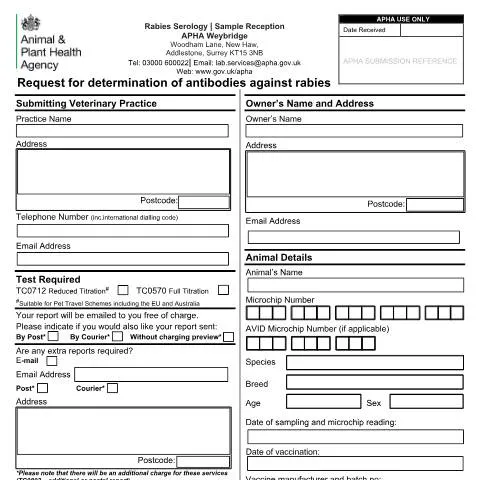
Planning to take your dog or cat on that long-awaited continental adventure? Before you book the ferry crossing or sort out that pet passport, there's a crucial laboratory hurdle your four-legged companion must clear. The VLARAB1 form represents the gateway to proving your pet has adequate rabies antibody levels—a mandatory requirement for bringing animals back into the UK under pet travel schemes.
This isn't just bureaucratic box-ticking. The Animal and Plant Health Agency (APHA) operates one of Europe's most rigorous rabies testing facilities at their Weybridge laboratory, holding both OIE Reference Laboratory status and EU approval for rabies serology. Every blood sample processed through their ISO/IEC 17025 accredited facility (UKAS accreditation number 1769) helps maintain the UK's rabies-free status—a public health achievement that's taken decades to establish and maintain.
The Laboratory Testing Landscape: Understanding Your Options
The VLARAB1 form offers two distinct testing pathways, each tailored to different circumstances and antibody levels. The TC0712 Reduced Titration test serves as the standard option for most pet travel scenarios, providing results that satisfy EU and Australian pet travel scheme requirements. This test will be selected automatically unless you specifically request the alternative.
However, some situations demand the more comprehensive TC0570 Full Titration test. If your pet's serum shows particularly high antibody levels, the full titration approach can provide more precise measurements, though this comes with increased costs and extended processing times. The form warns that samples exceeding the assay's endpoint will be reported as meeting or exceeding the upper limit, rather than providing exact numerical values.
| Test Type | Typical Use Case | Processing Time | Suitable For |
|---|---|---|---|
| TC0712 Reduced Titration | Standard pet travel requirements | 20 working days | EU and Australian schemes |
| TC0570 Full Titration | High antibody levels requiring precise measurement | 20 working days (potentially longer) | Specific veterinary requirements |
Both tests aim to demonstrate that your pet has achieved the critical threshold of 0.5 IU/ml antibody level—the internationally recognised marker of adequate rabies protection for travel purposes.
Decoding the Complex Web of Form Fields
The VLARAB1 form's dual-column layout reflects the collaborative nature of rabies testing, splitting responsibilities between the submitting veterinary practice and the pet owner. This structure isn't accidental—it ensures accountability and traceability throughout the testing process.
The veterinary practice section captures essential professional details, including full contact information and the crucial signature of the submitting veterinary surgeon. This signature must be accompanied by the veterinarian's name in block letters and date, creating a clear audit trail. The form specifically notes that incomplete submissions will result in testing delays—a warning that reflects APHA's experience with poorly completed paperwork.
Pet identification proves particularly critical, with the form demanding both standard microchip numbers and AVID microchip numbers where applicable. This dual identification system helps prevent mix-ups in laboratories processing hundreds of samples monthly. The timing fields—date of sampling, vaccination date, and vaccine batch information—create a chronological framework that laboratory technicians use to validate the biological plausibility of results.
Optional fields like travel date and destination country might seem superfluous, but they help APHA's laboratory prioritise urgent samples and ensure results align with specific country requirements. Some destinations impose additional testing requirements beyond the standard 0.5 IU/ml threshold.
Critical Timing Considerations
The relationship between vaccination date and sampling date isn't arbitrary. Rabies antibodies don't appear overnight—most pets require at least three weeks post-vaccination to develop measurable antibody levels. Sampling too early results in false negative results and wasted time, while sampling significantly later than necessary might push against travel deadlines given the 20-day processing timeframe.
Sample Collection and Packaging: Where Science Meets Logistics
APHA's guidance notes reveal the meticulous requirements governing sample collection and transport. The minimum sample volume—1ml of serum or 2ml of clotted blood—reflects the laboratory's need for adequate testing material while accounting for potential sample degradation during transport.
The packaging requirements extend beyond simple containment. Samples must travel in plain tubes marked with the owner's name, animal's name, and microchip number—a labelling protocol that prevents catastrophic mix-ups. The insulated, leak-proof container requirement (following IATA packing instructions 650) reflects both safety considerations and the need to maintain sample integrity during potentially lengthy postal journeys.
For samples originating outside the EU, additional complexity emerges. These submissions require import licences (Appendix 1) and specific labelling as "Category 3 Veterinary diagnostic specimens - not restricted." The form's reference to import licence ITIMP25.0800 and country of origin documentation highlights the international regulatory framework governing biological sample movement.
The Critical Cover Letter Requirement
Perhaps the most overlooked requirement involves the mandatory cover letter on headed paper, signed by the submitting veterinary surgeon. This isn't mere formality—the letter must include a "Freedom from Disease Declaration" containing specific legal language about the serum's origin and the animal's health status. The declaration's wording, referencing European Regulations and Animal Health Regulations, creates legal protection for both the laboratory and the broader UK animal health system.
Understanding the Financial Framework
The VLARAB1 form's payment structure reflects a professional service model where veterinary practices act as intermediaries. The submitting practice receives invoicing and bears responsibility for all payments, even when pet owners ultimately fund the testing. This arrangement simplifies APHA's billing processes while ensuring veterinary oversight of the testing request.
The form offers flexibility for practices wanting third-party payment arrangements, though this requires advance facilitation. For practices regularly submitting samples, this payment model streamlines administrative processes while maintaining professional accountability.
Additional charges apply for supplementary services. The TC0802 code mentioned for additional or postal reports suggests APHA operates a fee structure covering various service levels beyond basic testing. Practices should factor these potential additional costs when quoting clients for comprehensive testing services.
Report Distribution and Communication Pathways
The form's report distribution options reflect modern communication preferences while maintaining professional protocols. The default free email distribution to the submitting practice ensures rapid results communication, typically within the 20-day processing window.
However, the additional report options—postal delivery and courier services—serve specific professional needs. Some veterinary practices prefer hard copies for client files, while urgent cases might justify courier delivery despite additional costs. The "without charging preview" option suggests APHA provides preliminary results communication for time-sensitive cases, though formal reports follow through standard channels.
The duplicate report provision, requiring written consent from the submitting veterinary surgeon, maintains professional confidentiality while allowing flexibility for complex ownership or veterinary care arrangements. This might prove relevant when pets change veterinary practices during extended travel preparations.
Navigating International Variations and Special Circumstances
The form's guidance notes reveal significant differences in requirements based on sample origin. EU-based samples benefit from streamlined processing under established regulatory frameworks, while non-EU submissions face additional documentation and packaging requirements reflecting the UK's post-Brexit regulatory position.
The specific mention of Australian pet travel scheme compatibility indicates APHA's awareness of common destination requirements. Australia's notoriously strict biosecurity requirements mean many pet owners specifically request testing that satisfies both EU and Australian standards, even when immediate Australian travel isn't planned.
Clinical rabies suspicions trigger entirely different protocols. The form explicitly states it shouldn't be used where clinical rabies is suspected, directing such cases to APHA through the Defra Rural Services Helpline (03000 200 301). This distinction protects both laboratory staff and maintains appropriate public health responses to potential rabies exposure.
Laboratory Capacity and Surveillance Functions
APHA's laboratory doesn't operate solely as a commercial testing facility. The guidance notes mention that samples and test data may be used for training, research, and surveillance purposes while maintaining client confidentiality. This dual function means your pet's blood sample contributes to broader UK rabies surveillance efforts, helping maintain the country's disease-free status through ongoing monitoring and research.
Processing Timelines and Result Interpretation
The standard 20-day processing timeframe reflects the complex laboratory procedures involved in rabies antibody testing. Unlike simple diagnostic tests, serology requires careful sample preparation, incubation periods, and quality control measures that can't be rushed without compromising accuracy.
Results interpretation extends beyond simple pass/fail determinations. The 0.5 IU/ml threshold represents the minimum acceptable level for pet travel, but higher levels don't necessarily indicate better protection. Some pets naturally produce higher antibody responses, while others barely exceed the minimum requirement yet maintain adequate protection.
Laboratory reports provide quantitative results where possible, though samples with very high antibody levels might receive qualitative reports indicating they exceed the assay's upper measurement limit. For travel purposes, exceeding the minimum threshold satisfies requirements regardless of the specific numerical value.
The form's emphasis on complete submissions preventing delays underscores a practical reality: incomplete paperwork creates processing bottlenecks that can jeopardise travel plans. APHA's laboratory processes hundreds of samples weekly, and incomplete submissions require additional administrative handling that extends processing times.
Understanding the VLARAB1 form's requirements and processes helps ensure smooth rabies antibody testing for your pet's travel needs. The form represents more than administrative paperwork—it's a gateway to international pet travel and a crucial component in maintaining the UK's rabies-free status through rigorous scientific testing and regulatory oversight.
Special Circumstances and Alternative Testing Pathways
While the standard VLARAB1 process covers most pet travel scenarios, several special circumstances require modified approaches or additional considerations. Understanding these variations can prevent unexpected delays or complications in your travel plans.
For pets travelling from high-risk rabies countries, the antibody test timeline becomes particularly critical. These animals must complete their primary rabies vaccination, wait at least 21 days, undergo the VLARAB1 test, and then observe a mandatory 3-month waiting period before travel. This extended timeline means planning must begin at least 4-5 months before your intended departure date. Countries classified as high-risk include most of Africa, Asia, and parts of South America, though the specific list is regularly updated by DEFRA based on current epidemiological data.
Pregnant animals present unique challenges for rabies antibody testing. While the test itself poses no direct risk to pregnancy, timing becomes crucial as stress from travel and procedures should be minimised. Veterinary guidance typically recommends completing all travel health requirements, including VLARAB1 testing, before breeding or early in pregnancy to avoid complications near whelping or during late gestation.
Young animals under 12 weeks cannot receive rabies vaccination, making early travel impossible under current regulations. However, for animals born to vaccinated mothers, maternal antibodies may provide temporary protection, though this cannot substitute for the formal VLARAB1 testing requirements. Planning breeding and travel schedules requires careful coordination to ensure puppies or kittens can complete their vaccination and testing protocol at the appropriate age.
Service animals and assistance dogs may qualify for expedited processing in certain circumstances, though they must still meet all standard VLARAB1 requirements. The Equality and Human Rights Commission provides guidance on reasonable adjustments that may apply to the travel preparation process, though these adjustments cannot override fundamental health and safety requirements mandated by international agreements.
For animals with compromised immune systems due to age, illness, or medication, antibody response to vaccination may be reduced. In such cases, additional booster vaccinations or modified testing schedules may be necessary. Your veterinarian may recommend immune system assessment before beginning the VLARAB1 process to ensure optimal antibody production and test reliability.
International Variations and Bilateral Agreements
The VLARAB1 testing requirement varies significantly depending on your destination country, with some nations maintaining bilateral agreements that modify standard protocols. Understanding these variations is essential for compliance with both UK export requirements and destination country import regulations.
European Union member states generally accept UK VLARAB1 test results under the Trade and Cooperation Agreement provisions, though additional health certificates may be required. Each EU country maintains its own specific requirements for documentation format, language translation, and endorsement procedures. For instance, France requires all veterinary documentation to include French translations certified by approved translators, while Germany accepts English documentation provided it includes specific disease status declarations.
The United States operates under different protocols, accepting UK rabies vaccination certificates without requiring separate antibody testing for most pets, provided vaccinations are current and properly documented. However, the Centers for Disease Control and Prevention (CDC) may impose additional requirements during disease outbreaks or for animals from specific regions within the UK.
Australia and New Zealand maintain some of the world's strictest import requirements, necessitating VLARAB1 testing alongside extensive quarantine periods and additional health screenings. These countries require test results from laboratories specifically approved for their import programs, which may differ from UK-approved facilities. The quarantine periods can extend from 10 days to several months, depending on the animal's origin and health status.
Canada generally accepts UK VLARAB1 results but requires specific endorsements from the Animal and Plant Health Agency (APHA). The Canadian Food Inspection Agency (CFIA) maintains detailed requirements for health certificate wording and veterinary endorsements that must be followed precisely to avoid entry refusal.
Several countries maintain seasonal restrictions or temporary suspensions of pet imports due to disease outbreaks or policy changes. Recent examples include temporary suspensions of imports from regions experiencing avian influenza outbreaks, even for companion animals. The Foreign, Commonwealth & Development Office maintains current travel advisories that include information about temporary pet import restrictions.
Transit countries may also impose requirements even if your pet is not leaving the airport. Some Middle Eastern and Asian airports require health documentation for animals in transit, particularly during extended layovers. Airlines often maintain stricter requirements than government regulations, requiring comprehensive health documentation for any animal travelling through their network.
Laboratory Quality Assurance and Result Interpretation
Understanding the technical aspects of VLARAB1 testing helps ensure reliable results and proper interpretation of laboratory reports. The quality assurance measures surrounding these tests are critical for maintaining international acceptance and preventing travel disruptions.
Approved UK laboratories must maintain accreditation under ISO/IEC 17025 standards and undergo regular audits by the Veterinary Medicines Directorate (VMD). These facilities use standardised fluorescent antibody virus neutralisation (FAVN) or enzyme-linked immunosorbent assay (ELISA) methodologies to measure antibody titres. The minimum acceptable titre level is 0.5 International Units per millilitre (IU/ml), representing adequate immune response for international travel purposes.
Sample collection technique significantly affects result reliability. Blood samples must be collected using proper sterile technique, with serum separation occurring within specific timeframes to prevent antibody degradation. Samples showing haemolysis, lipemia, or other quality issues may require recollection, potentially delaying your travel timeline.
Laboratory reports include several critical elements beyond the basic titre result. The animal's microchip number must match exactly with other documentation, vaccination records must align with sample collection dates, and the testing laboratory's accreditation details must be clearly stated. Any discrepancies in these details can result in rejection by importing authorities.
False negative results, while uncommon, can occur due to various factors including recent illness, stress, certain medications, or individual immune system variations. If an animal with current vaccinations returns a negative result, veterinarians may recommend repeating the vaccination and retesting after an appropriate interval. Conversely, false positive results are extremely rare due to the specificity of current testing methodologies.
Quality control measures include regular testing of known positive and negative control samples, participation in international proficiency testing schemes, and maintenance of detailed chain-of-custody documentation. UK laboratories participating in VLARAB1 testing must demonstrate ongoing competency through external quality assessment programs coordinated by recognised international veterinary organisations.
Result interpretation may vary slightly between testing methodologies. FAVN testing provides quantitative titre measurements with high precision, while ELISA methods offer rapid results but may require confirmation testing for borderline cases. Your veterinarian can explain which methodology was used and any implications for result interpretation specific to your destination country's requirements.
Some countries specify particular testing methodologies or require results from designated laboratories. Japan, for example, accepts only FAVN testing performed by specific approved facilities, while other countries may accept either FAVN or ELISA results provided they meet minimum titre requirements. Verifying destination-specific testing requirements before sample submission prevents costly delays and repeat testing.