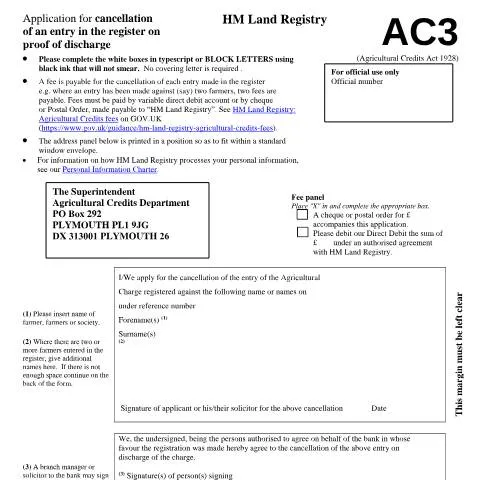
Understanding the AC3 Form: Your Key to Cancel Register Entries
Navigating the complexities of property law can often feel overwhelming, especially when it comes to formal documentation. The Proof of Discharge form, known officially as the AC3, is essential for those looking to cancel an entry in the land register. This process typically arises when a debt associated with an agricultural charge has been settled, and formal recognition of this discharge is required.Who Initiates the AC3 Process? The Key Actors
Understanding who exactly needs to complete the AC3 form is crucial. Generally, the primary applicant is the individual or entity that has satisfied the obligations under the agricultural charge. This could be:- Farmers: The primary debtor whose property is subject to the charge.
- Societies: Agricultural societies or groups that may also be subject to similar charges.
- Financial Institutions: Banks or lenders that have placed a charge on the property will need to consent to the cancellation.
Decoding the AC3: Step-by-Step Instructions
Completing the AC3 form requires attention to detail. Each section plays a critical role in ensuring your request is processed without unnecessary delays. Below is a breakdown of the key sections of the form:1. Applicant Information
This is where you enter the name of the primary applicant—be it an individual or an organization. Ensure to include the full name and, if applicable, a postal address. Note that:- The name must match the details registered in the land registry.
- Include the postcode to ensure accuracy in identification.
2. The Agricultural Charge Details
You must specify the nature of the cancellation. This includes providing the exact reference number of the agricultural charge you wish to discharge. This is critical as it serves as the identifier for the land registry.For example, if you are discharging a charge against two farmers, be sure to state both names clearly in the specified fields. Remember, you may need to use the back of the form if space runs out.
3. Consent from Financial Institutions
It’s not just about you signing the form. If a bank or financial institution placed the charge, they must also agree to its cancellation. This necessitates their signature on the AC3. For this purpose:- Ensure you include the title of the individual signing on behalf of the institution.
- Specify the date of the signature to maintain a clear timeline.
4. Payment Details
A critical part of the application involves fees. Each entry cancellation is subject to a fee, which can be paid through a direct debit or postal order.- Clearly indicate your preferred payment method in the designated fee panel.
- Health check your fee amount against the current fee schedule provided by HM Land Registry to avoid delays.
Chronological Flow: From Submission to Outcome
Understanding what happens once you submit your AC3 form helps set expectations. Here’s a chronological journey of the process:Step 1: Submission
Once you have completed the form and gathered necessary signatures, submit your application to HM Land Registry. The address is:The Superintendent Agricultural Credits Department PO Box 292 PLYMOUTH PL1 9JG
Step 2: Acknowledgment of Receipt
Upon receipt, HM Land Registry will process your application. Typically, you can expect an acknowledgment confirming they have your submission.Step 3: Processing Time
While there isn’t a fixed timeline, standard processing can take several weeks. It is advisable to keep track of your submission and have your reference number handy for inquiries.Step 4: Decision Notification
You will receive a notification detailing whether your application has been accepted or if further information is required. If accepted, you will receive documentation confirming the cancellation of the charge.Documentation: What You Need to Prepare
Efficient preparation of supporting documents is pivotal to avoid potential roadblocks. Here’s a categorized list of documents that may be needed depending on your specific scenario:Regular Cases
- Completed AC3 form.
- Payment confirmation (cheque or direct debit authorisation).
- Documentation proving the discharge of debt (if applicable).
Complex Cases
In cases where complexity arises (such as disputes over charge payments or claims of misregistration), additional documentation may include:- Legal agreements confirming debt discharge.
- Letters or emails from financial institutions expressing consent.
- Identification documentation for all signatories.
Timeline Insights: When to Act and What Follows
Being aware of critical dates can help you manage your application better. Here’s a simplified timeline:Initial Application: Immediately after the debt discharge.
Submission Deadline: There is no formal deadline for submitting the AC3, but it's wise to act promptly after settling your debts.
Processing Duration: Typically, expect up to 6 weeks for processing, but it can vary depending on the volume of applications.
Differentiating the AC3 from Similar Forms
It's essential to distinguish the AC3 from other forms concerning land registration. Below is a comparative table highlighting the main differences:| Form Code | Purpose | Who Files | Associated Fees |
|---|---|---|---|
| AC3 | Cancellation of an agricultural charge | Debtor or their representative | Fees applicable per entry |
| SA1 | Application for registration of a charge | Lender or charge holder | Standard registration fee |
| RX1 | Application to register a restriction | Anyone with interest in the land | Standard registration fee |
Submission Channels: Online vs. Paper Applications
The AC3 can typically be submitted through various channels. Understanding the nuances can facilitate a smoother process.Paper Submission
This traditional method involves filling out the form manually and sending it via post. Pros:- Standardised process familiar to many.
- Provides a physical copy of your submission for records.
- Longer processing times due to postal delays.
- Potential loss in transit if not properly tracked.
Online Submission
Currently, HM Land Registry does not allow for the electronic submission of the AC3 specifically, but it is worth checking for updates on applicable online services for other forms.Handling Complications: What If Things Go Wrong?
In the unfortunate event your application faces obstacles—be it a missing document, an error, or a refusal—knowing the correct steps to take can mitigate issues effectively.In Case of Refusal
If your AC3 application is denied, you will receive a notification detailing the reasons. Here’s what to do next:- Review the reasons carefully.
- Prepare any additional documentation that may address the issues.
- Resubmit your application with the newly attached documents.
Dealing with Errors
Mistakes in your submission can lead to delays. If you discover an error post-submission:- Contact HM Land Registry immediately.
- Provide them with the corrected information.
- Follow their instructions for how to proceed with corrections.
Understanding the Proof of Discharge Process
When dealing with financial obligations such as mortgages or loans, the Proof of Discharge is a crucial document that signifies the completion of these obligations. It effectively confirms that a borrower has fulfilled their financial commitments, allowing for the cancellation of the relevant entry in the Land Register. This process is particularly vital for individuals looking to sell their property or simply to ensure their financial records are accurate.
The discharging process involves several key steps, starting with securing the necessary documentation from your lender. Typically, lenders will provide a discharge statement once the debt is cleared, but it's essential to verify that it meets the requirements set forth by HM Land Registry. This includes ensuring that the details on the discharge statement match those in the original mortgage deed.
It is also advisable to keep records of your payments and any correspondence with your lender, which can serve as evidence should there be any disputes regarding the discharge. It is not uncommon for discrepancies to arise, particularly in cases of smaller lenders or when dealing with multiple properties.
Common Challenges in Cancel Register Entry Applications
While the Proof of Discharge process might seem straightforward, there are several common challenges that applicants may encounter. One of the most prevalent issues is incorrect or incomplete documentation. It is crucial to ensure that all required forms are filled out accurately, as mistakes can lead to delays in processing.
Another issue can arise if the lender fails to submit the required documentation to HM Land Registry on your behalf. In such cases, it may fall upon the borrower to take action to rectify the situation. This could involve contacting the lender to ensure they are fulfilling their obligations or, in some cases, filing a complaint with the Financial Ombudsman Service if the lender is unresponsive.
Fill in your form directly online
No printing: type your details into the boxes of the official form, tick, then download the PDF ready to send.
- 1Type into the form boxes
- 2Tick in one click
- 3Save and download the PDF
Additionally, applicants may experience delays due to backlog at HM Land Registry, especially if a large number of applications are submitted concurrently. Staying informed about the current processing times and following up appropriately can help alleviate some of these concerns.
The Importance of Accurate Record Keeping
Accurate and comprehensive record keeping is essential throughout the Proof of Discharge process. Not only does it help in verifying that you have met all your financial obligations, but it also provides a safeguard against potential disputes or issues that may arise in the future.
Maintain copies of all correspondence with your lender, including loan agreements, payment confirmations, and discharge statements. Keeping a timeline of payments made, along with any adjustments or changes in terms, can also be beneficial. This level of documentation not only supports your application to cancel the register entry but can also serve as vital evidence should any discrepancies occur later down the line.
Furthermore, once the discharge has been confirmed and the register entry canceled, it is advisable to review your credit report to ensure that all information is updated correctly. This helps you maintain a healthy credit profile and avoid potential issues when applying for new credit in the future.