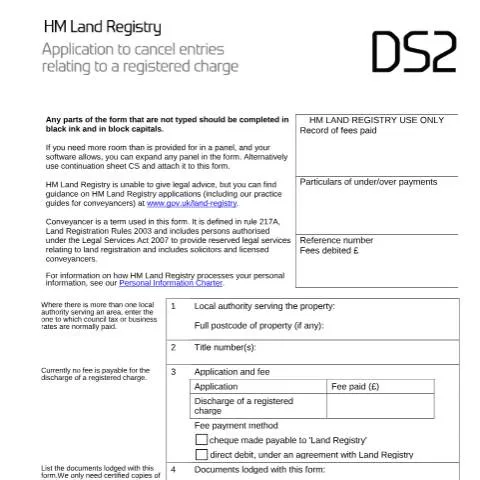
Understanding the DS2 Form: Your Gateway to Mortgage Discharge Registration
When your mortgage reaches its final payment or you've refinanced your property, the legal journey doesn't end with your last instalment. The DS2 form stands as the crucial bridge between completing your mortgage obligations and achieving clear title registration at HM Land Registry. This application form specifically handles the cancellation of entries relating to a charge, working in tandem with the DS1 discharge certificate to remove the lender's legal claim from your property's registered title.
Unlike many property transactions that can drag on for months, the DS2 process typically moves swiftly once properly submitted. However, the form's apparent simplicity masks several critical requirements that can trip up even experienced property owners. The registration process involves multiple parties - from mortgage lenders to conveyancers - each with distinct responsibilities that must align perfectly for successful completion.
Currently, HM Land Registry charges no fee for discharging a registered charge, making this one of the few cost-free interactions with the Land Registry system. This policy reflects the government's recognition that removing satisfied charges benefits the entire property registration system's integrity.
The Legal Framework Behind Charge Cancellation
The DS2 form operates within a carefully structured legal framework governed by the Land Registration Act 2002 and the Land Registration Rules 2003. When a mortgage lender issues a DS1 certificate confirming full repayment, this document alone doesn't automatically update the Land Registry records. The DS2 serves as the formal application mechanism to translate that discharge into official registration changes.
Under rule 217A of the Land Registration Rules 2003, the term conveyancer encompasses not only traditional solicitors but also licensed conveyancers and other professionals authorised under the Legal Services Act 2007 to provide reserved legal services relating to land registration. This broad definition reflects the evolving landscape of property law services and ensures appropriate professional oversight throughout the discharge process.
The form's design incorporates significant anti-fraud measures, particularly around identity verification. These requirements stem from section 100(4) of the Land Registration Act 2002, which empowers the Chief Land Registrar to establish identity confirmation procedures. The stringent identity checks reflect hard-learned lessons from property fraud cases where criminals exploited weaknesses in the discharge process to steal property equity.
| Legal Requirement | DS2 Panel | Verification Standard |
|---|---|---|
| Identity confirmation for represented parties | Panel 9 | Conveyancer professional standards |
| Evidence of identity for unrepresented parties | Panel 10 | Chief Land Registrar's directions |
| Professional representation disclosure | Panels 6 & 9 | Full transparency requirement |
Navigating Complex Property Ownership Scenarios
The DS2 form accommodates various ownership structures that reflect modern property investment patterns. For UK incorporated companies and Limited Liability Partnerships, panel 5 requires the complete registered number including any prefix. This detail proves crucial for HM Land Registry's automated verification systems, which cross-reference company information with Companies House records.
Overseas companies face additional complexity, needing both their territory of incorporation and their UK registered number. This dual requirement reflects the increasing international nature of UK property investment while maintaining regulatory oversight. Properties owned through complex corporate structures - such as holding companies or investment vehicles - must demonstrate clear authority chains leading to the discharge decision.
Multiple Title Numbers and Shared Charges
Panel 2 accommodates properties spanning multiple title numbers, a common scenario for large estates, converted buildings, or properties with separate access rights. Each title number must be listed individually, as HM Land Registry treats each registered title as a distinct legal entity. This requirement can catch property owners off-guard, particularly when dealing with properties that appear as single units but carry multiple registrations.
When charges affect multiple titles owned by different parties, separate DS2 applications may be required for each ownership interest. The form's design assumes straightforward ownership patterns, so complex arrangements often need careful planning to ensure all necessary registrations are addressed simultaneously.
Professional Representation Variations
Panel 9 addresses the increasingly common scenario where different parties in a mortgage discharge use different conveyancers or where some parties remain unrepresented. The table format allows clear documentation of who represents whom, but completing this section requires careful attention to ensure no party is inadvertently left without proper representation documentation.
For unrepresented lenders - an unusual but not impossible situation - the conveyancer submitting the DS2 must take on additional verification responsibilities. This includes confirming sufficient identity verification steps and potentially enclosing additional evidence of identity documentation as specified in Practice Guide 67.
Mastering the Submission Process and Documentation Requirements
The DS2 form arrives at HM Land Registry accompanied by a carefully orchestrated collection of supporting documents. Panel 4 requires listing all lodged documents, but the form's instructions contain a crucial detail often overlooked: HM Land Registry only needs certified copies of deeds or documents sent with application forms. This policy change streamlined the process significantly, as original documents are no longer retained.
The destruction policy for submitted documents - applying to both originals and certified copies - means applicants must retain their own copies of all submitted materials. This shift in document handling reflects HM Land Registry's digital transformation while placing greater responsibility on applicants for record-keeping.
Electronic vs Physical Submission Pathways
Professional customers with key numbers can utilise HM Land Registry's digital submission channels, which offer faster processing and automated acknowledgment systems. The key number system, available primarily to solicitors and licensed conveyancers, provides access to enhanced tracking capabilities and priority processing queues.
For applications submitted without key numbers, the traditional postal route remains available, though processing times may extend longer. The form specifically requests UK DX box numbers where available, reflecting the legal profession's continued reliance on document exchange networks for secure communication.
Email addresses inserted in panel 6 enable HM Land Registry to issue warning of cancellation letters electronically to conveyancers, significantly accelerating the communication process during application processing.
Fee Payment Mechanisms and Accounting
Although no fee applies for charge discharge applications, panel 3 includes fee payment infrastructure for potential future changes or additional services. The direct debit option requires pre-existing agreements with HM Land Registry, typically established by professional users who handle multiple applications regularly.
The form's fee calculation section includes space for under and overpayment particulars, reflecting HM Land Registry's systematic approach to financial reconciliation across all application types. Even zero-fee applications generate accounting records that integrate with the Registry's broader financial management systems.
Identity Verification: The Anti-Fraud Fortress
Panels 8, 9, and 10 of the DS2 form constitute perhaps the most critical anti-fraud measures in the entire property registration system. The identity verification requirements emerged from extensive consultation following high-profile property fraud cases where criminals exploited weaknesses in the discharge process to steal substantial property equity.
For applications submitted by conveyancers, panel 9 creates a professional responsibility framework where qualified legal professionals stake their professional reputation on identity verification. This approach leverages existing professional standards and regulatory oversight rather than creating parallel bureaucratic verification systems.
The Conveyancer Confirmation System
When conveyancers complete panel 9, they're not simply filling in administrative details - they're providing professional confirmation that appropriate identity verification steps have been taken. This confirmation carries professional liability implications and forms part of the conveyancer's professional indemnity insurance considerations.
The table format in panel 9(1) accommodates complex representation scenarios where different lenders use different conveyancers. Each lender must be clearly identified alongside their representing conveyancer's details, creating an audit trail that HM Land Registry can follow if questions arise about the discharge's legitimacy.
Unrepresented Party Protocols
Panel 10, though partially cut off in the source material, addresses situations where parties proceed without professional representation. These scenarios require enhanced scrutiny, as they lack the professional oversight that conveyancer involvement provides. Practice Guide 67 provides detailed guidance on acceptable evidence of identity for unrepresented parties, typically including combinations of photographic identification, address verification, and financial institution confirmation.
The Chief Land Registrar's directions under section 100(4) of the Land Registration Act 2002 establish specific evidence standards that evolve with emerging fraud patterns and technological developments. These directions carry legal force and are regularly updated to address new threats to the registration system's integrity.
Processing Timelines and Registry Interactions
Once submitted, DS2 applications enter HM Land Registry's processing workflow, where they're typically handled more rapidly than many other registration applications. The absence of fees and the straightforward nature of charge cancellation - assuming proper documentation - usually results in completion within 10-20 working days for routine cases.
However, applications triggering identity verification concerns or involving complex ownership structures may require additional processing time. HM Land Registry's approach prioritises accuracy over speed, particularly where potential fraud indicators emerge during initial assessment.
Requisition and Communication Management
Panel 6's email address field proves crucial for efficient requisition handling. When HM Land Registry identifies issues requiring clarification or additional information, electronic communication dramatically reduces resolution timeframes compared to traditional postal correspondence. Professional customers report that email-enabled applications resolve requisitions 60-70% faster than postal-only submissions.
The warning of cancellation letter system - available only to conveyancers with email addresses - provides advance notice of impending registration changes. This notification system helps conveyancers coordinate with their clients and address any last-minute concerns before the discharge becomes final.
Integration with Broader Property Transactions
DS2 applications rarely exist in isolation but typically form part of larger property transaction chains. When properties are being sold simultaneously with mortgage discharge, careful timing coordination ensures that the discharge completes before or simultaneously with the new registration, preventing temporary title complications.
For refinancing scenarios, the DS2 discharge of the existing charge must coordinate with registration of the new lender's charge. Professional conveyancers often submit these applications in carefully sequenced batches to ensure seamless title transitions without leaving properties temporarily unencumbered when security interests should remain in place.
Beyond Completion: Post-Registration Considerations
Successful DS2 processing results in updated title registers showing the removal of the discharged charge. Property owners should obtain updated official copies of their title register to confirm the discharge has been properly recorded and to maintain current documentation for future transactions.
The completion of charge discharge can trigger various administrative consequences beyond HM Land Registry registration. Insurance policies, particularly those with mortgage-related conditions, may require notification of the discharge. Local authority records, while not directly affected by HM Land Registry changes, may benefit from notification to ensure accurate council tax and business rates administration.
For properties with multiple charges, successful DS2 processing for one charge leaves other registered charges unaffected. Property owners must ensure they understand which specific charges have been discharged and which remain active, particularly important for properties with complex financing arrangements involving multiple lenders or secured loan products.
The clean title resulting from successful charge discharge enhances the property's marketability and provides owners with increased flexibility for future financing arrangements. However, the absence of registered charges also means the property lacks the payment protection that mortgage arrangements traditionally provide, potentially affecting insurance coverage and requiring alternative security arrangements for future lending.
Understanding Different Types of Charges and Their Cancellation Requirements
The DS2 form accommodates various categories of charges, each with distinct cancellation procedures and documentary requirements. Legal charges, the most common type encountered in property transactions, typically arise from mortgages or secured loans against the property. When cancelling these entries, you'll need to demonstrate that the underlying debt has been satisfied or that the charge holder has formally released their interest.
Equitable charges present more complex scenarios, as they may not always appear as separate register entries but can affect the property's marketability. These charges often stem from court orders, charging orders following unpaid debts, or family law proceedings. The cancellation process requires careful examination of the original charging document to determine whether full satisfaction has occurred or if partial release is appropriate.
Restrictive covenants, whilst not charges in the traditional sense, may require similar cancellation procedures when they become obsolete or unenforceable. The Land Registry distinguishes between positive and restrictive covenants, with different implications for removal. Positive covenants typically cannot be cancelled through the DS2 process alone and may require separate applications or tribunal proceedings.
Statutory charges, including those imposed by local authorities for unpaid council tax or planning enforcement, follow specific legislative frameworks. HM Land Registry requires evidence that the statutory body has formally discharged the charge, often through a certificate of satisfaction or statutory declaration. The timeframes for these cancellations can vary significantly depending on the originating authority's administrative processes.
Agricultural charges under the Agricultural Holdings Act present unique considerations, particularly when tenancies have ended or been surrendered. The cancellation must account for any ongoing obligations to former tenants or their successors, and may require confirmation from DEFRA or the Rural Payments Agency regarding compliance with environmental or subsidy conditions.
When dealing with charges created by companies, additional complications arise if the company has been dissolved or is in administration. The DS2 application must address the legal status of the charge holder and may require supporting evidence from Companies House, insolvency practitioners, or the Crown representative handling dissolved company assets.
Practical Challenges and Common Complications in the Cancellation Process
Missing or defective discharge documentation represents one of the most frequent obstacles in DS2 applications. When original charge holders cannot be traced or have ceased to exist, applicants must explore alternative routes to demonstrate satisfaction. This might involve statutory declarations from solicitors who handled the original transaction, insurance indemnities, or applications for directions from the County Court.
Partial releases create particular complexity when charges secure multiple obligations or cover several properties within a single registration. The DS2 form must clearly identify which specific obligations have been satisfied and which elements of the charge should remain. This often requires detailed legal analysis of the charging document's terms and careful drafting to avoid inadvertently affecting continuing security interests.
Priority disputes can emerge when multiple charges exist against the same property and their relative ranking affects the cancellation process. HM Land Registry may require confirmation that all interested parties consent to the proposed cancellation, particularly where junior charge holders might benefit from the removal of a senior charge. This consultation process can significantly extend processing times and may necessitate formal agreements between charge holders.
Cross-border complications arise increasingly in modern property transactions, particularly where charge holders are overseas entities or where the underlying obligations involve foreign law elements. The Land Registry may require additional certification or apostilled documents to verify foreign discharge certificates, and currency fluctuations can complicate calculations of satisfaction amounts.
Electronic signature validity presents emerging challenges as more transactions move to digital formats. Whilst the Land Registry accepts electronic signatures in many circumstances, the DS2 process may require enhanced verification when dealing with high-value charges or where fraud concerns exist. This can involve additional identity verification steps or requirements for wet-ink signatures on specific supporting documents.
Time-sensitive elements often complicate DS2 applications, particularly where charges include automatic renewal clauses or where satisfaction depends on ongoing compliance with specific conditions. Applicants must carefully time their submissions to ensure that satisfaction evidence remains current throughout the Land Registry's processing period, which can extend several weeks during busy periods.
Professional indemnity considerations affect solicitors and licensed conveyancers handling DS2 applications, as incorrect cancellations can create significant liability exposure. Best practice involves maintaining comprehensive file records, obtaining appropriate client confirmations, and considering professional indemnity insurance implications before submitting complex cancellation applications.
Post-Cancellation Procedures and Ongoing Obligations
Following successful cancellation of charge entries, several important administrative steps ensure complete closure of the matter. HM Land Registry issues updated official copies reflecting the cancelled entries, but applicants should verify that all related register entries have been appropriately amended. Sometimes subsidiary or consequential entries require separate attention, particularly where the cancelled charge supported other registered interests.
Notification obligations to relevant parties extend beyond the immediate cancellation process. Where charges were registered to secure obligations to multiple beneficiaries, or where guarantee arrangements exist, formal notification of the cancellation may be required to prevent future disputes. This is particularly important in commercial contexts where charge registrations form part of wider financing arrangements.
Tax implications of charge cancellations can be significant, especially for capital gains tax calculations or stamp duty land tax reliefs. HMRC may require evidence of the cancellation date and circumstances for accurate tax assessments, particularly where property disposals or refinancing arrangements coincide with the charge release. Professional tax advice often proves essential in complex commercial scenarios.
Document retention requirements continue after successful DS2 processing, as cancelled charges may remain relevant for limitation period calculations, warranty claims, or future property investigations. The Law Society recommends maintaining comprehensive files for at least six years after completion, with longer periods advisable for commercial or high-value transactions.
Insurance considerations may change following charge cancellations, particularly where title insurance policies specifically excluded risks associated with the cancelled charge. Policyholders should review their coverage and consider whether additional protection is needed for any continuing risks or potential warranty claims from the cancellation process.
Monitoring ongoing compliance becomes important where cancelled charges were subject to conditional releases or where residual obligations continue despite the charge cancellation. This might include ongoing covenant compliance, environmental monitoring requirements, or periodic reporting obligations to regulatory bodies.
Quality assurance procedures help prevent future complications by ensuring that all aspects of the cancellation have been properly completed. This includes verifying that any related planning obligations, environmental conditions, or statutory requirements have been appropriately addressed as part of the overall charge release process.
Future transaction considerations should account for the cancelled charge history, as purchaser due diligence may still identify the former charge and require explanation of its satisfaction. Maintaining clear records of the cancellation process and supporting evidence helps streamline future property dealings and provides reassurance to prospective buyers or lenders.