When Property Charges Need Clearing: Understanding the K11 Cancellation Process
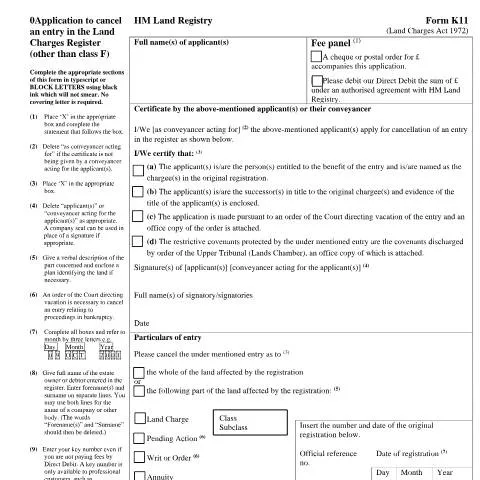
Property transactions often leave behind a trail of charges and restrictions registered against land that may no longer serve their purpose. Whether it's a mortgage that's been fully repaid, restrictive covenants that have been formally discharged, or court proceedings that have concluded, these entries can create complications for future dealings with the property. The K11 form serves as the official mechanism through which such entries are formally removed from the Land Charges Register, ensuring the property's title reflects its current legal status.
Unlike the more familiar registered land system managed through Land Registry titles, the Land Charges Register operates as a separate registry system primarily affecting unregistered land. This distinction is crucial because while registered land has its charges noted directly on the title, unregistered land relies on this central register to record various interests and restrictions. The K11 form specifically addresses the cancellation of these registered charges, excluding Class F matrimonial home rights and certain bankruptcy-related entries which require different procedures.
Navigating the Legal Grounds for Charge Cancellation
The K11 application process revolves around four distinct legal scenarios, each requiring specific evidence and following particular procedures. Understanding which category applies to your situation determines not only the documentation required but also who has the legal standing to make the application.
Original Chargee Cancellation Rights
The most straightforward scenario occurs when the original chargee—the party who initially registered the charge—seeks its cancellation. This typically happens when a mortgage has been repaid in full, or when the chargee voluntarily releases their interest in the property. In these cases, the application can be made directly by the named chargee or their authorised representative, requiring minimal additional documentation beyond proof of identity and authority.
Successor in Title Applications
More complex situations arise when the original chargee has transferred their interest to another party, or when corporate restructuring has occurred. Banks frequently merge or transfer mortgage portfolios, and the successor institution must demonstrate their legal right to cancel charges originally registered by their predecessor. This requires submitting evidence of the chain of title, such as assignment documents, merger certificates, or other legal instruments that establish the connection between the current applicant and the original registration.
Court-Directed Cancellations
When disputes arise or statutory procedures require judicial intervention, court orders may direct the cancellation of land charge entries. This encompasses various scenarios including successful challenges to the validity of charges, court-ordered sales where charges are being cleared, or formal proceedings that result in the discharge of previously registered interests. The application must be accompanied by an office copy of the relevant court order, and notably, this route is mandatory for cancelling entries related to bankruptcy proceedings.
Upper Tribunal Covenant Discharges
Restrictive covenants, which limit how land can be used, sometimes outlive their practical purpose or become unreasonably burdensome. The Upper Tribunal (Lands Chamber) has jurisdiction to formally discharge such covenants when specific criteria are met. When the Tribunal issues a discharge order, the related land charge entry can be cancelled using the K11 form, provided the discharge order is submitted as supporting evidence.
Critical Documentation and Evidence Requirements
The success of a K11 application hinges on providing appropriate supporting documentation that corresponds to the legal basis being claimed. The Land Registry's approach is necessarily cautious, given that incorrect cancellations could prejudice legitimate interests and create significant legal complications.
| Application Type | Essential Evidence | Additional Considerations |
|---|---|---|
| Original chargee | Proof of identity and authority | Company seal acceptable for corporate applicants |
| Successor in title | Chain of title documentation | Must establish clear legal connection to original chargee |
| Court order | Office copy of court order | Order must specifically direct vacation of the entry |
| Tribunal discharge | Office copy of Upper Tribunal order | Discharge must relate to the specific covenants protected |
When applicant names have changed due to marriage or other circumstances, additional evidence such as marriage certificates or deed poll documents must accompany the application. This requirement reflects the Registry's need to maintain accurate records and prevent fraudulent applications.
Authority and Representation Issues
Particular attention must be paid when applications are made by representatives rather than the principals themselves. Powers of attorney, liquidators, LPA receivers, and other appointed representatives must provide evidence of their authority to act. The form specifically requires such representatives to specify their capacity and provide supporting documentation demonstrating their legal right to make the application on behalf of the true applicant.
Partial Cancellation Complexities and Land Identification
Not all cancellation applications affect entire registered charges. Property development, sales of portions of larger holdings, or partial releases of security can create situations where charges need to be cancelled only as they affect specific parts of the originally charged land. These partial cancellations present particular challenges in terms of land identification and description.
When seeking partial cancellation, applicants must provide both a verbal description of the affected area and, where necessary, a plan that clearly identifies the relevant boundaries. The verbal description should be sufficiently detailed to enable the Registry to understand exactly which portion of the originally charged land is being released from the charge. This might involve references to plot numbers, measurements, or descriptions that relate to identifiable features.
The requirement for plans arises particularly in cases where the verbal description alone might create ambiguity. Modern surveying techniques and detailed Ordnance Survey mapping make it possible to provide precise boundary identification, but the plan must be clear, accurate, and professionally prepared to avoid delays or rejection of the application.
Professional vs Personal Applications: Understanding the Distinction
The K11 form accommodates both professional conveyancers acting for clients and individuals making personal applications. This distinction affects not only the completion of various sections but also the payment methods available and the level of service provided.
Conveyancer Involvement and Key Numbers
Professional conveyancers—including solicitors, barristers, licensed conveyancers, and CILEx Conveyancing Practitioners—can apply for key numbers that facilitate electronic processing and Direct Debit payment arrangements. The key number system streamlines the application process and provides access to enhanced services, but it's exclusively available to recognised professionals who have established authorised agreements with HM Land Registry.
When a conveyancer acts for an applicant, they must clearly identify their capacity and provide their professional details including name, address, phone number, and email address. The form allows for the deletion of references to conveyancer involvement when applications are made directly by the affected parties, ensuring clarity about who bears responsibility for the accuracy of the information provided.
Direct Applications and Payment Methods
Individuals making personal applications without professional representation must use traditional payment methods—cheques or postal orders made payable to "HM Land Registry." The current fee structure, set out in the Land Charges Fee Order, applies equally to all applicants, but professional users benefit from streamlined payment processing through their Direct Debit arrangements.
Personal applicants should be particularly careful when completing address details for correspondence, as any errors could result in important acknowledgements or queries being misdirected. The form provides flexibility in specifying where acknowledgements should be sent, recognising that applicants may wish to use different addresses for correspondence purposes.
Processing Timeline and Registry Procedures
Understanding the Land Registry's internal procedures helps applicants set realistic expectations and plan their property transactions accordingly. Unlike some administrative processes that offer guaranteed processing times, land charge cancellations can vary in complexity depending on the circumstances and the quality of the application submitted.
Applications are processed in the order received, but the Registry may need to make enquiries or request additional information if the initial application raises questions. Complete applications with all necessary supporting documentation typically progress more quickly than those requiring clarification or additional evidence. The Registry's approach prioritises accuracy over speed, recognising that incorrect cancellations could create significant legal problems.
Common Processing Delays and How to Avoid Them
Experience suggests that certain types of applications encounter predictable delays. Applications involving corporate applicants where company names have changed, or where complex chains of title need verification, often require additional time for processing. Similarly, applications where the original registration details are unclear or where supporting documentation is incomplete may be subject to queries from Registry staff.
To minimise delays, applicants should ensure that all reference numbers and dates are clearly legible and accurately transcribed from the original registration. The form requires dates to be entered in a specific format using three-letter month abbreviations, and incorrect formatting can cause processing delays. Similarly, ensuring that all mandatory fields are completed and that signatures are clear and match the names provided elsewhere on the form helps avoid unnecessary queries.
Integration with Wider Property Transaction Processes
K11 applications rarely occur in isolation but typically form part of broader property transaction processes. Understanding how charge cancellations fit into the wider conveyancing timeline helps ensure that applications are submitted at appropriate times and that potential complications are anticipated and addressed.
In mortgage redemption scenarios, the K11 application often follows the completion of property sales where the proceeds are used to discharge existing mortgages. Timing becomes crucial because buyers and their lenders need assurance that charges will be properly cancelled, but the application cannot be submitted until the mortgage has actually been redeemed. This creates a window where careful coordination between all parties is essential.
Coordination with Registered Land Procedures
Properties may be subject to both land charges affecting unregistered interests and registered charges noted on Land Registry titles. When dealing with mixed situations, conveyancers must ensure that all relevant charges are properly addressed through the appropriate procedures. The K11 form specifically addresses land charges register entries and cannot be used for registered land charges, which require different forms and procedures.
This distinction becomes particularly important in cases where land is being registered for the first time, as part of a sale or other transaction. The first registration process may involve both the cancellation of existing land charges and the creation of new registered charges, requiring careful coordination between different Registry departments and procedures.
Addressing Complications and Rejected Applications
Despite careful preparation, K11 applications sometimes encounter complications that require additional action or resubmission. Understanding the common reasons for rejection and the available remedies helps applicants respond effectively to Registry queries and avoid prolonged delays.
The most frequent complications arise from insufficient evidence of authority to make the application, particularly in successor-in-title cases where the chain of ownership is complex or poorly documented. When original documents are unavailable, applicants may need to obtain certified copies or provide alternative evidence that establishes the necessary legal connections.
In cases where court orders are required but have not been obtained, applicants may need to initiate separate legal proceedings before the K11 application can proceed. This is particularly relevant for bankruptcy-related entries, where court direction is mandatory, and for disputed charges where the parties cannot reach agreement on cancellation.
When applications are rejected or queries raised, the Registry typically provides specific guidance on what additional information or evidence is required. Prompt response to such queries, with complete and accurate information, usually results in successful resolution of the application. However, applicants should be prepared for the possibility that some situations may require legal advice or court intervention before cancellation can be achieved.
Understanding the Implications of Cancelled Land Charge Entries
Once your K11 application successfully removes a land charge entry from the register, the implications extend beyond mere administrative housekeeping. The cancellation fundamentally alters the legal status of the affected property and can trigger various downstream consequences that property owners must carefully consider.
For Class C(i) puisne mortgages, cancellation typically occurs following full redemption of the underlying debt. However, the timing of this cancellation can be crucial for subsequent transactions. If you're planning to sell or remortgage the property shortly after redemption, ensuring the land charge cancellation is processed before exchange of contracts prevents potential completion delays. Buyers' solicitors routinely conduct final searches immediately before completion, and an unreflected cancellation could necessitate last-minute postponements.
The removal of Class C(iii) general equitable charges often signals the resolution of complex financial arrangements. These might include charges securing business loans where property was offered as collateral, or family arrangements involving beneficial interests. When such charges are cancelled, it's worth reviewing whether any replacement security arrangements are needed, particularly in ongoing business relationships where the underlying commercial arrangement continues but the security mechanism has changed.
Class D restrictive covenants present unique considerations upon cancellation. Unlike debt-based charges, these cancellations might occur due to covenant modification agreements, unity of ownership (where the benefiting and burdened land come under common ownership), or successful applications to the Upper Tribunal (Lands Chamber) for covenant discharge or modification. Each scenario carries different implications for future land use and development potential.
The cancellation process also impacts priority searches and protection periods. If you conducted a priority search before submitting your K11 application, the search certificate provides a 15-working-day protection period during which no adverse entries can be registered. This protection extends to ensuring your cancellation application receives priority over any competing applications affecting the same property.
For properties subject to multiple charges, the order of cancellation can be significant. Tacking provisions under the Law of Property Act 1925 might affect how remaining charges rank against each other once intermediate charges are removed. If you're dealing with a complex charge structure, consider seeking legal advice before proceeding with selective cancellations.
Fill in your form directly online
No printing: type your details into the boxes of the official form, tick, then download the PDF ready to send.
- 1Type into the form boxes
- 2Tick in one click
- 3Save and download the PDF
Common Pitfalls and How to Avoid Them
The K11 cancellation process, while straightforward in principle, contains several potential stumbling blocks that can delay or derail your application. Understanding these common pitfalls helps ensure your application proceeds smoothly and achieves the desired outcome without unnecessary complications.
Incomplete discharge documentation represents the most frequent cause of application rejection. HM Land Registry requires clear evidence that the underlying obligation has been fully satisfied or otherwise discharged. For mortgage-based charges, this typically means providing a properly executed deed of discharge or statutory receipt. However, these documents must contain specific elements: clear identification of the original charge, confirmation of full satisfaction, proper execution by or on behalf of the chargee, and in some cases, witness attestation.
A particularly common error involves partial discharges presented as full cancellations. This often occurs in commercial arrangements where multiple facilities are secured by a single charge, but only one facility has been repaid. The documentation might refer to "partial discharge" or "release of part of the security," which doesn't support full cancellation of the land charge entry. In such cases, you'll need either to obtain a full discharge (if all secured obligations have indeed been satisfied) or consider whether a partial cancellation application is more appropriate.
Corporate authority issues frequently arise when the original chargee was a company. If the discharging party is a corporate entity, HM Land Registry must be satisfied that the person signing the discharge had proper authority to bind the company. This might require board resolutions, powers of attorney, or evidence of the signatory's position within the corporate structure. For overseas companies, additional authentication might be necessary, potentially including apostille certification or consular authentication.
Timing complications can affect applications where the underlying transaction has complex sequencing requirements. For instance, if the property is being sold and the charge is being redeemed from sale proceeds, the cancellation application should align with the completion timeline. Submitting the application too early (before redemption is actually completed) will result in rejection, while submitting too late might delay the buyer's registration.
Identity verification problems occasionally surface when there have been changes in the parties' circumstances since the original charge was registered. This might involve name changes (particularly following marriage or divorce), corporate reorganizations, or succession issues following death. Each scenario requires specific evidence to establish the link between the original charge and the current application.
Another frequent issue involves inadequate property identification. While the K11 form requires the title number, some applicants assume this is sufficient and provide incomplete property descriptions. However, HM Land Registry needs to be certain that the charge being cancelled relates to the specific property in question, particularly where the charge was registered against multiple properties or where property boundaries have changed since the original registration.
Fee calculation errors might seem trivial but can delay processing. The current fee structure should be verified at the time of application, as fees can change. Additionally, if you're submitting multiple cancellation applications simultaneously (perhaps for related charges), ensure each application includes the correct individual fee rather than attempting to pay a combined amount.
Post-Cancellation Considerations and Record Management
Successfully completing your K11 application marks the beginning rather than the end of important administrative considerations. The post-cancellation period requires careful attention to ensure the benefits of your cancelled entry are properly preserved and that your property records remain accurate and complete.
Verification of cancellation should be your immediate priority once HM Land Registry processes your application. The registry will send confirmation of the cancellation, but you should also conduct an independent search to verify that the entry has been properly removed from the register. This verification serves multiple purposes: it confirms the application was processed correctly, provides evidence for your records, and ensures that any copies of the charge entry in your possession can be appropriately marked as cancelled.
The retention of cancellation documentation requires strategic thinking beyond simple record-keeping. Your cancellation papers, including the original K11 form, supporting discharge documentation, and HM Land Registry's confirmation, form part of your property's legal history. These documents might prove crucial years later if questions arise about the property's title or if you need to demonstrate that certain obligations were properly discharged. Consider maintaining both physical and digital copies, with the digital versions stored in multiple locations to prevent loss.
Updating related records often extends beyond the land charges register itself. If the cancelled charge was referenced in other legal documents—such as lease agreements, partnership deeds, or family trust documentation—these instruments might require updating or annotation to reflect the changed circumstances. While the land charge cancellation is legally effective regardless of these updates, maintaining consistent records prevents future confusion and potential disputes.
For commercial properties, the cancellation might trigger reporting obligations to lenders, investors, or regulatory bodies. If the property secures ongoing business arrangements, stakeholders need to understand how the charge cancellation affects their positions. This might involve updating loan documentation, revising security packages, or implementing alternative arrangements to maintain the same level of protection.
Tax implications of land charge cancellations can be subtle but significant. While the cancellation itself typically doesn't create taxable events, the underlying transaction that prompted the cancellation might have tax consequences. For instance, if a charge is cancelled because the underlying debt was forgiven rather than repaid, the forgiveness might constitute a taxable benefit. Similarly, if property is transferred between family members to achieve unity of ownership and thereby eliminate restrictive covenants, capital gains tax considerations might arise.
The impact on property valuation following charge cancellation can be substantial, particularly for restrictive covenant removals. Properties previously subject to development restrictions or use limitations might experience significant value increases once these constraints are removed. If you're considering selling or refinancing in the near term, obtaining an updated valuation that reflects the improved title position could be worthwhile.
Insurance considerations might also require attention following cancellation. If your property insurance included coverage for legal expenses related to the cancelled charge, or if the charge itself provided certain protections, you might need to review and potentially adjust your coverage. Additionally, title insurance policies might need updating to reflect the changed circumstances, particularly if the original policy specifically addressed risks associated with the now-cancelled charge.
Finally, succession planning should account for the simplified title position that results from charge cancellation. Properties with clean titles are generally easier to transfer and less likely to create complications for beneficiaries. If estate planning considerations influenced your decision to pursue cancellation, ensure that related documents such as wills, trust deeds, or powers of attorney reflect the current title position and take advantage of the simplified circumstances.