The Crucial Role of Notice of Order to Dispose of Charged Property in Insolvency Proceedings
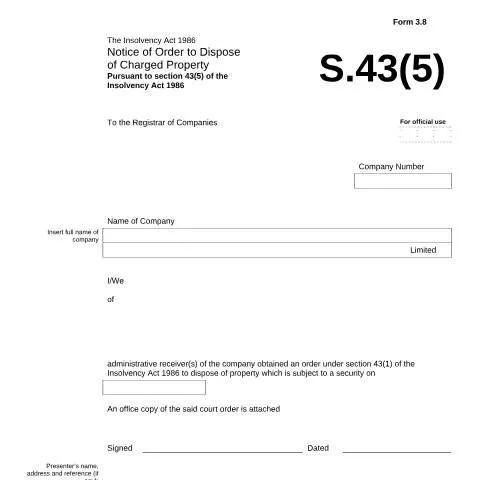
In the complex world of corporate insolvency, the Notice of Order to Dispose of Charged Property (Form 3.8) is a critical document that administrative receivers must understand thoroughly. When a company experiences financial distress, assets that are charged as security for debts may need to be disposed of to recover funds for creditors. This document serves as an official communication to the Registrar of Companies regarding such an order and outlines specific legal implications under the Insolvency Act 1986.
Understanding the Legal Framework Behind Form 3.8
To appreciate the significance of Form 3.8, it is essential to grasp the legal context in which it operates. Under section 43(1) of the Insolvency Act 1986, an administrative receiver can obtain a court order allowing for the disposal of property that is charged. The Notice of Order to Dispose of Charged Property serves as a formal notification to the Registrar of Companies, confirming that the order has been granted and providing transparency in the insolvency process.
The Impact of Section 43(5) on Creditors and Debtors
Section 43(5) specifies the procedural requirements that an administrative receiver must follow when disposing of charged property. This section ensures that both creditors and debtors are aware of the proceedings, as it addresses the need for fairness and accountability during insolvency. The implications of failing to submit this notice appropriately can be severe, potentially leading to legal challenges or delays in asset disposal.
When is Form 3.8 Indispensable?
Administrative receivers should be acutely aware of the scenarios where Form 3.8 becomes necessary:
- Court-Ordered Disposal: When a court grants permission to sell or otherwise dispose of charged property, filing this notice becomes mandatory.
- Protecting Creditors' Interests: Submitting the notice is essential for ensuring that the interests of all creditors are represented and safeguarded during the asset disposal process.
- Compliance with Legal Obligations: It helps administrative receivers comply with their legal obligations under the Insolvency Act, thereby reducing the risk of personal liability.
Specific Situations Requiring Immediate Action
Consider the following situations where the filing of Form 3.8 is critical:
- A company has been deemed insolvent, and its assets are subject to charges held by secured creditors.
- An administrative receiver is appointed, and a court order is obtained to dispose of these charged assets.
- There is a risk of asset depreciation, necessitating a swift sale to maximize returns for creditors.
Navigating the Contents of the Notice
Form 3.8 is straightforward yet vital for the integrity of the insolvency process. Here's a breakdown of its essential components:
| Section | Description |
|---|---|
| Company Details | Includes the company number and full name, establishing the identity of the entity under insolvency. |
| Administrative Receiver Information | Identification of the administrative receiver(s) responsible for the company. |
| Court Order Reference | Details of the court order obtained under section 43(1) allowing for disposal. |
| Signature and Date | Mandatory sign-off by the administrative receiver(s), affirming the validity of the submission. |
| Presenter’s Information | Contact information for the individual submitting the notice to facilitate any necessary follow-up communications. |
Steps to Effectively Utilize Form 3.8
Administrative receivers must follow a structured approach when handling Form 3.8. Here’s a step-by-step guide:
Step 1: Secure a Court Order
Before filing Form 3.8, an administrative receiver must first obtain a court order. This order is crucial as it provides the legal basis for the disposal of charged property.
Step 2: Gather Necessary Documentation
Ensure that you have the following documents ready:
- The court order, which will be attached to Form 3.8.
- Any relevant correspondence with creditors regarding the proposed disposal.
Step 3: Complete Form 3.8
Fill out the notice accurately, ensuring all details are correct. Pay special attention to the company name and number, as inaccuracies can lead to complications.
Step 4: Submit to the Registrar of Companies
Once completed, submit Form 3.8 along with the court order to the Registrar of Companies. It’s advisable to do this promptly to avoid unnecessary delays in the disposal process.
Common Procedural Queries Surrounding Form 3.8
While the process seems straightforward, several queries often arise. Here are some frequent considerations:
What if the Court Order is Delayed?
If there are delays in obtaining a court order, administrative receivers should engage with the court to expedite the process. Timing is crucial, and any delays can adversely affect the recovery of assets.
How to Handle Objections from Creditors?
In cases where creditors object to the disposal of charged property, it is essential to represent these objections at the court hearing. The court will then decide on the validity of the objections before proceeding.
Can the Notice be Amended After Submission?
Once submitted, any amendments to Form 3.8 typically require resubmission with a note clarifying the changes made. Administrative receivers should maintain detailed records of all communications and changes for compliance purposes.
Interconnections with Related Documents and Procedures
Form 3.8 does not exist in isolation; it is part of a broader framework of insolvency procedures. Understanding these connections can provide deeper insights for administrative receivers:
- Form 3.8 and Form 3.9: While Form 3.8 deals with notices of disposal, Form 3.9 addresses notices of intention to appoint an administrative receiver. Understanding these forms can help receivers navigate their responsibilities effectively.
- Financial Statements: Receivers may need to provide a summary of financial statements, detailing the company's status and the rationale behind the proposed disposals.
- Communication with Secured Creditors: Continuous communication with secured creditors is essential to maintain transparency and trust throughout the asset disposal process.
Recognizing Common Interpretative Pitfalls
Misinterpretation of Form 3.8 can lead to significant errors. Here are some common pitfalls to avoid:
- Assuming Informal Notifications are Sufficient: Many receivers might think that verbal notifications to creditors suffice; however, formal written notice through Form 3.8 is essential for compliance.
- Overlooking the Importance of Timeliness: Delays in submitting Form 3.8 can hinder the disposal process and may lead to depreciation of assets. Timely action is crucial.
- Neglecting to Attach Required Documents: Failing to include the court order with Form 3.8 is a common mistake that can invalidate the notice.
By understanding the nuances of Form 3.8, administrative receivers can navigate the insolvency process more effectively, ensuring compliance with legal requirements while protecting the interests of creditors and the liquidated company.
Understanding Charged Property: What It Means for You
Charged property typically refers to assets that have been pledged as security for a loan or other obligation. This situation arises when a borrower grants a charge over their property to secure repayment of a debt. When dealing with charged properties, it’s crucial to comprehend the types of charges that can be placed on an asset, such as mortgages or other secured loans. These charges can have different implications depending on whether they are fixed or floating charges.
A fixed charge is a specific claim over an asset, whereas a floating charge allows the borrower to use and dispose of the asset in the ordinary course of business until a default occurs. Understanding the distinction can help you navigate your rights and obligations more effectively when notifying others about the disposal of such property.
Before you initiate any disposal action, it’s vital to consider whether there are other creditors with claims over the charged property, as this may affect your ability to sell or transfer the asset without undue complications. Always consult legal advice if you are uncertain about the potential consequences of disposing of charged property.
The Process of Notifying Relevant Parties
When you decide to dispose of charged property, notifying all relevant parties is an essential step. The notice should clearly outline the intention to sell or otherwise dispose of the property, and it must be served according to the legal requirements set out in the governing documentation of the charge. This might include sending formal written notices to credit holders or lenders who are secured by the charge.
It’s advisable to maintain a record of all communications sent and received. This can save you from potential disputes later. Generally, the notice must include:
- The identifying details of the charged property
- The nature of the charge
- The intended method of disposal
- A timeline for the disposal, if applicable
- Any conditions imposed by the charge
It's essential to adhere to the stipulations in the charge documents. Failing to provide proper notice can lead to complications, including the possibility of the transaction being challenged legally or counterclaims being filed by other creditors.
Handling Disputes and Challenges
Disposing of charged property may lead to disputes, especially if other creditors or stakeholders feel their interests are being undermined. Should a dispute arise, it’s crucial to address it promptly and effectively. In many cases, mediation or negotiation with the disputing parties may offer a resolution without escalating to litigation.
If disputes cannot be resolved amicably, you may need to seek court involvement. A court may review the circumstances surrounding the disposal of the charged property and consider whether proper notice was given and if all parties' rights were respected. Be prepared for the possibility of a court order that could either validate your disposal or impose restrictions on it.
Furthermore, under the Data Protection Act 2018 and UK GDPR, ensure that all communications regarding the disposal of charged property comply with these regulations. This includes protecting any personal data that may be involved in the transaction or notification process. Violations can result in substantial fines and legal repercussions.