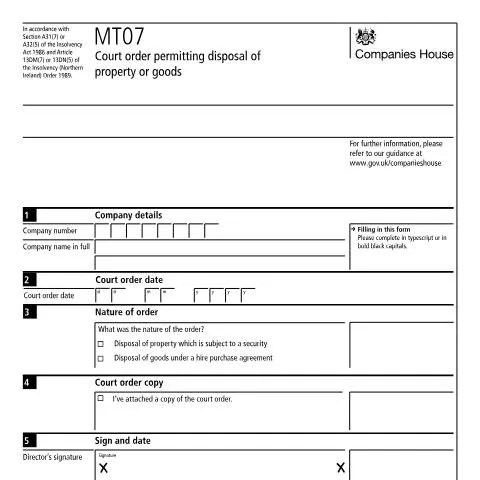
Navigating the MT07: Your Guide to the Court Order Permitting Disposal of Property or Goods
When managing assets within a company, situations may arise that necessitate the swift disposal of property or goods, especially under legal circumstances. The MT07 form is a crucial document submitted to Companies House, guiding companies through the process of obtaining a court order that permits such disposals. It’s essential to understand its context, implications, and the necessary steps to successfully navigate this process.
Understanding the Context: Why the MT07 Matters
Imagine a scenario where a company faces financial distress, leading to an insolvency situation. A court may issue an order allowing the company to dispose of certain assets to satisfy debts or obligations. The MT07 form acts as a bridge between the legal system and Companies House, ensuring that the disposal complies with regulations laid out in the Insolvency Act 1986. Specifically, sections A31(7) and A32(5) outline the procedures for issuing such orders, highlighting the form’s critical role in legal compliance.
In essence, the MT07 facilitates transparency and accountability in the disposal process, providing a structured way for companies to report such transactions. This ensures that all disposals are documented, which is vital for regulatory bodies, stakeholders, and the companies themselves when it comes to financial reporting and accountability.
Who Submits the MT07: A Detailed Look at the Stakeholders
The submission of the MT07 form is typically the responsibility of company directors or designated officers. However, understanding who exactly should fill out and submit this form requires delving into specific circumstances:
- Insolvency Practitioners: In cases of insolvency, an appointed insolvency practitioner might be responsible for filing the MT07. They act on behalf of the company to comply with legal requirements.
- Company Directors: If a court order is obtained prior to insolvency proceedings, the company directors will typically handle the submission to ensure all disposals are legally sanctioned.
- Legal Representatives: In certain scenarios where a company is represented by a legal team, they may prepare and submit the MT07 as part of a broader legal strategy.
Understanding these roles is crucial, as it delineates responsibility and ensures that the correct party is engaging with Companies House to safeguard the company's interests during asset disposal.
Decoding the MT07: Essential Sections and Common Pitfalls
Completing the MT07 form involves meticulous attention to detail. Each section serves a unique purpose and requires specific information to prevent delays or rejections from Companies House. Below is a breakdown of crucial sections of the MT07 along with potential pitfalls to watch out for:
Company Information
The first section requests the full name of the company along with its unique company number. This information must align exactly with what is recorded at Companies House.
- Common Mistake: Failing to use bold black capitals or typescript can lead to the form being rejected.
Nature of the Order
This section requires clarity regarding the type of order being submitted. Applicants must select between options such as:
- Disposal of property subject to a security
- Disposal of goods under a hire purchase agreement
The nature of the order must be explicitly stated to avoid confusion and to ensure compliance with the relevant legal framework.
- Common Pitfall: Misidentifying the type of order can lead to legal complications or delays.
Attach the Court Order
Including a copy of the court order is a non-negotiable requirement. This document serves as evidence of the legal authority to proceed with the disposal.
- Important Note: Ensure that the attached document is clear and legible. Poor quality scans can result in processing errors.
Signature and Date
A signature from the director or company officer is mandatory, along with the date of signing. This serves as confirmation that all information provided is accurate and truthful.
- Tip: Ensure that the signature matches official records to avoid discrepancies.
Submission Routes: Online vs. Paper, and What You Need to Know
Submitting the MT07 form can be achieved through various channels, each with its own set of guidelines and processing times.
Online Submission
Companies House encourages online submissions, which can often lead to quicker processing times. When opting for this route:
- Ensure that you have an active account with Companies House.
- Upload the completed MT07 form along with the attached court order as digital files.
Paper Submission
For those preferring a paper route, the MT07 must be printed, completed in typescript or bold black capitals, and sent to the appropriate address:
| Region | Address | DX |
|---|---|---|
| England and Wales | The Registrar of Companies, Companies House, Crown Way, Cardiff, Wales, CF14 3UZ. | DX 33050 Cardiff |
| Scotland | The Registrar of Companies, Companies House, Fourth Floor, Edinburgh Quay 2, 139 Fountainbridge, Edinburgh, Scotland, EH3 9FF. | DX ED235 Edinburgh 1 |
| Northern Ireland | The Registrar of Companies, Companies House, Second Floor, The Linenhall, 32-38 Linenhall Street, Belfast, Northern Ireland, BT2 8BG. | DX 481 N.R. Belfast 1 |
It's crucial to ensure that the company name and number on the form match the public register. Any discrepancies can lead to the form being returned or rejected.
The Broader Context: Where MT07 Fits in the Administrative Landscape
The MT07 form does not operate in isolation but rather as part of a broader framework of insolvency and asset management regulations. Understanding its place within this framework requires consideration of various interconnected processes:
- Insolvency Proceedings: The MT07 may be part of a larger set of documents submitted during insolvency proceedings.
- Reporting Requirements: Disposals must often be reported in subsequent financial statements, impacting the company’s financial health and stakeholder perceptions.
- Compliance with the Insolvency Act: Proper use of the MT07 ensures compliance with the Insolvency Act 1986, thereby safeguarding directors from potential legal repercussions.
This interconnectedness highlights the importance of accurate and timely submission of the MT07, as errors can cascade into broader compliance issues.
What to Do If Things Go Awry: Handling Refusals and Errors
Even with the best preparations, issues can arise during the submission of the MT07. Understanding the potential problems and how to address them is crucial for smooth navigation through the process:
Refusals
If Companies House refuses your submission, they will typically provide a reason. Common reasons for refusals include:
- Incomplete information on the form
- Attachments not provided, such as the court order
- Signature issues or mismatches with official records
In these cases, promptly rectify the cited issues and resubmit the form along with any necessary documentation.
Missing Information
Should any information be missing, Companies House may return your MT07 form. It is essential to carefully review your submission against their requirements before sending it off. Keeping a checklist of required information can significantly reduce the chances of this occurring.
Following Up: How to Track Your MT07 Submission
Once the MT07 form is submitted, keeping track of its status is essential. Companies House provides several ways to follow up on submissions:
- Online Tracking: If submitted online, you can often track the status via your account.
- Contacting Companies House: If there are concerns, reaching out to Companies House directly can provide clarity. Remember to have your company number and submission details handy when contacting them.
Effective communication with Companies House is vital for ensuring that any issues are addressed promptly and that your submission is processed without delay.
Final Thoughts: The Importance of Accuracy and Compliance
Understanding the intricacies of the MT07 form is essential for directors and stakeholders involved in asset management and disposal. This form is not merely a bureaucratic requirement; it represents a vital tool in navigating the complexities surrounding insolvency and asset management.
Through meticulous preparation, a clear understanding of the submission process, and awareness of potential pitfalls, companies can effectively manage their legal obligations while safeguarding their interests in the face of asset disposal. Engaging with Companies House correctly will not only ensure compliance but will also foster trust and transparency with stakeholders, which is imperative in today’s business landscape.
Understanding the Court Order for Disposal of Property or Goods (MT07)
In the context of UK law, a court order permitting the disposal of property or goods is often associated with cases where an individual or entity has been granted the right to sell, transfer, or dispose of specific assets. This can occur in various scenarios, including bankruptcy proceedings, enforcement of judgments, and disputes among joint owners. It is crucial to understand the conditions under which such an order can be obtained and the procedural steps involved.
The MT07 form is primarily used when the court has decided that the disposal of property or goods is imminent for various reasons, including unpaid debts or the resolution of disputes regarding ownership. The application process usually requires the petitioner to outline the necessity for disposal, provide evidence of ownership, and clarify any outstanding claims or liens against the property in question.
When applying for an MT07 order, it’s essential to gather comprehensive documentation. This includes proof of ownership, valuation reports, and any correspondence with involved parties. The court will assess whether it is in the public interest to grant the order, taking into account the rights of any other parties involved. The process may also involve a hearing where affected parties can present their views, ensuring transparency and fairness.
Appealing a Court Order for Disposal
Once a court order allowing for the disposal of property or goods is granted, it may not be the end of the line for affected parties. There exists a right to appeal under certain circumstances. If an individual believes that the order was unjustly granted or there are procedural errors in the application process, they may seek to appeal the decision. The appeal must typically be lodged within a specific timeframe, commonly set at 21 days from the date of the order.
In appealing, the aggrieved party must provide a substantial basis for contesting the order. This involves filing the appropriate notice with the court and assembling a compelling argument, often supported by legal representation. The appeal process may lead to a fresh hearing, allowing both sides to present their case anew. The court may then reaffirm, vary, or set aside the original order based on the findings from the appeal.
Furthermore, it's important to consider the implications of the appeal process on the actual disposal of goods. Depending on the nature of the case, a stay may be issued, temporarily halting any sale or transfer of the property until the appeal is resolved. This aspect can be critical for protecting the rights of all parties involved in the dispute.
Legal Consequences of Non-Compliance with the MT07 Order
Compliance with a court order permitting the disposal of property or goods is mandatory. Failure to comply can lead to serious legal consequences, including contempt of court proceedings. A court may impose penalties, fines, or even custodial sentences against individuals who disregard the order. Therefore, understanding the implications and the required actions is crucial for anyone involved in such situations.
Once an MT07 order is in effect, the individual or entity responsible for executing the order must ensure that all actions taken are in strict adherence to the terms outlined by the court. This includes accurately documenting the sale or transfer of goods, providing necessary notices to affected parties, and ensuring that any proceeds from the disposal are handled according to court directives. Any deviation or mismanagement could lead to further legal challenges and potential liability.
Moreover, it’s worth noting that the disposal process itself often involves additional legal considerations. For instance, if the goods in question are subject to liens or other encumbrances, the disposer must be cognizant of these interests and ensure they are adequately addressed. This often involves consulting with legal experts to navigate the complexities of property rights and ensure compliance with both the MT07 order and broader property law.