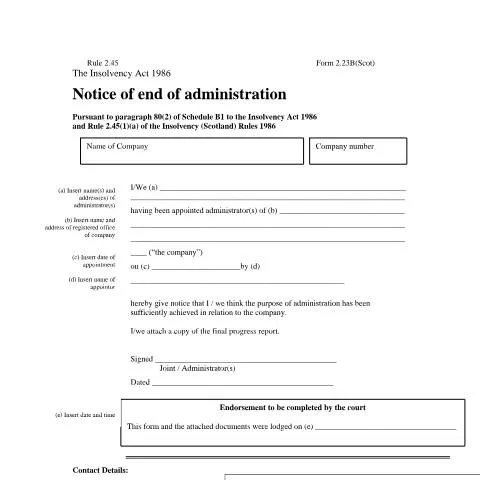
Understanding the Notice of End of Administration: Form 2.23B in Scotland
The Notice of End of Administration, denoted as Form 2.23B, is a crucial document within the framework of the Insolvency Act 1986, specifically designed for companies undergoing administration in Scotland. Its execution marks a significant juncture in the administration process, signaling that the objectives of the administration have been satisfactorily met. This article dives deep into the specifics of this notice, elaborating on its purpose, the processes involved, and practical considerations for those engaged in insolvency practices.
Unpacking the Purpose of the Notice
At the heart of the administration process lies the need for financial restructuring and recovery. When a company faces financial distress, administration provides a pathway to either rescue the business or achieve an orderly winding down. The submission of the Notice of End of Administration serves as a formal communication from the administrator to the Registrar of Companies, indicating that the efforts undertaken during the administration period have reached their objective.
- Objective Achievement: The administrator's assessment that the aims of the administration are fulfilled is paramount. This may involve successful restructuring, sale of business assets, or preventing liquidation.
- Final Progress Report: Accompanying the notice is a final progress report, which outlines the actions taken during the administration and the outcomes achieved.
Form Structure and Required Information
The Form 2.23B is not merely a blank template; it has specific sections where detailed information must be provided. Understanding the layout is essential for accurate completion.
| Section | Description |
|---|---|
| (a) Administrator(s) Details | Name(s) and address(es) of the appointed administrator(s) must be entered, ensuring that contact details are accurate for any follow-up. |
| (b) Company Information | Includes the name and registered office of the company undergoing administration, critical for identifying the entity concerned. |
| (c) Appointment Date | The date when the administrator was appointed should be included, providing a timeline for the administration process. |
| (d) Appointor's Details | The name of the person or entity that appointed the administrator must be recorded. |
| (e) Lodgement Information | The date and time when the form and attached documents are lodged with the court will be filled out post-submission. |
Key Considerations for Administrators
As administrators prepare to file the Notice of End of Administration, several factors should be considered to avoid common pitfalls and ensure compliance with legal obligations.
- Compliance with Schedule B1: Administrators must ensure that they are compliant with paragraph 80(2) of Schedule B1 of the Insolvency Act 1986, which governs the conclusion of administration.
- Document Preparation: The accompanying final progress report must be meticulously prepared, providing evidence of the actions taken, financial outcomes, and justifications for the termination of administration.
- Timeliness: Filing the notice within the appropriate timeframe is essential to maintain regulatory compliance and avoid potential penalties.
Navigating the Intersections with Other Insolvency Documents
The administration process is interlinked with several other insolvency documents, and understanding these relationships can enhance the effectiveness of the filing process.
- Comparison with Notice of Appointment: The Notice of Appointment (Form 2.23A) serves to notify stakeholders of the appointment of administrators, while the Notice of End of Administration indicates the conclusion. Keeping both documents in mind ensures a coherent narrative throughout the administration process.
- Final Report Requirements: The final progress report attached to Form 2.23B should reference prior documentation, such as the initial proposal submitted at the start of administration, to provide a comprehensive view of the company's status.
Practical Steps for Filing the Notice
To effectively utilize Form 2.23B, administrators must follow a series of practical steps that ensure compliance and clarity in the filing process.
- Drafting the Final Progress Report: Ensure this report highlights all critical developments during the administration, financial performance, and strategic decisions made.
- Completing Form 2.23B: Fill in all required fields accurately, using the guidance outlined in this article to avoid common errors.
- Verify and Sign: The form must be duly signed by the administrator(s), and it is advisable to double-check for accuracy before submission.
- Lodging the Notice: Submit the completed form and attached documents to the Registrar of Companies at Companies House, ensuring adherence to submission guidelines.
- Post-Submission Follow-up: Maintain communication channels open with Companies House, as they may reach out for clarification or additional information.
Addressing Common Queries about the Notice
In the realm of insolvency, several queries frequently arise regarding the Notice of End of Administration. Addressing these questions clarifies the process for all stakeholders involved.
- What happens if the administration was unsuccessful? In cases where the administration does not achieve its intended goals, the company may enter liquidation. Administrators should prepare alternate plans and communicate these changes clearly.
- Can the administration be extended? Extensions are possible under certain circumstances. The administrator may seek a court order to prolong the administration period if it is deemed necessary.
- What are the consequences of non-compliance? Failure to file the notice appropriately can result in legal repercussions, including potential fines, disqualification of directors, or additional scrutiny from regulatory bodies.
Final Thoughts on the Notice of End of Administration
Understanding the intricacies of the Notice of End of Administration: Form 2.23B is essential for administrators, legal professionals, and company directors alike. This document not only facilitates the formal conclusion of administration but also reflects the diligence and strategic decision-making that has transpired throughout the process. By adhering to the guidelines established, stakeholders can navigate this complicated landscape with confidence and clarity.
Understanding the Administration Process in Scotland
The administration process is a crucial aspect of insolvency law in Scotland, designed to rescue companies or achieve a better outcome for creditors than liquidation. Under the Insolvency Act 1986, administrators are appointed to manage the affairs of a company in financial distress. In this context, Form 2.23B, known as the Notice of End of Administration, is a vital document that signifies the conclusion of an administration process.
This form must be completed and lodged with the relevant authorities, typically the Accountant in Bankruptcy (AiB), once the administration period has concluded. Understanding the nuances of the administration process can help stakeholders—such as directors, creditors, and employees—navigate the complexities involved. The administrator must ensure that they have adequately fulfilled their duties during the administration period, which includes assessing the company’s financial position, communicating with creditors, and working towards either a voluntary arrangement or liquidation if necessary.
It's essential to highlight that the administration process can take different forms based on the company’s circumstances. For instance, if the administration was successful in rescuing the company, the end of administration might lead to a return to normal trading. Conversely, if a sale of assets was pursued, the end of administration may precede a complete wind-down of operations.
Moreover, the implications of the end of administration must be communicated effectively to all stakeholders involved to prevent any misunderstandings. The completion of Form 2.23B not only indicates that the company is no longer under administration but also serves as a formal record that can be pivotal in any future legal proceedings.
Completing Form 2.23B: Key Considerations
Filling out Form 2.23B requires meticulous attention to detail. The form is divided into several sections, each requiring specific information regarding the administration's conclusion. Here are some critical considerations for completing this form:
- Provide Accurate Company Information: Ensure that the company’s registered name and number are correct. Any discrepancies here can lead to delays or complications in processing the form.
- Details of the Administrator: Clearly state the name and address of the administrator. It is advisable to include their registration number as a licensed insolvency practitioner. This information will help provide context and validate the administrator's authority.
- Reason for End of Administration: It is crucial to accurately state the reason for the end of administration. Whether the company has been rescued, liquidated, or if the administration has simply run its course, clarity is vital for transparency.
- Signature and Date: The form must be signed by the administrator and dated appropriately. This signifies compliance with legal requirements and confirms that all information provided is accurate to the best of the administrator's knowledge.
Moreover, keeping thorough records throughout the administration process can aid in the completion of Form 2.23B. The administrator should have comprehensive documentation of meetings, communications with creditors, and any financial reports prepared during the process. These records not only support the information shared in the form but can also serve as valuable evidence should any disputes arise in the future.
Fill in your form directly online
No printing: type your details into the boxes of the official form, tick, then download the PDF ready to send.
- 1Type into the form boxes
- 2Tick in one click
- 3Save and download the PDF
The Aftermath of Administration: What Stakeholders Should Know
Once the administration process concludes and Form 2.23B has been submitted, various consequences and responsibilities emerge for all stakeholders involved. Understanding what comes next can mitigate uncertainty and enable smoother transitions.
For example, if the company has been successfully rescued, former employees and creditors may have concerns regarding job security and outstanding debts. Communication regarding the company’s operational status and future plans is critical. Transparency about the steps taken during administration and how the company intends to move forward can help restore confidence among stakeholders.
In cases where the administration ends with liquidation, stakeholders should be aware of their rights and the procedures for claiming owed amounts. Employees may be entitled to redundancy payments, while creditors must understand the process for submitting claims against any remaining assets.
Additionally, the administrator must be prepared for potential fallout from the administration process. This could include inquiries from regulatory authorities or even legal challenges from disgruntled creditors or shareholders. Engaging legal counsel during this stage can be beneficial, especially if there are complexities regarding asset distribution or if any discrepancies surfaced during the administration period.
Finally, it is prudent for stakeholders to familiarize themselves with further resources available through the AiB and other relevant authorities. These resources can provide guidance on post-administration procedures and rights, ensuring that everyone is informed and prepared for the next steps.