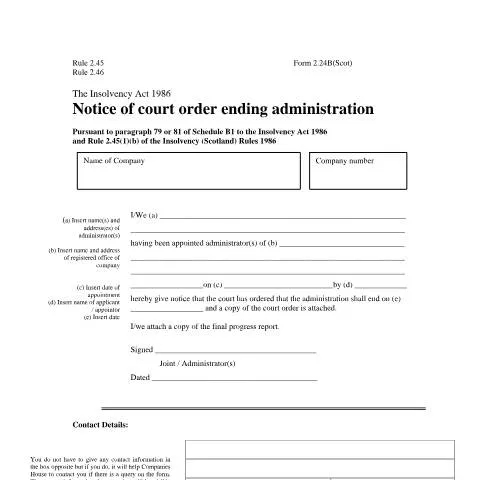
Understanding the Notice of Court Order Ending Administration: Form 2.24B (Scotland)
When a company in Scotland enters administration, it is crucial to follow a structured process to resolve its financial distress. One of the key documents in this procedure is the Notice of Court Order Ending Administration, formally known as Form 2.24B. This document signifies the conclusion of the administration phase and informs relevant stakeholders about the outcome. Understanding its nuances is essential for administrators, creditors, and company directors alike.
The Legal Framework Surrounding Form 2.24B
Form 2.24B is governed by the Insolvency Act 1986 and the Insolvency (Scotland) Rules 1986. Specifically, it adheres to Rule 2.45(1)(b), which outlines the necessary actions tied to ending administration. The information contained within this document is prompted by either paragraph 79 or 81 of Schedule B1 of the Insolvency Act 1986, which stipulates the conditions under which administration can be concluded.
- Paragraph 79: Addresses scenarios where a company may be restored to its original state or an exit from administration is warranted due to improved circumstances.
- Paragraph 81: Details alternatives such as liquidation or voluntary arrangements that could follow the administration phase.
The Role of Administrators in Relation to Form 2.24B
Administrators play a pivotal role in the administration process. They are tasked with the responsibility of managing the company’s affairs while aiming to rescue or wind down the enterprise. Upon receiving a court order that dictates the cessation of administration, the administrator must issue Form 2.24B. This form serves not only as a notification but also as an essential piece of documentation that must be submitted to Companies House.
It bears repeating that the completion and submission of this notice is not merely a bureaucratic step; it represents a vital communication tool to creditors, employees, and other stakeholders. The way this document is filled out can have lasting implications on the company’s reputation and its ongoing relationships.
Key Components of the Document
Form 2.24B contains several critical elements, each contributing to its purpose:
- Details of the Administrators: The names and contact information of the administrators are essential. This information ensures that stakeholders know who to reach out to for any further queries.
- Company Information: The name and registered office address of the company in administration must be provided, ensuring clarity about which entity is involved.
- Date of Appointment: This refers to when the administrators were appointed, marking the starting point of the administration phase.
- Order Date: Highlighting the date on which the court ordered the end of administration is crucial, as it establishes the timeline for all subsequent actions.
Practical Steps for Utilizing Form 2.24B
Administering a company’s end of administration process can be complex, but Form 2.24B simplifies this by outlining clear next steps for administrators.
- Obtain the Court Order: Ensure that you have the official court order that ends the administration. This document serves as the basis for the information you will report on Form 2.24B.
- Complete the Form: Accurately fill out each section, paying close attention to details such as the company name, registration number, and the dates involved.
- Attach Supporting Documents: When submitting Form 2.24B, include a copy of the final progress report. This report provides a comprehensive overview of the administration process and its outcomes, offering transparency to stakeholders.
- Submission to Companies House: The completed form, along with the attached documents, must be sent to the Registrar at Companies House in Edinburgh. Use the specified address to prevent any delays in processing.
These steps are critical, as any discrepancies or missing information can lead to delays or complications in the official closure of the administration process.
Target Audience and Indispensable Context for Form 2.24B
This notice is indispensable for multiple stakeholders involved in corporate insolvency:
- Administrators: They must understand the responsibilities tied to Form 2.24B to ensure compliance with the law.
- Creditors: Knowing when administration has ended is vital for creditors to decide their next course of action, whether that involves pursuing claims or entering into negotiations.
- Company Directors: Directors need to be informed about the implications of the end of administration on their company’s status and financial obligations.
Each stakeholder group has different motivations for consulting Form 2.24B, and understanding their perspectives can aid in smoother communication and resolution of outstanding issues following the end of administration.
Exploring Common Misinterpretations
Interpreting Form 2.24B can lead to misunderstandings, which is why clarity is essential. Here are some common misinterpretations that can occur:
- Assuming Immediate Closure: While the notice signifies the end of administration, it does not imply that all issues are resolved. There may still be outstanding debts or claims that need addressing.
- Misunderstanding the Role of the Administrator: Some stakeholders may mistakenly believe that the administrator's responsibility ends with the submission of Form 2.24B, rather than understanding that they may still play a role in resolving outstanding issues.
- Overlooking Follow-Up Requirements: Stakeholders may neglect to follow up on claims or communication that is still necessary once the administration has concluded.
By being aware of these misinterpretations, stakeholders can navigate the transition more effectively and avoid potential pitfalls.
Linkages with Other Documents in the Administration Process
Form 2.24B does not exist in isolation. It interacts with several other key documents in the insolvency framework, which is important for understanding its full context:
| Document | Purpose |
|---|---|
| Final Progress Report | Summarizes the administration process and provides stakeholders with insights into the decisions made. |
| Statement of Affairs | Offers a snapshot of the company’s financial position at the outset of administration. |
| Court Order | Officially concludes the administration process; essential for Form 2.24B completion. |
| Creditor Reports | Details communications with creditors, vital for transparency and trust. |
The interplay between these documents creates a comprehensive record of the administration process, ensuring that all parties are informed and engaged throughout the winding-down phase.
Final Considerations for Administrators: A Detailed Approach
As you navigate the complexities of the end of administration process through Form 2.24B, consider the following detailed approaches to ensure an effective transition:
- Engagement with Stakeholders: Maintain open lines of communication with creditors and employees. Hosting a meeting or issuing a communication can help clarify the outcomes and next steps.
- Monitor Legal Compliance: Ensure that all steps taken are compliant with the Insolvency Act 1986, including the proper filing of all necessary documents.
- Prepare for Post-Administration Issues: Be proactive in assessing any lingering obligations or potential disputes that may arise following the conclusion of administration.
These considerations can help align the administration's conclusion with broader corporate governance and financial recovery strategies, ultimately benefiting all stakeholders involved.
Understanding the Implications of a Notice of Court Order Ending Administration
When a business enters administration, it is a process designed to protect the company from creditors while a resolution is sought. The Notice of Court Order Ending Administration (form 2.24B) signifies an important turning point in this process. It effectively ends the administration phase and indicates to all stakeholders that the court has approved this action. Understanding the implications of such a notice is crucial for both the company and its creditors.
Once the administration ends, the directors typically regain control of the company, but various conditions may apply depending on the specific circumstances surrounding the administration. For creditors, this notice serves as a signal to reassess their positions. They may need to consider any outstanding debts and work towards recovery, as the administration process, while protective, also indicates that not all debts may be recoverable.
Moreover, the completion of administration could trigger different types of resolutions, such as a merger, takeover, or liquidation. Each scenario carries its own set of legal processes and implications, which creditors and stakeholders must navigate carefully. Therefore, it’s advisable to seek professional advice to assess the best course of action following the issuance of form 2.24B.
Filing and Procedural Requirements for Form 2.24B
The completion of form 2.24B is not just a bureaucratic step; it involves a series of filing and procedural requirements that must be adhered to. When completing this form, it is essential to follow the guidelines outlined by The Insolvency Service to ensure compliance with the relevant regulations.
The form itself requires detailed information, such as the date of the court order, the name of the company, and the particulars of the administrator. Additionally, it must be signed by the administrator and filed with the court. It is important to maintain accurate records of this filing, as it may be needed for future reference, especially if disputes arise regarding the administration process.
Furthermore, there are deadlines associated with the filing of this notice. For instance, it generally needs to be submitted promptly following the court order to ensure that all parties are duly informed of the end of the administration. Failure to meet these deadlines could result in penalties or complications that could affect the credibility of the administration process.
In some cases, an objection may arise against the court order, prompting a review or further hearings. Therefore, the implications of filing form 2.24B extend beyond mere completion; it is part of a larger legal framework that governs the conclusion of administration.
Navigating Challenges Following the End of Administration
After the Notice of Court Order Ending Administration is issued, various challenges may arise as the company transitions back to normal operations or faces liquidation. The challenges can include managing creditor expectations, addressing ongoing operational issues, and ensuring compliance with any conditions set by the court.
For instance, creditors may have legitimate queries regarding outstanding debts and the recovery of owed amounts. It is essential for the directors to communicate openly and transparently with creditors. They might consider holding a meeting or issuing a formal communication to clarify the company's position and future outlook. This transparency can help in rebuilding trust and potentially negotiating payment plans that benefit all parties involved.
In addition, operational challenges may emerge, especially if the company has been in administration for a prolonged period. The directors may need to reassess the management structure, workforce, and business strategies to ensure that the company can operate effectively moving forward. This may involve making difficult decisions regarding staffing or pivoting the business model to adapt to new market conditions.
Moreover, if the administration ended due to a failed restructuring plan, the company may face a looming threat of liquidation. In such cases, it is vital for the directors to stay vigilant about their responsibilities to the creditors and act in the best interests of all stakeholders. Seeking the guidance of insolvency practitioners can provide insight into the best routes to take at this juncture.