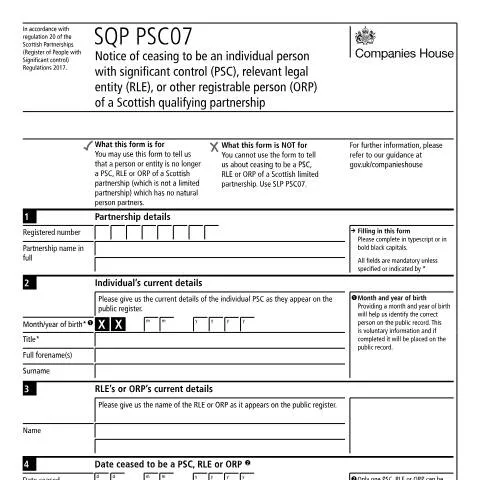
Understanding the SQP PSC07: A Key Document in Scottish Partnership Governance
When it comes to the intricacies of corporate governance in Scotland, understanding the role of significant control is paramount. The SQP PSC07 document serves as a critical notice for individuals and entities wishing to communicate their cessation as a person with significant control (PSC), relevant legal entity (RLE), or other registrable person (ORP) in a Scottish qualifying partnership (SQP). While the completion of this document is often seen as a mere administrative task, a deeper understanding of its contents and implications can lead to more effective compliance and smoother operational transitions.
Navigating the Process: Step-by-Step Guide
To successfully utilise the SQP PSC07, it’s essential to follow a systematic approach. Each step outlined here can help clarify the process and ensure all necessary information is accurately reported.
- Identify the Need for the Notice: Before starting the process, ascertain whether you are indeed ceasing to be a PSC, RLE, or ORP for the partnership in question. This is crucial as the document is specific to Scottish qualifying partnerships without natural person partners.
- Gather Required Information: Compile all necessary details about the partnership and the individual or entity ceasing their role. This includes:
- Partnership name
- Partnership registered number
- Current details of the individual or entity
- Date on which the person ceased to hold their position
- Complete the Document: Fill in the SQP PSC07 form with accurate information. Ensure to use typescript or bold black capital letters as specified.
- Signature Requirement: The individual or their appointed representative must sign the form. This step cannot be overlooked as it validates the cessation notice.
- Submission: Choose between submitting the document electronically via Companies House’s online services or mailing it to the appropriate address. Double-check the details to avoid delays.
Key Terminology: Decoding Essential Concepts
For those unfamiliar with the jargon associated with Scottish partnerships, understanding certain terms can greatly enhance your comprehension of the SQP PSC07 document:
- Person with Significant Control (PSC): An individual who meets specific thresholds of ownership or control over the partnership.
- Relevant Legal Entity (RLE): An entity that is registered as having significant control but is not an individual.
- Other Registrable Person (ORP): A term that includes various other entities that need to be disclosed under the same regulations.
- Scottish Qualifying Partnership (SQP): A type of partnership that conforms to particular legal standards in Scotland, generally characterised by its lack of natural person partners.
What the SQP PSC07 Covers: Scope and Limitations
The SQP PSC07 is specifically designed to address changes related to individual persons and entities' significant control within a Scottish qualifying partnership. However, it is essential to acknowledge its limitations:
- This document is strictly for use by partnerships that are NOT classified as limited partnerships. If you are involved with a limited partnership, you should refer to the SLP PSC07 instead.
- The document does not cover situations in which there are natural person partners involved in the partnership.
Common Misinterpretations and Their Consequences
Misunderstanding the implications of the SQP PSC07 can lead to significant administrative challenges. Here are some common misconceptions:
- Assuming Automatic Notification: Some individuals might think that simply ceasing to be a PSC automatically updates the public record. This is false; formal notification via the SQP PSC07 is necessary.
- Neglecting Accurate Date Entry: The date of cessation must be carefully noted. Incorrect dates can result in regulatory complications or delays in updating records.
- Overlooking Signatory Requirements: A common error involves submitting the form without a signature from the departing individual or their representative.
Interconnections with Other Regulatory Frameworks
Understanding how the SQP PSC07 interacts with other regulatory documents is vital for maintaining compliance. This notice is one part of a larger framework governing partnerships in Scotland:
| Document | Purpose | Relevance to SQP PSC07 |
|---|---|---|
| SLP PSC07 | Notice for cease of PSC in limited partnerships | Should be used for limited partnerships instead of SQP PSC07. |
| PSC Register Updates | Maintaining updated records of PSCs | SQP PSC07 facilitates necessary updates when a PSC ceases. |
| Annual Confirmation Statement (CS01) | Annual verification of company details | Ensure all registered partners are accurately reflected in the CS01. |
Practical Tips for Seamless Submission
Submitting the SQP PSC07 can be straightforward if a few practical tips are followed:
- Review Before Submission: Always double-check the information provided against your records before sending the document.
- Use Clear Formatting: Ensure that the document is typed correctly and formatted in bold black capitals to meet Companies House requirements.
- Keep a Copy: Retain a copy of the completed form for your records. This may be necessary for future reference or verification.
- Seek Confirmation: It’s advisable to confirm with the individual who is ceasing to be a PSC, RLE, or ORP that they are aware of the submission and have provided their consent.
Continuing Responsibilities Post-Submission
Once the SQP PSC07 has been submitted, there are still responsibilities to uphold:
- Monitoring Updates: Keep an eye on the Companies House register to ensure that the changes are accurately reflected.
- Maintain Records: Document all communications and submissions related to the cessation of control, as these may be needed in future audits or inquiries.
- Adhere to Other Reporting Requirements: Ensure that any other reporting obligations related to the partnership are still met, such as filing annual accounts or additional registration documents.
Final Thoughts on Effective Partnership Management
Understanding and properly utilising the SQP PSC07 is a vital aspect of managing a Scottish qualifying partnership. By being informed and proactive, partners can navigate the complexities of corporate governance more effectively, ensuring compliance and clarity in their business operations.
Understanding Your Role as a PSC, RLE, or ORP in the Context of an SQP
Before diving into the process of notifying HMRC about ceasing to be a Person of Significant Control (PSC), Relevant Legal Entity (RLE), or Other Relevant Person (ORP) in a Small Quoted Company (SQC), it’s essential to grasp the implications of these roles. Being a PSC, RLE, or ORP involves specific responsibilities and legal requirements that can significantly impact a company's governance and compliance with the Companies Act 2006.
A PSC is an individual who holds more than 25% of the shares or voting rights, or who otherwise exercises control over the company. RLEs can include partnerships or corporate entities that maintain significant control or influence. ORPs typically refer to persons or entities that do not fit strictly into PSC or RLE categories but still play a vital role in the company’s operations. Understanding your responsibilities is crucial, not just for compliance but also for maintaining the trust of stakeholders and the integrity of the financial markets.
The Process of Completing the PSC07 Form: Step-by-Step Guide
Completing the PSC07 form is a critical step when you decide to cease being a PSC, RLE, or ORP of an SQP. Below is a detailed step-by-step guide to help you navigate this process efficiently.
- Assess Your Eligibility: Ensure that you indeed meet the criteria for ceasing to be a PSC, RLE, or ORP. This typically involves transferring your shares, relinquishing control, or other actions that diminish your influence over the company.
- Gather Necessary Information: Collect all relevant details about the company and your position. This includes your National Insurance number, company registration number, and details of the shares you previously held.
- Complete the Form: Use the PSC07 form to provide all required information. This includes your name, address, and the date on which you ceased to be a PSC, RLE, or ORP. Be precise and accurate, as inaccuracies can lead to delays or complications.
- Submit the Form: The PSC07 can be submitted online via Companies House’s WebFiling service or sent via post. If you choose to send it by post, ensure it is properly addressed to the appropriate Companies House office, as per the guidelines.
- Keep Records: After submission, retain copies of the form and any correspondence for your records. This is essential in case of any future inquiries or audits.
Completing the PSC07 form accurately and promptly is vital. The deadline for filing is typically within 14 days of the change, ensuring compliance with the Companies Act 2006.
Common Pitfalls and How to Avoid Them
While the process of ceasing to be a PSC, RLE, or ORP may seem straightforward, there are several common pitfalls that individuals and entities can encounter. Here are some of the most frequent issues and tips on how to avoid them:
- Incomplete Information: One of the most common mistakes is failing to provide complete and accurate information on the PSC07 form. Ensure that all sections are filled out as required and double-check for any possible errors.
- Missed Deadlines: Be aware of the deadlines associated with submitting the PSC07 form. A delay in submission can lead to penalties or complications in your company’s compliance status. It’s advisable to mark your calendar with key dates related to your filing obligations.
- Unawareness of Additional Obligations: Ceasing to be a PSC, RLE, or ORP may trigger other obligations, such as notifying HMRC regarding any tax implications or changes in your National Insurance contributions. Stay informed about related requirements to avoid falling into compliance traps.
- Neglecting Stakeholder Communication: Failing to inform other stakeholders of your change in status may cause confusion or mistrust. It is good practice to communicate your intentions clearly and transparently to relevant parties.
- Ignoring Legal Changes: Laws and regulations can change. Regularly check for updates to the Companies Act 2006 or any amendments that may affect your responsibilities or the PSC07 process. This ensures that you remain compliant and well-informed.
By being aware of these potential pitfalls and taking proactive measures, you can facilitate a smoother transition when ceasing to be a PSC, RLE, or ORP in an SQP.