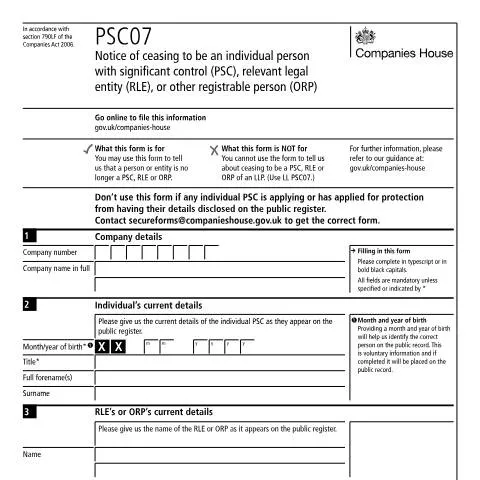
When Companies Lose Their Key Controllers: Understanding the PSC07 Cessation Process
The departure of a person with significant control from a company marks a pivotal moment in corporate governance that demands immediate attention from directors and company secretaries. Whether triggered by a shareholding dilution, resignation from directorship, or the sale of voting rights, these changes fundamentally alter the company's control structure and must be formally communicated to Companies House through the PSC07 notice.
This administrative requirement extends beyond simple notification—it represents a critical compliance checkpoint that affects the company's public record, transparency obligations, and regulatory standing. The PSC07 form serves companies limited by shares or guarantee, excluding limited liability partnerships which require the separate LL PSC07 variant.
Decoding the Three Categories of Departing Controllers
The PSC07 framework encompasses three distinct types of departing entities, each carrying specific identification requirements and procedural nuances that companies must navigate carefully.
Individual Persons with Significant Control
Individual PSCs represent the most common category, typically encompassing company directors, major shareholders, or persons exercising significant influence through voting agreements. The form requires their current details as they appear on the public register, emphasising the importance of maintaining accurate records throughout their tenure.
Month and year of birth information, whilst optional, provides crucial disambiguation where multiple individuals share similar names. This voluntary data becomes part of the public record, helping searchers identify the correct person among potential matches.
Relevant Legal Entities
RLEs typically include corporate shareholders, parent companies, or institutional investors that previously held qualifying positions within the company structure. These entities must be identified precisely using their registered name as it appears on the public register, avoiding any abbreviations or informal variations that might create confusion.
Other Registrable Persons
The ORP category captures entities that don't fit neatly into individual or corporate classifications but nonetheless exercise significant control. This might include unincorporated associations, partnerships, or trusts that have held qualifying positions within the company's control framework.
Critical Timing Requirements and Confirmation Protocols
The PSC07 process hinges on two fundamental dates that companies must carefully distinguish and document: the actual cessation date and the confirmation date.
| Date Type | Definition | Documentation Requirement |
|---|---|---|
| Cessation Date | When the person actually stopped being a PSC, RLE, or ORP | Must be precisely determined based on shareholding records, agreements, or other evidence |
| Confirmation Date | When the company confirmed both the cessation and its effective date | Later of the two confirmation events if they occurred on different dates |
Companies must obtain explicit confirmation from departing individual PSCs that their particulars are correct before submitting the PSC07. This requirement creates a deliberate checkpoint, ensuring accuracy whilst protecting individuals from unauthorised disclosure of incorrect information.
The confirmation protocol becomes particularly significant when dealing with contentious departures or disputed control arrangements. Companies cannot simply assume cessation has occurred—they must actively verify and document the change through appropriate channels.
Authentication Hierarchy and Authorisation Boundaries
The PSC07 form accepts authentication from a carefully defined hierarchy of company officials, each carrying specific responsibilities and limitations within the filing process.
Standard Company Officers
Directors and company secretaries represent the primary authentication tier, possessing inherent authority to file PSC notifications as part of their statutory duties. Their authentication carries presumptive validity, though they remain liable for accuracy and completeness.
Authorised Persons Under Companies Act Provisions
Persons authorised under sections 270 or 274 of the Companies Act 2006 may authenticate PSC07 forms, extending filing authority beyond traditional company officers. This provision accommodates situations where standard officers are unavailable or where specific authorisation arrangements exist.
Insolvency and Receivership Officials
The authentication framework extends to various insolvency practitioners, including administrators, receivers, and judicial factors. This breadth ensures continuity during corporate distress situations when normal governance structures may be disrupted or superseded.
Societas Europaea Considerations
European companies operating under SE status require specific authentication modifications, reflecting their distinct governance structures. The standard 'director' designation must be deleted and replaced with details of the relevant SE organ membership, acknowledging the different organisational framework these entities employ.
Protected Disclosure Scenarios and Alternative Procedures
The PSC07 process encounters significant complications when dealing with individuals who have applied for, or obtained, protection from public disclosure of their personal details. These situations demand entirely different procedural approaches that companies must recognise early in the process.
Companies House explicitly prohibits using the standard PSC07 form when any individual PSC has applied for disclosure protection, regardless of whether that application has been approved. Instead, companies must contact [email protected] to obtain appropriate alternative forms that accommodate protected disclosure requirements.
This prohibition reflects the serious nature of disclosure protection arrangements, which typically arise in circumstances involving personal safety concerns, witness protection programmes, or other sensitive situations requiring enhanced privacy measures.
Identifying Protected Status Indicators
Companies should establish protocols for identifying when departing PSCs may have protected status, including:
- Regular communication with PSCs regarding any protection applications
- Monitoring for unusual correspondence from Companies House regarding specific individuals
- Maintaining awareness of any personal security concerns expressed by PSCs
- Consulting legal advisors when uncertainty exists about protection status
Presenter Information Strategy and Public Record Implications
The PSC07 form's presenter information section creates an interesting strategic choice for companies, balancing operational convenience against public disclosure preferences. Unlike many Companies House forms where contact details remain private, presenter information becomes part of the public record, visible to anyone searching company records.
Voluntary Disclosure Considerations
Companies are not obligated to provide presenter contact information, but doing so facilitates resolution of any queries Companies House may raise regarding the filing. This creates a practical tension between transparency and privacy that different companies resolve according to their specific circumstances and policies.
Professional service providers, such as corporate secretarial firms or legal advisors, often serve as presenters to shield internal company personnel from direct public contact whilst maintaining professional communication channels with the registrar.
Strategic Information Management
Effective presenter information management involves considering:
- Whether queries are likely given the complexity of the cessation
- The company's tolerance for public disclosure of internal contact details
- Availability of professional intermediaries to serve as presenters
- Long-term implications of contact information appearing on public records
Common Pitfalls in Cessation Date Determination
Accurately determining when someone ceases to be a PSC, RLE, or ORP presents more complexity than initially apparent, particularly in situations involving gradual transitions, conditional arrangements, or disputed interpretations of control thresholds.
Shareholding Dilution Scenarios
When PSC status changes due to shareholding dilution, companies must pinpoint the exact moment when ownership fell below qualifying thresholds. This becomes particularly challenging during phased transactions, rights issues, or complex corporate restructuring where multiple events affect ownership percentages simultaneously.
The cessation date corresponds to when the dilution actually occurred, not when it was planned, agreed, or subsequently documented. Companies must therefore maintain precise records of share transfers, allotments, and other ownership-affecting events to determine accurate cessation dates.
Voting Rights and Influence Arrangements
PSC status often depends on voting rights or influence arrangements that may terminate through various mechanisms beyond simple share transfers. Voting agreements, proxy arrangements, or influence pacts may expire, be terminated, or become ineffective, each potentially triggering PSC cessation requirements.
Companies must monitor these arrangements carefully, particularly where they involve complex commercial relationships or conditional arrangements that may affect PSC status unpredictably.
Death and Incapacity Situations
Individual PSC cessation through death or legal incapacity requires sensitive handling, with cessation dates corresponding to when the relevant event occurred rather than when it was discovered or formally confirmed. Companies must balance accuracy requirements with practical challenges in obtaining necessary documentation and confirmations.
Integration with Ongoing PSC Register Maintenance
The PSC07 filing represents just one element within the broader PSC register maintenance framework that companies must manage continuously. Understanding how cessation notifications integrate with other PSC obligations ensures comprehensive compliance and avoids regulatory gaps.
Companies must simultaneously update their internal PSC register, reflecting the departure whilst ensuring continuity of control documentation. This dual requirement—internal register maintenance and external notification—demands coordinated administrative processes that prevent discrepancies between internal records and public filings.
The timing of PSC07 submission relative to other corporate events, such as confirmation statements or accounts filings, requires strategic coordination to ensure regulatory consistency across all Companies House interactions. Late or inconsistent PSC notifications can trigger regulatory scrutiny that extends beyond the immediate compliance requirement.
Forward-looking companies establish PSC monitoring protocols that anticipate potential changes, enabling proactive rather than reactive compliance management. These systems prove particularly valuable during periods of corporate change, ensuring PSC obligations remain current despite shifting business circumstances.
Digital Submission and Authentication Requirements
The PSC07 form must be filed electronically through Companies House WebFiling service or via approved third-party software. Paper submissions are no longer accepted for PSC notifications, reflecting the government's digital-first approach to company administration. The authentication process requires the company's authentication code, which differs from the standard company number and serves as a security measure to prevent unauthorised filings.
When accessing the WebFiling system, you'll need to enter the company number, authentication code, and select 'People with significant control' from the filing options menu. The system will then present the PSC07 form template, which includes mandatory fields for the departing PSC's details and the cessation date. All fields marked with an asterisk must be completed before submission is possible.
The digital signature process involves confirming that the information provided is accurate and complete to the best of your knowledge. This carries the same legal weight as a physical signature under the Electronic Communications Act 2000. Companies House systems automatically generate a receipt upon successful submission, which should be retained for your records as proof of filing.
For companies using third-party software, ensure the application is authorised by Companies House and capable of handling PSC notifications. Popular accounting packages often include this functionality, but verification of compatibility is essential before relying on automated submissions. The software must generate the correct XML format and include all mandatory data fields to avoid rejection.
Impact on Statutory Registers and Record-Keeping
Filing PSC07 triggers automatic updates to the public PSC register held at Companies House, but companies must also maintain their internal PSC register accordingly. The cessation date recorded on PSC07 becomes the official end date for the individual's significant control status, affecting both public records and internal compliance documentation.
Companies must update their internal PSC register within 14 days of becoming aware of the change, which typically coincides with the PSC07 filing deadline. This register should record the cessation date, circumstances of departure, and any relevant supporting documentation. The internal register serves as the primary source for future filings and must align exactly with information submitted to Companies House.
Cross-referencing between the PSC register and other statutory books may be necessary, particularly the register of members if the departing PSC was also a shareholder. Share transfers that reduce holdings below PSC thresholds should be documented consistently across all registers to maintain audit trails and regulatory compliance.
Annual confirmation statements (CS01) will reflect the updated PSC position automatically once PSC07 has been processed. However, companies should verify this information when preparing their next confirmation statement to ensure accuracy. Discrepancies between PSC records and confirmation statements can trigger compliance queries from Companies House.
Record retention requirements under the Companies Act 2006 mean PSC-related documentation, including PSC07 submissions and supporting evidence, must be kept for at least ten years from the cessation date. This includes correspondence with the departing PSC, board resolutions acknowledging the change, and any legal opinions regarding control thresholds.
Complex Ownership Structures and Multiple PSC Changes
Companies with intricate ownership arrangements often face challenges when PSC status changes affect multiple individuals simultaneously. Corporate restructuring, family trust arrangements, or investment fund rebalancing can trigger several PSC cessations and appointments concurrently, requiring careful coordination of multiple form submissions.
When multiple PSCs are departing, separate PSC07 forms must be filed for each individual, even if the changes occur on the same date due to a single transaction. The forms should be submitted together where possible to provide Companies House with complete context about the ownership restructuring. Sequential submission of related changes can sometimes cause confusion in the public record.
Indirect control scenarios present particular complexity, especially when intermediate holding companies undergo ownership changes. An individual may cease to be a PSC not through direct share disposal, but because their control over an intermediate entity has been diluted. In such cases, PSC07 must clearly indicate the cessation date based on when the indirect control fell below threshold levels.
Trust arrangements require special attention when beneficiaries or trustees change, potentially affecting PSC status. Where individuals hold PSC status through discretionary trusts, changes in beneficiary circumstances or trustee appointments may necessitate PSC07 filings. The cessation date should reflect when the individual's right to exercise significant control actually ended, not necessarily when formal trust documentation was executed.
Joint control situations, where multiple individuals collectively exercise significant control, can create ambiguity about cessation timing. If joint controllers reduce in number but remaining individuals still meet PSC thresholds, departing members require PSC07 filings while others may need PSC04 updates to reflect changed circumstances. Clear documentation of control-sharing arrangements helps determine accurate cessation dates.
Companies should consider engaging legal counsel when complex ownership changes affect PSC status, particularly involving offshore structures, partnership interests, or sophisticated financial instruments. Professional advice ensures compliance with both Companies House requirements and broader regulatory obligations under economic crime legislation and beneficial ownership disclosure rules.