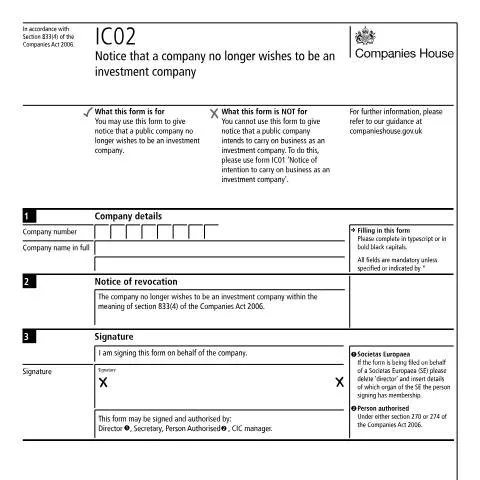
Navigating the IC02: A Comprehensive Guide to Stopping Investment Company Status
In the dynamic landscape of UK business operations, investment companies play a unique and critical role. However, there are instances when a public company may decide to cease its status as an investment company. This is where the IC02 notice, formally known as the "Notice of intention to stop being an investment company," comes into play. The IC02 is not merely a form; it is an essential document that signifies a pivotal transition in the company's operational strategy.
Understanding the Implications of Filing the IC02
Deciding to stop being an investment company can arise from various strategic business decisions. The implications of filing the IC02 are significant, as it indicates a shift in how the company will operate moving forward.
- Regulatory Compliance: Filing the IC02 is a legal requirement under Section 833(4) of the Companies Act 2006, establishing that the company no longer wishes to be classified as an investment company.
- Impact on Investment Strategy: By ceasing to be an investment company, the entity may alter its investment goals, focusing instead on other business operations or sectors.
- Change in Reporting Obligations: There are significant differences in regulatory reporting obligations for investment companies versus non-investment companies, which can impact how the business is managed and reported to stakeholders.
Critical Steps to Prepare Before Submission
Before initiating the filing process for the IC02, several preparatory steps are crucial to ensure a smooth transition. This preparation can help avoid delays or the return of improperly completed documents.
- Review Company Status: Ensure that the company meets the criteria for ceasing its classification as an investment company.
- Consult Legal Advice: Seek legal guidance to fully understand the implications of this status change, especially regarding shareholder agreements and fiduciary duties.
- Internal Communication: Inform stakeholders, including employees, shareholders, and board members, about the planned transition to manage expectations and facilitate buy-in.
What the IC02 Notice Specifically Covers
The IC02 is specifically designed for public companies that wish to notify Companies House of their decision to stop being an investment company. However, it is crucial to understand what this document does not cover to avoid confusion:
- This notice does not indicate a company’s intention to start or continue operating as an investment company. For such interests, the IC01 form must be filed instead.
- It is also pivotal to note that the IC02 is not a form to be used for private companies, which are governed by different regulations when it comes to investment classifications.
Essential Components of the IC02 Form
When completing the IC02, certain components must be accurately filled out to ensure compliance with Companies House regulations. Each section of the form has a specific purpose and requires careful attention.
| Form Section | Description |
|---|---|
| Company Details | Includes the full company name and company number, which must match the public register to avoid rejection. |
| Notice of Revocation | This section confirms the company's intention to revoke its status as an investment company. |
| Signature | Must be signed by a director, company secretary, or an authorized person representing the company. |
| Contact Information | While not mandatory, providing contact details can facilitate correspondence if Companies House has queries. |
Pitfalls to Avoid When Filing the IC02
When submitting the IC02 to Companies House, awareness of common pitfalls can prevent unnecessary complications that may delay the process or result in rejection.
- Mismatched Information: Ensure all details provided match the public record; discrepancies can lead to form rejection.
- Incomplete Fields: Every section marked as mandatory must be completed, as leaving fields blank can be grounds for returning the form.
- Failure to Sign: The IC02 must be duly signed; an unsigned form will be considered invalid.
Linking the IC02 with Other Regulatory Requirements
The decision to file an IC02 may have broader implications that tie into various regulatory frameworks, particularly regarding financial reporting and corporate governance.
- Annual Return Filings: Following the cessation of investment company status, companies may undergo changes in their reporting requirements as outlined under other sections of the Companies Act.
- Financial Statements: The transition will also require the company to ensure that its financial statements reflect the new operational status.
- Ongoing Compliance: Switching from investment to non-investment status will necessitate ongoing compliance with the relevant laws governing non-investment companies.
Case Scenarios for Filing the IC02
Understanding the context in which a company would file the IC02 can provide insight into its strategic use. Here are examples of scenarios where the IC02 may become necessary:
- Shifts in Business Strategy: A company may pivot from an investment-focused business model to a service-oriented approach, necessitating a change in status.
- Market Conditions: Economic downturns or shifts in market dynamics may compel a company to reassess its investment activities and cease investment operations.
- Regulatory Changes: New regulations may alter the viability of maintaining investment company status or influence operational strategies.
Post-Submission Considerations
Once the IC02 has been filed, there are several considerations for the company to keep in mind to ensure compliance and smooth transitions into its new operational status:
- Monitor Approval: Keep track of the status of the submitted IC02 with Companies House to confirm that it has been accepted and processed.
- Update Internal Policies: Revise company policies and operational procedures to align with the new business model that no longer categorizes the company as an investment entity.
- Communicate with Stakeholders: Maintain transparent communication with all stakeholders regarding the changes in operational status and what it means for them moving forward.
Final Thoughts on the IC02 Process
Transitioning away from investment company status is a significant step for any public company in the UK. The IC02 notice serves as a formal notification to Companies House of this change and invites careful consideration of the implications tied to such a decision. Ensuring compliance with the form’s requirements, understanding the associated obligations, and communicating effectively with stakeholders are critical components of successfully navigating this transition.
By taking the time to thoroughly understand the IC02 and its relevance, companies can make informed decisions about their future and operational focus, ultimately positioning themselves for success in their chosen business models.
Understanding the Investment Company Framework in the UK
The Investment Company framework in the UK operates under the Companies Act 2006, with specific provisions tailored for those companies whose primary objective is to manage investments for profit. These companies are categorized under the Financial Services and Markets Act 2000 (FSMA) and thus have to adhere to a set of regulatory standards imposed by the Financial Conduct Authority (FCA). Understanding the nuances of being classified as an investment company is crucial for directors and shareholders alike.
Investment companies benefit from a distinct tax regime and possess certain operational flexibilities, such as the ability to distribute profits more transparently to shareholders through dividends. However, these benefits are accompanied by regulatory oversight that requires comprehensive reporting, ensuring that all transactions align with the principles of transparency and accountability. Companies need to be vigilant, ensuring compliance with both the Companies Act and FCA regulations, as non-compliance can lead to substantial penalties and potentially jeopardize their standing as an investment entity.
Moreover, directors need to assess their company's operational focus continuously. If a company shifts its business model away from investment activities, the act of notifying one's intention to cease being classified as an investment company is the appropriate course of action. Such a transition might arise from strategic business shifts, financial restructuring, or market conditions that necessitate a pivot away from traditional investment operations. As a director, understanding when and how to notify the Companies House of this change is vital for maintaining regulatory compliance and protecting the interests of shareholders.
Consequences of Not Following the IC02 Procedure
Failing to adhere to the correct procedure when notifying the Companies House of your intention to stop being an investment company can have significant repercussions. Initially, companies may face regulatory scrutiny, which can lead to investigations by the FCA or Companies House. This scrutiny can be damaging not only to a company's reputation but also to its operational capabilities, as it may hinder future fundraising efforts or partnerships.
Furthermore, if a company does not formally notify its intention to change its classification, it may become inadvertently liable for regulatory breaches linked to investment activities it no longer engages in. This misalignment can lead to severe financial penalties and potential disqualification of directors if deemed willful neglect. Beyond mere financial implications, there’s also the risk of legal ramifications, particularly if shareholders or investors feel that they were misled about the company’s operational focus or financial stability.
Additionally, companies may miss out on tax efficiencies associated with their investment company status. For example, investment companies are often entitled to specific tax advantages, such as exemptions from certain capital gains taxes. Transitioning away from investment status without proper notification could lead to unexpected tax liabilities, resulting in a significant financial burden. Therefore, the importance of carefully following the IC02 procedure cannot be overstated; it is essential for both compliance and continued operational health.
The Role of Shareholder Approval in the IC02 Process
The process of notifying Companies House of your intention to stop being an investment company (via form IC02) often intersects significantly with shareholder approval. While the legislation specifically outlines the procedural requirements for notification, it does not explicitly mandate shareholder approval for the decision itself. However, best practices suggest that obtaining shareholder consent is advisable to maintain transparency and uphold good governance practices.
Engaging shareholders through formal meetings—whether annual general meetings (AGMs) or extraordinary general meetings (EGMs)—allows directors to present the rationale behind the proposed change. This engagement not only fosters trust but also provides a platform for addressing any concerns or objections shareholders may have. In cases where a significant number of shareholders oppose the decision, it can prompt directors to reconsider their approach or to adjust the timing of the notification process accordingly.
Moreover, in the context of the UK’s data protection regulations under the Data Protection Act 2018, directors must ensure that any communication regarding this change is handled with care, safeguarding personal data while effectively conveying the necessary information to stakeholders. This maintains compliance with the UK GDPR and prevents potential breaches that could arise from mismanaged communications.
Ultimately, securing shareholder approval is not just about compliance; it’s about fostering a collaborative environment where shareholders feel invested in the company’s direction. Failure to do so could lead to shareholder discontent, affecting the company's stability and future operations. Thus, while it may not be a legal requirement, it is indeed a strategic recommendation.