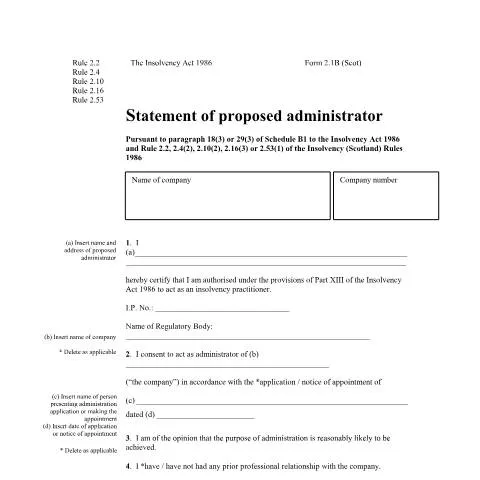
Navigating the Statement of Proposed Administrator: Form 2.1B (Scotland)
When faced with financial distress, companies in Scotland may find themselves in need of restructuring through administration. One pivotal step in this process is the completion and submission of the Statement of Proposed Administrator: Form 2.1B. This document is critical for appointing an administrator who will oversee the company’s transition while aiming to safeguard its viability.
Understanding the Context: Why the Statement of Proposed Administrator Matters
In the realm of insolvency, the Insolvency Act 1986 lays down the framework for companies undergoing financial difficulties. The form 2.1B is a formal requirement that articulates the proposed administrator’s intent to take on the role. Under paragraphs 18(3) and 29(3) of Schedule B1 to the Insolvency Act 1986, this document is essential for ensuring that the administration process is initiated correctly.
Who Completes the Form?
The responsibility of completing this form typically lies with the insolvency practitioner who has been proposed for the role of administrator. This practitioner must be authorized under the provisions of Part XIII of the Insolvency Act 1986. Understanding who is qualified to submit this document is pivotal, as only those holding an appropriate license may act as an administrator.
Step-by-Step Guidance: Completing the Form 2.1B
Completing Form 2.1B requires careful attention to detail. Below is a structured approach to filling it out:
- Section 1: The administrator must insert their full name and address.
- Section 2: Clearly state the name of the company that is to be administered.
- Section 3: Include the name of the person presenting the administration application, alongside the date of the application or notice of appointment.
- Professional Opinion: The administrator must confirm their belief that the purpose of administration is likely to be achieved, providing a basis for their appointment.
- Prior Relationships: It’s essential to disclose any previous professional relationship with the company. If none exists, this must also be clearly stated.
- Signature: The document must be signed and dated by the proposed administrator.
Each section requires accuracy, as any discrepancies could delay the administration process. Therefore, thoroughness in completing Form 2.1B is crucial.
Key Documentation: Supporting Your Submission
To bolster the effectiveness of Form 2.1B, certain supporting documents should be prepared. These may include:
- A letter of consent from the proposed administrator, confirming their acceptance of the role.
- A summary of any prior professional relationships with the company, if applicable.
- Evidence of the company’s financial status, including balance sheets or financial statements that illustrate the necessity for administration.
These documents not only support the form but also provide context and justification for the administration process. In situations where the financial status of the company is complicated, additional documentation may be necessary to clarify the proposal further.
Distinguishing Form 2.1B from Other Official Documents
Form 2.1B should not be confused with other insolvency-related documents, such as the Notice of Appointment of Administrator or Form 2.12B, which is used in England and Wales. The nuances in these forms reflect different jurisdictional requirements and the specific legal frameworks operating in Scotland. Understanding these distinctions is essential for ensuring that the correct procedures are followed.
Comparative Overview of Related Forms
| Form | Jurisdiction | Purpose |
|---|---|---|
| Form 2.1B | Scotland | Statement of proposed administrator |
| Notice of Appointment of Administrator | England and Wales | Formally appoints an administrator |
| Form 2.12B | England and Wales | Statement of administrator's intentions |
From Submission to Approval: What Happens Next?
After the form is completed and submitted, it enters a vital phase where it is reviewed by the relevant authorities. The Insolvency Service plays a key role in this process, overseeing submissions to ensure compliance with legal standards. The administrator must be prepared for the following:
- Review Period: There may be a period during which the submission is under review. The administrator should remain available for queries.
- Potential Follow-ups: Administrative bodies might request additional information or clarification. Timely responses can facilitate a smoother process.
- Approval Notification: Once approved, the administrator will receive confirmation, allowing them to officially commence their duties.
Handling Complex Cases: Unique Scenarios and Considerations
While the Form 2.1B process is straightforward, certain scenarios may introduce complexities. Here’s how to navigate unique situations:
Foreign Entities Seeking Administration
For companies registered outside of Scotland but operating within its jurisdiction, the process involves additional steps, such as confirming compliance with both UK and international laws. It’s imperative that foreign entities engage with a licensed insolvency practitioner familiar with cross-border insolvency issues.
Joint Administrators: When More Than One is Needed
In instances where more than one administrator is proposed, Form 2.1B must reflect this. Each proposed administrator must individually certify their willingness and capability to serve. The form should detail their respective roles and how they will collaborate during the administration process.
Urgent Situations: Time is of the Essence
In urgent situations, such as impending liquidation or asset seizure, it’s crucial to expedite the completion and submission of Form 2.1B. Engaging legal counsel can help navigate statutory requirements swiftly, ensuring that the proposed administrator is appointed without unnecessary delays.
Post-Appointment: The Administrator’s Role and Responsibilities
Once the administrator is appointed, they undertake various responsibilities aimed at stabilizing the company’s operations. Key duties include:
- Assessing the company’s financial position and developing a strategy for recovery.
- Communicating with creditors and stakeholders to manage expectations throughout the administration process.
- Overseeing the management of the company’s assets and ensuring compliance with the relevant legal obligations.
These responsibilities further underscore the importance of selecting a qualified and experienced administrator through the proper completion of Form 2.1B.
Final Thoughts: Ensuring Compliance and Successful Outcomes
Navigating the complexities of insolvency in Scotland involves a thorough understanding of the legal framework and documentation required. The Statement of Proposed Administrator: Form 2.1B is not just a bureaucratic requirement; it serves as a pivotal first step in a process aimed at potentially rescuing a distressed company.
For insolvency practitioners and companies alike, understanding the nuances of this form is essential. From preparation to submission, each detail matters in ensuring that the administration process proceeds smoothly and effectively. Companies facing financial difficulties should consider seeking professional advice to aid in this critical juncture.
Fill in your form directly online
No printing: type your details into the boxes of the official form, tick, then download the PDF ready to send.
- 1Type into the form boxes
- 2Tick in one click
- 3Save and download the PDF
Understanding the Statement of Proposed Administrator: Form 2.1B in Scotland
The Statement of Proposed Administrator, formally known as Form 2.1B, is a crucial document under the Insolvency (Scotland) Rules 1986, particularly significant in the context of a company facing insolvency. This document is essential for appointing an administrator and is part of the procedure outlined by the Insolvency Act 1986. Understanding its structure and requirements is vital for company directors, creditors, and insolvency practitioners.
The primary purpose of Form 2.1B is to provide a comprehensive account of the company’s financial situation, including a detailed analysis of its assets and liabilities. This information is imperative for the creditors to make informed decisions regarding the proposed administration. Additionally, the form allows for the identification of potential administrators who could take over the management of the company during the administration process. A well-prepared Form 2.1B can significantly influence the outcome of the administration and the protection of creditors' interests.
Critical Components of Form 2.1B
Form 2.1B consists of several critical sections, each designed to gather specific information regarding the company’s status. Understanding these components can aid in the accurate completion of the form, minimizing the risk of delays or rejections in the administration process.
- Company Information: This section requires the company’s name, registration number, and details regarding its registered office. It is essential to ensure that this information matches that on the Companies House register to avoid discrepancies.
- Statement of Affairs: One of the most important elements is the Statement of Affairs, which details the company’s assets and liabilities as of a specific date. This should include valuations of tangible assets, outstanding debts, and any contingent liabilities. It must be prepared in accordance with the prescribed format and accurately reflect the company's financial standing.
- Proposed Administrator: This section allows the directors to nominate a proposed administrator. The nominee must be an insolvency practitioner licensed to act in Scotland, and their consent to act must be included. It is advisable to consult with potential nominees beforehand to ensure their willingness and availability.
- Directors’ Statements: Directors must provide a declaration regarding the company’s financial position. This includes an assertion that the information within the form is accurate and complete to the best of their knowledge. Misstatements can lead to potential liabilities for the directors.
Navigating the Submission Process for Form 2.1B
Completing Form 2.1B is only half the battle; understanding the submission process is equally important to ensure timely administration. The form must be filed with the court in the appropriate jurisdiction where the company is registered. This requires careful planning and organisation as it involves adhering to specific legal timelines.
Before submission, it is advisable to have the form reviewed by a legal professional or an insolvency practitioner. They can provide critical feedback and ensure that all necessary documentation is included. Once the form is deemed satisfactory, it should be submitted along with any necessary supporting documents, such as the minutes of any meetings regarding the decision to appoint an administrator.
The court will then review the submission, and if everything is in order, will grant the administration order. This typically occurs during a court hearing, where the proposed administrator may also be present to respond to any queries from the judge. If the court finds any deficiencies or if further information is required, it may set a date for a subsequent hearing or request additional documentation before proceeding.
Once an administration order is granted, the proposed administrator gains control over the company’s affairs, enabling them to implement the administration plan aimed at safeguarding the interests of creditors while attempting to rescue the company.