Understanding the Court Funds Office Authority Form: A Deputy's Gateway to Protected Assets
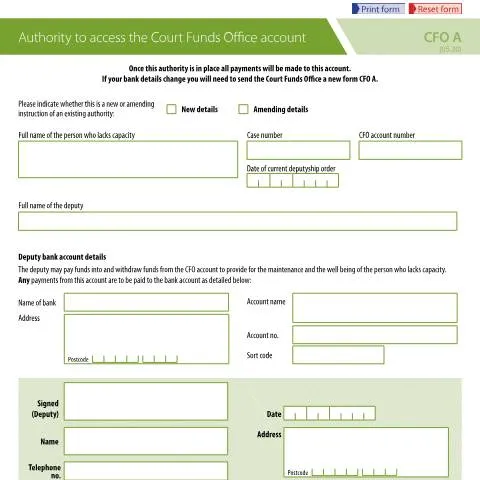
When someone loses mental capacity to manage their own financial affairs, the Court of Protection may appoint a deputy to act on their behalf. Yet even with this legal authority, accessing funds held by the Court Funds Office requires a specific authorisation process. The CFO A form serves as the crucial bridge between a deputy's appointment and their practical ability to access protected assets for the person who lacks capacity.
This authority form establishes the banking arrangements that will govern how funds flow from the Court Funds Office account to meet the daily needs of vulnerable individuals. Without this properly completed form, deputies find themselves unable to access the very funds they've been appointed to manage, creating potential hardship for those they're meant to protect.
The Court Funds Office Ecosystem: Where Protected Money Lives
The Court Funds Office operates as a specialised banking service within the Ministry of Justice, holding funds for individuals who cannot manage their own financial affairs. These accounts typically contain significant sums - inheritance money, compensation awards, property sale proceeds, or accumulated benefits - that require protection from potential exploitation or mismanagement.
Unlike ordinary bank accounts, CFO accounts operate under strict judicial oversight. Every withdrawal must serve the legitimate interests of the person who lacks capacity, whether for their maintenance, accommodation, medical care, or general wellbeing. The CFO A form creates the authorised pathway for these essential payments to flow from the protected account to the deputy's designated bank account.
The Court Funds Office maintains its headquarters in Sunderland, processing thousands of these authority forms annually. Each form undergoes careful scrutiny to ensure compliance with the deputyship order and proper safeguarding of vulnerable individuals' assets.
The Protected Person's Profile
Individuals whose funds are held by the Court Funds Office typically fall into several categories. Many are elderly people with dementia or other cognitive impairments who can no longer safely manage substantial assets. Others include adults with learning disabilities who have inherited money or received compensation payments. Some are younger adults who have suffered brain injuries in accidents and received significant compensation awards.
The common thread is their inability to make informed decisions about their finances, as determined by the Court of Protection under the Mental Capacity Act 2005. Their funds might have been placed with the CFO following a court case, through the actions of concerned family members, or as part of ongoing safeguarding measures.
Decoding the CFO A Form: Section by Section Analysis
The CFO A form's apparent simplicity masks several critical requirements that can trip up even experienced deputies. The form demands precise information across multiple interconnected sections, each serving a specific verification purpose.
Personal Identification Requirements
The form begins by establishing the identities of both the protected person and their deputy. The full name of the person who lacks capacity must match exactly with the Court of Protection records. Any discrepancies - including middle names, maiden names, or alternative spellings - can delay processing significantly.
Similarly, the deputy's full name must correspond precisely to the deputyship order. Professional deputies, such as solicitors acting in their professional capacity, must ensure their firm name appears correctly if the deputyship was granted to the practice rather than an individual.
Court References and Dating
The case number links the form to the specific Court of Protection proceedings that created the deputyship. This alphanumeric reference appears on the deputyship order and all subsequent court correspondence. The CFO account number identifies the specific fund account and may differ from the case number, particularly where multiple accounts exist for one protected person.
The date of current deputyship order requires careful attention, especially for deputies whose powers have been renewed or amended. The Court Funds Office needs to verify that the deputyship remains current and that the deputy's authority hasn't lapsed or been restricted.
Banking Details: The Heart of the Form
The deputy bank account details section demands meticulous accuracy. The account name should reflect how the account is actually held - whether in the deputy's personal name, their professional capacity, or as a designated account for the protected person's funds. Many professional deputies maintain separate client accounts specifically for deputyship funds.
The sort code and account number must be verified against recent bank statements. A single digit error can result in funds being sent to the wrong account, creating significant complications and potential liability for the deputy. The bank name and address help the CFO verify the account's legitimacy and process payments through the correct banking channels.
| Account Type | Typical Account Name Format | Additional Considerations |
|---|---|---|
| Family Deputy | John Smith re: Mary Smith | May use personal account if separate records kept |
| Professional Deputy | Smith & Co Client Account | Must comply with professional conduct rules |
| Designated Account | Mary Smith by John Smith (Deputy) | Clearly identifies protected person's funds |
New Authority Versus Amendments: Different Paths, Different Requirements
The form requires deputies to specify whether they're establishing a new authority or amending existing details. This distinction affects both processing times and documentation requirements.
New Authority Applications
New authorities typically accompany fresh deputyship appointments or situations where no previous CFO A form has been submitted. These require the full supporting documentation package, including the sealed deputyship order and recent bank verification documents. Processing new authorities can take several weeks, during which the protected person's funds remain inaccessible for routine payments.
First-time deputies often underestimate the importance of timing their CFO A submission. Submitting the form immediately after deputyship appointment ensures quicker access to funds when needed for the protected person's care or accommodation costs.
Amending Existing Authorities
Amendments typically arise when deputies change their banking arrangements, perhaps moving to a different bank or opening a dedicated client account. The Court Funds Office treats amendments more straightforwardly than new applications, often processing them within days rather than weeks.
However, deputies must remember that all future payments will automatically redirect to the new account details once the amendment is processed. This immediacy can catch deputies off-guard if they're not prepared to manage funds in the new account straight away.
Essential Supporting Documentation: Beyond the Basic Requirements
The CFO A form explicitly requires two key supporting documents, but understanding their nuances prevents common submission errors.
The Sealed Deputyship Order
A sealed copy of the deputyship order bears the official court seal and signature, distinguishing it from draft orders or unsigned copies. Deputies who have previously submitted this document to the Court Funds Office may not need to provide it again, but confirming this with CFO staff prevents unnecessary delays.
Professional deputies managing multiple deputyships must ensure they submit the correct sealed order for each protected person. The Court Funds Office maintains strict records linking each CFO A form to its corresponding deputyship authority.
Bank Verification Documents
The required bank statement or bank letter must be dated within three months of the CFO A submission. This requirement ensures the account remains active and the details are current. Bank statements should clearly show the account name, number, and sort code, while bank letters must be on official letterhead confirming these same details.
Online bank statements are generally acceptable provided they display the bank's official formatting and include all required account information. However, deputies should ensure printouts are clear and complete, as poor-quality documents can trigger requests for replacement evidence.
Processing Timeline and Operational Considerations
Understanding the Court Funds Office's processing approach helps deputies plan effectively for their protected person's financial needs. The CFO operates on business days only, with processing times varying based on application complexity and seasonal volumes.
Standard Processing Expectations
New CFO A forms typically require 10-15 business days for processing, assuming all documentation is complete and accurate. This timeline includes initial receipt acknowledgment, document verification, and system setup for the new banking authority. Deputies should factor this delay into their planning, particularly when immediate access to funds is anticipated.
Amendments to existing authorities usually process more quickly, often within 3-5 business days. However, deputies should confirm the change has been implemented before assuming new banking details are active.
Communication and Follow-up
The Court Funds Office provides a dedicated customer helpline (0300 0200 199) for deputies needing to check application status or resolve documentation queries. Email enquiries to [email protected] offer an alternative communication channel, though phone contact often provides quicker responses for urgent matters.
Deputies should retain copies of all submitted documents and note their submission date. If processing extends beyond expected timeframes, proactive follow-up helps identify and resolve any issues affecting the application.
Ongoing Management and Future Changes
Once established, the CFO A authority creates an ongoing relationship between the deputy, the Court Funds Office, and the designated bank account. This relationship requires active management to ensure continued effectiveness.
Banking Changes and Updates
Any change to the deputy's banking arrangements necessitates submitting a fresh CFO A form. This includes changing banks, switching account types, or updating account details following bank mergers or system changes. The Court Funds Office cannot process partial updates or verbal instructions - all changes require formal written notification via the CFO A process.
Deputies should plan banking changes carefully, ensuring continuity of access to funds throughout any transition period. Some choose to maintain overlapping accounts temporarily to avoid disruption to the protected person's financial arrangements.
Professional Deputy Considerations
Professional deputies face additional compliance requirements when managing CFO A authorities. Solicitors must ensure their client account arrangements comply with SRA regulations, while other professional deputies must meet their respective regulatory standards for client money handling.
Professional deputies often maintain dedicated accounts for deputyship funds, clearly separating these from other client monies. This approach simplifies record-keeping and demonstrates proper safeguarding of vulnerable individuals' assets.
Practical Safeguards and Risk Management
The CFO A form sits within a broader framework of protections designed to safeguard vulnerable individuals' assets. Deputies must understand both their powers and their limitations under this system.
All withdrawals from CFO accounts must serve legitimate purposes related to the protected person's maintenance and wellbeing. Deputies cannot use these funds for investments, gifts to family members, or purposes outside their deputyship authority. The Court Funds Office may request explanations for unusual withdrawal patterns or amounts.
Record-keeping requirements extend beyond the initial CFO A submission. Deputies must maintain detailed records of all fund usage, supported by receipts and documentation demonstrating how expenditure benefits the protected person. These records may be scrutinised during annual reporting or court reviews of the deputyship.
The authority established by the CFO A form represents a significant responsibility, creating practical access to potentially substantial funds while maintaining the protective oversight that safeguards vulnerable individuals from financial exploitation. Deputies who understand both the form's requirements and the broader system's expectations can navigate this process effectively, ensuring their protected person's financial needs are met while maintaining full compliance with their legal obligations.
Handling Multiple Court Fund Accounts and Complex Estate Scenarios
When dealing with substantial estates or multiple legal proceedings, beneficiaries and administrators often encounter situations involving several court fund accounts simultaneously. The Court Funds Office maintains separate accounts for different cases, even when they relate to the same individual or family. Understanding how to coordinate access across multiple accounts requires careful attention to the specific authority requirements for each fund.
In cases where a deceased person held multiple court fund accounts—perhaps from different personal injury settlements, inheritance disputes, or trust arrangements—each account typically requires separate application for access. The Court Funds Office does not automatically link related accounts, meaning executors must identify and apply for each fund individually. This process becomes particularly complex when dealing with accounts established decades ago, where original documentation may be incomplete or parties have since died.
For professional administrators managing multiple client accounts, the Court Funds Office has developed streamlined procedures, though these still require individual authority for each account. Solicitors acting for several beneficiaries within the same family may need to demonstrate their authority separately for each person's entitlement, even when the underlying legal matter is connected. The Office maintains strict separation between accounts to prevent unauthorised cross-access, regardless of apparent family or legal connections.
When court fund accounts involve international elements—such as beneficiaries residing abroad or funds originating from overseas litigation—additional complications arise. Foreign nationals inheriting UK court fund monies must navigate both UK procedures and their home country's legal requirements for receiving such funds. The Court Funds Office requires proof of identity that meets UK standards, which may involve apostilled documentation or embassy verification for overseas applicants.
Trustees managing court fund accounts for multiple beneficiaries face particular challenges when beneficiaries reach majority or trigger distribution events at different times. The Office requires fresh authority documentation for each distribution event, meaning trustees cannot rely on initial appointment letters indefinitely. Regular review of trustee authority becomes essential, particularly for long-term arrangements where original appointing documents may become outdated or insufficient under current procedures.
Dispute Resolution and Appeal Procedures for Access Decisions
When the Court Funds Office refuses or delays access to court fund accounts, applicants have specific avenues for challenge and review. Understanding these procedures proves crucial for beneficiaries facing unexpected obstacles in accessing their entitlements. The Office's decision-making process, while generally straightforward, can sometimes result in disputes requiring formal resolution mechanisms.
Initial disputes often arise from documentation requirements that applicants consider excessive or inappropriate to their circumstances. The Court Funds Office maintains discretion in requesting additional evidence beyond standard requirements, particularly for accounts involving substantial sums or complex legal histories. When applicants disagree with such requests, they may seek review through the Office's internal complaints procedure before pursuing external remedies.
The formal complaint process requires written submission detailing the specific grounds for challenge, supported by relevant documentation demonstrating why the Office's requirements are inappropriate or disproportionate. Response times for internal reviews typically range from several weeks to months, depending on the complexity of the dispute and the Office's current workload. During this review period, access to funds remains suspended, creating potential financial hardship for beneficiaries relying on these monies.
For disputes involving legal interpretation of court orders or trust documents, applicants may need to return to the original court for clarification or amended directions. The Court Funds Office cannot interpret ambiguous court orders independently and will refuse access pending judicial clarification when uncertainty exists. This situation commonly arises with older court orders drafted under previous procedural rules or where circumstances have changed substantially since the original order.
Appeals against Court Funds Office decisions may ultimately require judicial review proceedings if internal procedures fail to resolve disputes. However, such action requires demonstrating that the Office has acted unreasonably, failed to follow proper procedure, or misinterpreted relevant legal requirements. The Administrative Court expects applicants to exhaust internal remedies before accepting judicial review applications, making thorough engagement with the Office's complaint procedures essential.
Alternative dispute resolution mechanisms, including ombudsman services, generally do not apply to Court Funds Office decisions due to their judicial nature. However, complaints about administrative service quality or unreasonable delays may fall within broader government complaint procedures. Distinguishing between substantive legal decisions and administrative service failures becomes important when determining appropriate challenge routes.
Investment Performance and Fund Management Considerations
Court fund accounts generate investment returns through the Court Funds Office's managed investment programmes, though beneficiaries have limited control over investment decisions. Understanding how these investment arrangements affect account access and distribution planning helps beneficiaries make informed decisions about timing withdrawals and managing their overall financial position.
The Court Funds Office operates several investment funds with different risk profiles and return expectations. Basic court fund accounts typically invest in lower-risk instruments providing steady but modest returns, while special investment accounts may offer higher potential returns with corresponding increased risk. The choice between investment options usually depends on the original court order or trust document establishing the account, though some flexibility may exist for long-term arrangements.
Investment performance directly affects the amount available for withdrawal, as accounts reflect both capital and accumulated returns. Beneficiaries planning significant expenditure should consider timing their access applications to coincide with favourable market conditions or scheduled distribution dates. However, the Court Funds Office's investment policies prioritise capital preservation over maximum returns, meaning dramatic value fluctuations are relatively uncommon.
For accounts established many years ago, compound investment returns may have substantially increased the original fund value. Beneficiaries should request current account statements before making withdrawal applications to understand the full amount available. The Court Funds Office provides regular statements for active accounts, though beneficiaries may need to request updated information for dormant accounts or those with infrequent activity.
Tax implications of court fund withdrawals depend on various factors including the original source of funds, investment returns earned, and the beneficiary's overall tax position. Investment gains within court fund accounts may be subject to capital gains tax upon withdrawal, though specific exemptions or reliefs might apply depending on circumstances. HMRC guidance on court fund taxation should be consulted, particularly for substantial withdrawals or beneficiaries with complex tax affairs.
Strategic withdrawal planning becomes important for beneficiaries with large court fund holdings who wish to minimise tax exposure while meeting their financial needs. Phased withdrawals over multiple tax years may prove advantageous compared to single large distributions, though this approach requires careful coordination with the Court Funds Office's procedures and any restrictions in the original court order or trust document governing the account.