Navigating the Payment Request Process: Understanding the Court Funds Form
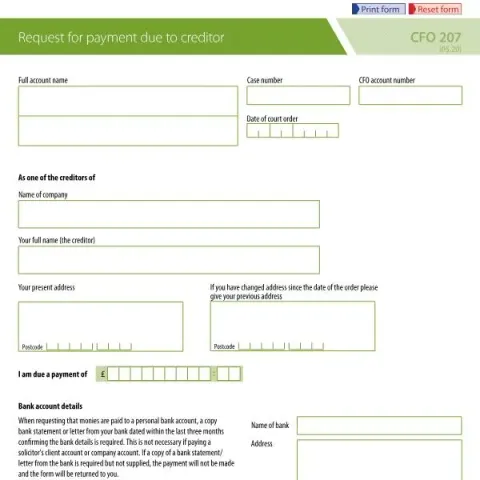
When you find yourself as a creditor awaiting payment under a court order, the intricacies of the process can feel daunting. Specifically, the Request for Payment Due to Creditor (CFO 207) form represents a pivotal step in reclaiming what is rightfully owed to you. This document is essential for ensuring that the funds awarded in a court ruling are effectively transferred to your account. Navigating this official channel is crucial, and understanding its nuances can save you time and frustration.
Timeframes and Key Dates: What You Need to Know
Before diving into the steps required to complete the CFO 207 form, it’s essential to grasp the timeline surrounding your request. The process begins once the court order is issued, particularly focusing on the payment terms stipulated in that ruling. The following elements must be considered:
- Issuance of the Court Order: This marks the beginning of your journey as a creditor. It's crucial to keep a record of this date as it informs subsequent actions.
- Submission of the CFO 207 Form: This form should be submitted promptly after the court order becomes enforceable. Delays may inadvertently affect your ability to receive payment.
- Processing Time: After submission, the Court Funds Office typically processes requests within 10 to 15 working days. However, this may vary based on workload and completeness of submitted documentation.
It’s advisable to check your bank details and ensure all information is correct before submission, as any discrepancies can lead to further delays.
Distinguishing the CFO 207: Unique Features and Common Confusions
The CFO 207 form is often confused with other related documents, such as the Form N1 used for initiating claims. However, the function and context of the CFO 207 are distinct:
- Target Audience: This form is specifically for creditors who have won a monetary judgment and are seeking to access those funds. In contrast, Form N1 is for initiating claims against debtors.
- Payout Only: The CFO 207 is strictly for requesting the release of funds already awarded by the court, while other forms may serve broader purposes.
Being aware of these distinctions can streamline your experience and ensure you’re using the correct document for your needs.
Special Circumstances: Unique Scenarios Requiring Attention
Different situations may necessitate additional considerations when filling out the CFO 207. A few common scenarios include:
- International Payments: If you are requesting funds to be transferred to a bank account outside the UK, you must provide specific details such as IBAN and SWIFT/BIC codes. Failure to do so will delay your payment.
- Minor Creditors: If you are a minor (under 18 years), legal guardians must facilitate the application process on your behalf, including signing necessary documents.
- Power of Attorney: If someone is applying on your behalf due to incapacitation or other reasons, they must present a valid Power of Attorney along with their application.
Addressing these particular cases early on can help mitigate potential setbacks in the payment process.
Addressing Issues: What to Do If Your Application Faces Challenges
Despite careful preparation, issues can arise post-submission of your CFO 207 form. Being prepared to navigate these challenges is pivotal:
- Refusal of Payment: If your request is refused, carefully check the accompanying explanation. Common reasons can include missing documentation, such as a recent bank statement or proof of identity.
- Incomplete Application: If your form is returned due to missing information, review the requirements meticulously. Making corrections and resubmitting promptly can help you avoid further delays.
- Errors in Details: Should you notice an error in the submitted information post-filing, contact the Court Funds Office immediately. They can advise on the best course of action to amend the submission.
Proactive communication with the Court Funds Office can be invaluable in rectifying issues and ensuring a seamless payment process.
Preparing Your Documentation: Essential Supporting Materials
Completing the CFO 207 form is just one part of the equation. Properly gathering and submitting the necessary documentation is equally critical to avoid processing delays. Here’s a breakdown:
| Required Document | Description | Notes |
|---|---|---|
| Bank Statement | Recent statement confirming your account details | Must be dated within the last three months |
| Proof of Identity | Photo ID or similar documentation | Crucial for verification of identity |
| Copy of Court Order | The original court order awarding you payment | Must be submitted with your request |
Ensure you have copies of all documents, as originals may not be returned.
Deciphering the Form: A Section-by-Section Analysis of CFO 207
A successful submission of the CFO 207 hinges on accurately completing each section of the form. Below is a breakdown of its critical components and common pitfalls:
- Full Name: Ensure your full legal name is entered as listed in the court order to avoid mismatches.
- Address: Provide both your current and previous address if applicable. This helps the court to verify your identity accurately.
- Payment Amount: Clearly specify the amount due using numerals and words to prevent misunderstandings.
Attention to detail is paramount; any errors or omissions may lead to delays or rejections.
Understanding the Consequences: Rights and Obligations as a Creditor
Finally, it is crucial to recognize the implications of submitting the CFO 207 form. As a creditor, you are not just filling out a form; you are engaging in a legal process that entails certain rights and responsibilities:
- Right to Payment: As a creditor, you have the right to claim the payment awarded to you by the court promptly.
- Obligation to Provide Correct Information: You are responsible for ensuring that all information provided is accurate and up to date. Failing to do so can jeopardize your claim.
- Consequences of Delays: Delaying your submission or failing to act promptly may lead to prolonged waiting periods or even loss of entitlement.
Understanding these rights and obligations can empower you in your dealings with the Court Funds Office and ensure a more efficient process.
Understanding the Types of Court Funds in the UK
In the UK, the term 'court funds' often refers to various financial remedies that arise from court orders. These can include compensation payments, damages awarded in civil disputes, or funds held in trust for minors or those lacking mental capacity. Understanding the types of court funds is crucial, as each type has different procedural requirements and entitlements. For instance, funds from personal injury claims typically involve significant considerations regarding how the funds are managed, the investment of funds, and the eventual distribution to the claimant.
There are several key types of court funds:
- Loss of Earnings Fund: Compensatory payments related to loss of past and future earnings following an injury.
- Damages Fund: Monetary amounts awarded to a claimant as compensation for harm suffered due to another party's negligence or breach of duty.
- Trust Funds: Funds held in trust for individuals who are unable to manage their own financial affairs, often due to age or mental incapacity.
Each type of fund has specific guidelines for access and distribution, which should be closely adhered to in order to ensure compliance with legal standards and the proper handling of finances. For instance, claims related to damages must be well-documented and presented correctly to the court, while trustees managing funds must follow strict fiduciary duties under the Trustee Act 2000.
How to Initiate a Claim for Court Funds
Initiating a claim for court funds due to a creditor can involve a multi-step process. The first step is to gather all necessary documentation that supports your claim. This might include court orders, payment records, and any correspondence related to the debt. Once you have compiled these documents, you will need to determine the appropriate court to approach, which largely depends on the nature of the debt and the amount involved.
In most cases, claims for court funds should be filed in the County Court or the High Court, depending on the claim's value and complexity. It's important to note that the procedure may change based on the specifics of the case. If the debt is below £10,000, it may be appropriate to use the Small Claims Court, where the process is simplified, and legal representation is not mandatory. For larger debts, or if the case involves complex legal issues, seeking legal advice may be beneficial.
Fill in your form directly online
No printing: type your details into the boxes of the official form, tick, then download the PDF ready to send.
- 1Type into the form boxes
- 2Tick in one click
- 3Save and download the PDF
Once you have determined the right court, you will need to fill out the requisite claim form, such as the N1 form for general claims in the County Court or the appropriate form for the High Court. Ensure that you include comprehensive details about the debtor, the amount owed, and any supporting documentation. There is typically a fee associated with filing a claim, which can vary based on the amount being claimed.
After submitting your claim, the court will issue a claim number, and you will be required to serve the claim on the defendant. This means that you must ensure the debtor receives a copy of the claim papers, which can usually be done via recorded delivery or personal service. The defendant then has a set period, usually 14 days, to respond to the claim. Failure to respond may result in a default judgment in your favour, allowing you to take further steps to recover the funds.
Enforcement of Court Orders for Payment
Once a court has issued a judgment in your favour for funds owed by a creditor, the next step involves enforcing that judgment, if necessary. Enforcement actions can vary widely and depend on the specifics of the situation, including the debtor's financial situation and willingness to pay.
Common enforcement methods include:
- Attachment of Earnings Orders: This allows you to collect payments directly from the debtor's salary, which is particularly effective for employed individuals. The court can order the debtor’s employer to deduct a specified amount from their salary and pay it directly to you.
- Charging Orders: If the debtor owns property, you can apply for a charging order which secures the debt against their property. This means you can potentially recover your funds when the property is sold.
- Bailiffs: You can request the court to appoint bailiffs to seize the debtor's goods and sell them, with the proceeds going towards your owed amount. However, this should be considered carefully, as it can be a lengthy process and may not always result in full recovery.
It’s crucial to understand that enforcement methods can also incur additional costs, so it’s wise to weigh these against the likelihood of recovering the funds. Seeking legal advice or assistance from a debt recovery agency can provide you with more tailored strategies based on your specific circumstances.
The Role of the Financial Ombudsman in Disputes Over Court Funds
In cases where there are disputes regarding the management or distribution of court funds, the Financial Ombudsman Service (FOS) can play a significant role in resolving issues. Although primarily focused on financial services, the FOS offers valuable insights and decisions that can impact how court funds are perceived in disputes involving financial institutions.
If you believe that a bank or financial institution is mishandling court-awarded funds or failing to comply with a court order, you can lodge a complaint with the FOS. They will investigate the matter and offer a resolution based on their findings. This process is separate from court proceedings, but a ruling from the FOS can sometimes prompt further action in court where necessary.
Remember that the FOS has specific eligibility criteria; therefore, it is essential to ensure your case falls under their jurisdiction. Generally, they can help if the complaint involves services offered by regulated financial entities and can provide a pathway to resolving disputes without the need for costly legal battles.
Engaging with the Financial Ombudsman can also be a strategic move while pursuing a claim for court funds. If you can demonstrate that you have made reasonable attempts to resolve the issue with the financial institution directly, it may strengthen your case for a favorable outcome.