Navigating the Application for Authority to Use Local Bank Accounts
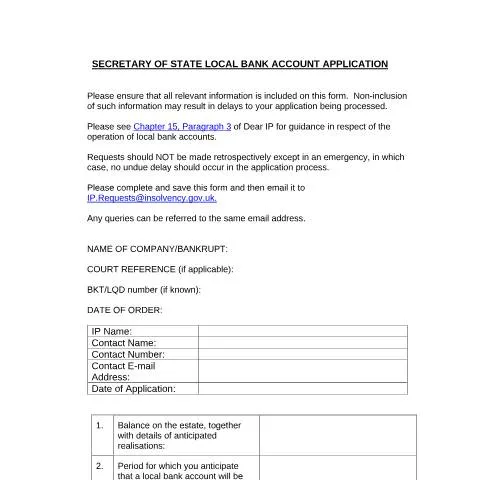
When facing the complexities of insolvency, the need for financial management becomes vital. One specific tool that insolvency practitioners may utilize is the Application for Authority to Use Local Bank Account issued by The Insolvency Service. This application is pivotal in situations where conventional banking solutions are insufficient or impractical. Understanding its role and procedure can greatly ease the management of an insolvent estate.
The Regulatory Framework Underpinning Local Bank Accounts
The use of local bank accounts in insolvency proceedings finds its foundation in the regulations outlined by The Insolvency Service. Governed by the provisions set forth in the Insolvency Act 1986, this framework ensures that the financial activities surrounding an insolvent estate are both transparent and accountable.
Chapter 15, Paragraph 3 of the guidance documents, known as Dear IP, explicitly details the operation of local bank accounts during insolvency. It’s essential to grasp that while the Insolvency Service Account is typically the primary avenue for funds, local accounts may be required under specific circumstances. The guiding principle is that requests should not be made retroactively, except in emergencies, thereby necessitating an efficient application process.
Understanding the Need for a Local Bank Account
In certain insolvency scenarios, practitioners may find themselves in need of a local bank account for various reasons, such as:
- Practicality: When using a standard Insolvency Service Account poses logistical challenges.
- Immediate Access: Local accounts may provide quicker access to funds for necessary disbursements.
- Tailored Transactions: In some cases, the local business environment necessitates flexibility in handling payments and receipts.
Before proceeding with the application, it’s crucial to evaluate whether the need truly aligns with the regulations, as improper requests can result in processing delays.
A Step-by-Step Guide to Submitting Your Application
To ensure a smooth application process, it’s beneficial to follow a methodical approach:
1. Preparation of Documentation
Begin by gathering all necessary information, including:
- Name of the company or individual experiencing bankruptcy
- Court reference number, if applicable
- Date of the insolvency order
- Details of any anticipated realizations from the estate
2. Completing the Application Form
Fill out the application form meticulously. Key sections to focus on include:
- Balance on the estate: Provide an accurate assessment.
- Period for account usage: Specify the anticipated duration.
- Reasons for the request: Clearly articulate why conventional methods are impractical.
3. Submission Techniques
Once completed, the application must be emailed to [email protected]. Ensure the email includes all relevant details and attachments.
4. Follow-Up
Having submitted your application, it is prudent to maintain communication with the Insolvency Service. If you haven’t received a response within a reasonable timeframe, a follow-up email can be beneficial.
Specific Situations: Who Needs to Apply?
Certain circumstances can necessitate an application for a local bank account. These include:
Case 1: International Insolvency Practitioners
For insolvency practitioners operating outside the UK, navigating banking systems can be particularly challenging. Establishing a local bank account may streamline operations, allowing for easier management of funds while adhering to UK regulations.
Case 2: Complex Insolvency Scenarios
In cases with multiple stakeholders or particularly intricate financial histories, local accounts can facilitate transactions that would otherwise be cumbersome. This is especially true when dealing with creditors or employees in a local context.
Case 3: Urgent Financial Needs
In emergencies, such as the need to meet immediate operational costs, applying for a local bank account may provide the necessary financial workaround. In these instances, practitioners should detail the urgency in their application to avoid undue delays.
Decoding the Application Form: Key Sections
Understanding the application form is crucial for a successful submission. Let’s delve into each section:
| Section | Description | Common Pitfalls |
|---|---|---|
| Balance on the estate | Provide an accurate figure along with details of anticipated realizations. | Underestimating this figure can lead to application rejection. |
| Period for account usage | Indicate the duration you anticipate needing the account. | Be realistic; overly long durations may raise questions. |
| Reason for use | Explain why a local account is necessary. | Vague explanations without supporting details can hinder approval. |
| Nature and address of business | Describe the business’s operations and location. | Inaccurate or incomplete descriptions can affect clarity. |
| Bank details | Provide the name and address of the proposed bank. | Not disclosing all relevant details can lead to delays. |
What Happens Next: The Processing Journey
Once your application has been submitted, it enters the review stage. The Insolvency Service will assess your request based on the provided details, with particular attention to:
- Compliance with regulations
- Justification for the local account
- Anticipated estate balance and transaction activity
Response times can vary, but applicants should typically expect to hear back within two to four weeks. If your request is approved, further instructions will be provided about how to proceed. In cases where the application is denied, detailed reasons will be given, allowing for amendments or appeals if necessary.
Essential Supporting Documents: What You Must Prepare
In support of your application, it’s wise to prepare relevant documentation that corroborates your claims. Commonly required documents include:
- Proof of identity and authority to act (if applicable)
- Financial statements of the estate
- Details of any secured or unsecured creditors
Ensuring all documentation is complete and accurately reflects your situation will facilitate a smoother review process.
Timeline Expectations: From Application to Approval
Understanding the timeframe associated with this process can help manage expectations. Here’s what to anticipate:
- Initial preparation: Allow 1-2 days to gather all necessary information and documents.
- Application submission: Be prepared for some time spent carefully filling out the application.
- Processing time: Expect response times of approximately 2-4 weeks.
- Post-approval steps: An immediate follow-up will be required to set up the local bank account.
Being mindful of these timelines encourages a proactive approach, allowing you to plan for the next phases of managing the estate.
Making the Most of Your Local Bank Account
Upon receiving approval for the local bank account, practitioners must adhere to strict guidelines regarding its use. It’s crucial to maintain accurate records of all transactions and ensure that they serve the interests of the estate. Usage should align with the specified reasons outlined in the application, to avoid any compliance issues down the line.
Furthermore, regular communication with the Insolvency Service is essential to ensure ongoing compliance and to address any concerns that may arise during the management of the estate.
Understanding the Necessity of Local Bank Accounts for Foreign Nationals
In the United Kingdom, opening a local bank account is crucial for various financial transactions, especially for foreign nationals residing or working in the country. The UK banking system has specific protocols designed to ensure that all banking activities comply with the regulatory framework set by the Financial Conduct Authority (FCA). This includes monitoring the sources of funds and ensuring that the account holder is legally entitled to use the account.
For foreign nationals, understanding the requirements to open a local bank account often necessitates an application for authority to use a local bank account. This can be a key step in gaining access to local financial systems, for tasks ranging from receiving salaries to paying for daily expenses and utilities. It is important to note that each bank may have its own specific requirements, and therefore, potential account holders should engage with their chosen bank to ensure they meet all necessary criteria.
Moreover, banks may request specific documentation to verify your identity and address. This often includes your passport, proof of residence, and sometimes, employment contracts or letters from your employer. Understanding what documents are necessary ahead of time can expedite the application process, reducing the time spent navigating these requirements.
Potential Issues and Resolution Pathways
When applying for authority to use a local bank account, applicants might encounter several issues. These can range from documentation inconsistencies to regulatory checks that may delay the process. One common issue arises when the applicant’s documentation does not align with the bank's requirements or local norms.
For example, if you have recently relocated to the UK and your proof of address is not fully established (such as awaiting a utility bill in your name), this may cause complications. Some banks may accept alternate forms of documentation, while others may strictly adhere to their policies. It’s advisable to engage in upfront conversations with your banking institution to clarify what alternatives they may accept.
Another hurdle may involve verification processes. Banks are obligated under the Money Laundering Regulations to conduct rigorous checks. If there are discrepancies in your identity verification, your account application could be indefinitely postponed. In such cases, the best course of action is to maintain open communication with the bank, providing any additional information requested promptly.
Furthermore, should you encounter persistent issues, consider appealing to the bank’s complaints department or the Financial Ombudsman Service. These entities provide oversight for banking practices and can assist in resolving disputes between customers and financial institutions.
Local Bank Account Regulations and Compliance
When exploring the application for authority to use a local bank account, it’s crucial to navigate the UK’s regulatory landscape. Banks must adhere to several laws and guidelines, including the Data Protection Act 2018 and UK GDPR, which govern how personal information is handled. Understanding how your data will be processed is essential, as it not only affects your privacy rights but also your overall banking experience.
In addition to compliance with data protection laws, banks must also abide by the Financial Services and Markets Act. This legislation encompasses measures for consumer protection within the banking sector, ensuring that customers are treated fairly and equitably. As a result, when you submit your application, you should expect transparency regarding fees, terms, and conditions associated with the account usage.
Furthermore, keeping abreast of the local taxation landscape is vital. For non-residents, understanding obligations regarding income tax and National Insurance contributions is necessary to avoid complications with HMRC. Consulting with a financial advisor or tax professional may provide additional clarity on these matters. Particularly for foreign nationals, understanding obligations can prevent unintentional non-compliance that could delay banking services or lead to penalties.
In essence, successfully obtaining authority to use a local bank account is contingent upon understanding the interplay between local laws, bank requirements, and personal obligations. Engaging with a financial expert can offer significant insights into navigating this intricate landscape, ensuring compliance and facilitating smoother banking experiences.