When Your PSV Operates Beyond Standard Tachograph Requirements
Public service vehicle operators occasionally find themselves in situations where their vehicles fall outside the standard tachograph regulations that govern most commercial passenger transport. Whether you're running a vintage bus for heritage tours, operating specialised emergency vehicles, or providing transport services in unique circumstances, the Driver and Vehicle Standards Agency recognises that blanket tachograph requirements don't suit every operational context.
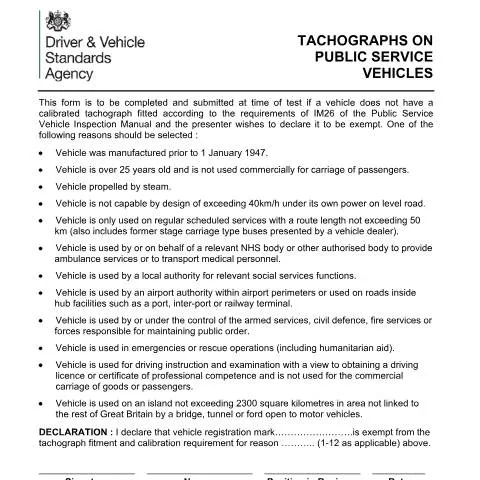
The DVSA form for declaring PSV tachograph exemptions addresses these specific scenarios where vehicles legitimately operate without the digital recording equipment that typically monitors driver hours and vehicle movement. This declaration process ensures compliance whilst acknowledging the diverse nature of passenger vehicle operations across the UK transport landscape.
Understanding when and how to complete this declaration becomes particularly important during annual testing procedures, where DVSA examiners must verify that non-tachograph vehicles meet appropriate exemption criteria rather than simply lacking required equipment.
Twelve Distinct Categories of Tachograph Exemption
The DVSA framework recognises twelve specific circumstances where public service vehicles may legitimately operate without calibrated tachographs. Each category reflects particular operational contexts where standard driver monitoring requirements would be inappropriate or impractical.
Heritage and Age-Related Exemptions
Vehicles manufactured before 1 January 1947 automatically qualify for exemption, reflecting the obvious impossibility of retrofitting modern recording equipment to pre-war designs. This covers preserved omnibuses, charabancs, and early motor coaches used in heritage operations.
Additionally, vehicles over 25 years old gain exemption provided they're not used commercially for passenger carriage. This distinction proves crucial for preserved vehicle operators who may use vintage buses for rallies, exhibitions, or private hire without commercial passenger service.
Technical Design Limitations
Steam-propelled vehicles receive automatic exemption, acknowledging their fundamentally different operating characteristics. Similarly, vehicles incapable by design of exceeding 40km/h on level road under their own power qualify for exemption, covering specialised low-speed passenger vehicles used in controlled environments.
Limited Route Operations
Regular scheduled services with route lengths not exceeding 50 kilometres qualify for tachograph exemption. This category specifically includes former stage carriage buses presented by vehicle dealers, recognising the limited operational scope that reduces the regulatory monitoring requirements typically associated with longer-distance commercial operations.
| Exemption Category | Key Requirement | Typical Applications |
|---|---|---|
| Pre-1947 Manufacture | Manufacturing date verification | Heritage vehicles, museum collections |
| Over 25 years, non-commercial | Age proof + usage documentation | Preserved buses, private rallies |
| Speed limitation | Technical specification evidence | Airport shuttles, industrial transport |
| Short route services | Route distance measurement | Local circulars, dealer demonstrations |
Essential Public Services and Emergency Operations
Several exemption categories specifically address vehicles providing critical public services where standard tachograph monitoring might compromise operational effectiveness or prove inappropriate given the service context.
Healthcare and Emergency Services
Vehicles used by or on behalf of relevant NHS bodies for ambulance services or medical personnel transport receive exemption recognition. This covers patient transport services, mobile medical units, and specialist healthcare vehicles where operational demands may conflict with standard driver hour regulations.
Emergency and rescue operations, including humanitarian aid vehicles, qualify for exemption given their unpredictable operational patterns. Fire services, civil defence organisations, armed services vehicles, and those maintaining public order operate under different regulatory frameworks that make standard tachograph monitoring inappropriate.
Local Authority Social Services
Vehicles operated by local authorities for relevant social services functions receive specific exemption recognition. This typically covers day centre transport, social services client vehicles, and community support transport where the focus remains on service delivery rather than commercial passenger carriage monitoring.
Specialised Operational Environments
Certain operational environments create unique circumstances where standard tachograph requirements prove impractical or unnecessary, leading to specific exemption provisions.
Airport and Port Operations
Vehicles used by airport authorities within airport perimeters or operating on roads inside hub facilities such as ports, inter-port areas, or railway terminals qualify for exemption. These controlled environment operations typically involve short-distance passenger movement with different safety and monitoring requirements compared to public road operations.
Island Operations
A particularly specific exemption covers vehicles used on islands not exceeding 2,300 square kilometres in area, provided the island lacks bridge, tunnel, or ford connections to mainland Great Britain. This recognises the unique operational constraints and limited geographical scope that characterise island transport services.
Training and Examination Vehicles
Vehicles used for driving instruction and examination purposes, specifically for obtaining driving licences or certificates of professional competence, receive exemption provided they're not simultaneously used for commercial goods or passenger carriage. This separation ensures that training activities remain distinct from commercial operations.
Completing the Declaration During Vehicle Testing
The tachograph exemption declaration must be completed and submitted at the time of test when a vehicle lacks calibrated tachograph equipment according to IM 26 requirements of the Public Service Vehicle Inspection Manual.
Essential Declaration Components
The declaration process requires specific information including the vehicle registration mark and the applicable exemption reason, numbered 1-12 corresponding to the categories outlined in the form. The declaring party must provide their signature, printed name, position in business, and date of declaration.
The form emphasises the legal significance through a clear warning: "It is an offence to make a declaration knowing it to be untrue". This underscores the importance of accurate assessment before claiming exemption status.
Business Position and Authority
The requirement for declaring the signatory's "position in business" ensures that only authorised individuals make exemption claims. This typically means company directors, fleet managers, or other personnel with appropriate authority over vehicle operations and compliance matters.
Data Protection and Enforcement Implications
The DVSA collects and processes personal data from exemption declarations for specific compliance and enforcement purposes, operating under Data Protection Act 2018 and UK GDPR frameworks.
Information Sharing Protocols
Declaration information may be passed to DVSA Enforcement staff for information purposes and possible further investigation. This creates a direct link between exemption claims and ongoing compliance monitoring, ensuring that claimed exemptions undergo appropriate scrutiny.
The agency may share personal data when lawful reasons exist, including criminal investigations, fraud prevention, or public inquiry requirements. This broad sharing authority reflects the serious regulatory context surrounding commercial vehicle operations.
Ongoing Compliance Monitoring
Unlike simple one-time declarations, tachograph exemption claims create ongoing compliance obligations. Operators must ensure that exemption circumstances continue to apply throughout the vehicle's operational period, as changes in usage patterns or operational context could invalidate previously claimed exemptions.
Strategic Considerations for Fleet Operators
Fleet operators managing diverse vehicle types must carefully evaluate which vehicles genuinely qualify for tachograph exemptions versus those requiring standard digital recording equipment installation and calibration.
Mixed Fleet Compliance
Operators running mixed fleets often find that some vehicles clearly require tachographs whilst others qualify for exemption. This creates administrative complexity requiring careful documentation of each vehicle's operational profile and exemption status.
Regular review of exemption claims becomes essential, particularly for vehicles whose operational patterns may change over time. A vehicle initially qualifying under the 50-kilometre route exemption might require tachograph installation if route extensions bring it above the threshold.
Documentation and Record Keeping
Maintaining comprehensive records supporting exemption claims proves crucial for ongoing compliance demonstration. This includes route measurements for distance-based exemptions, age verification for heritage vehicles, and operational documentation for service-specific exemptions.
The form's integration with the Public Service Vehicle Inspection Manual requirements means that exemption documentation becomes part of the broader vehicle compliance framework, subject to review during routine inspections and enforcement activities.
For detailed guidance on specific exemption criteria and operational requirements, operators should search "Tachograph rules for passenger vehicles" on the official government website, ensuring access to the most current regulatory interpretation and compliance expectations.
Specific PSV Categories and Their Tachograph Exemption Criteria
The tachograph exemption landscape for public service vehicles operates across several distinct categories, each with particular qualifying conditions that operators must understand thoroughly. Local service buses represent the most common exemption category, covering vehicles operating regular passenger services within defined geographical boundaries. These services must follow established routes with designated stopping points, typically serving urban areas, towns, or specific districts where passengers can board and alight at recognised bus stops.
For a local service to qualify for tachograph exemption, the route must not exceed 50 kilometres from the operating centre to the furthest point of the service. This distance measurement follows the most direct road route, not aerial distance. Additionally, the service must operate with a frequency that demonstrates genuine public transport provision rather than occasional or charter-style operations. DVSA guidance indicates that services running at least twice daily in each direction typically meet this criterion, though specific circumstances may vary.
School transport services constitute another significant exemption category, encompassing vehicles dedicated to transporting pupils between home and educational establishments. These services must operate exclusively for educational purposes, carrying children to and from schools, colleges, or other recognised educational institutions. The exemption extends to vehicles used for educational trips and excursions, provided these activities form part of the curriculum or educational programme.
However, school transport exemptions require careful documentation. Operators must maintain records demonstrating the educational nature of journeys, including contracts with local education authorities or schools, pupil transport policies, and route schedules that align with academic terms. Mixed-use vehicles that sometimes operate commercial services alongside school transport may lose their exemption status for non-educational journeys.
Specialised passenger services represent a more complex exemption category, covering vehicles adapted for passengers with reduced mobility, medical transport services, and certain community transport operations. These services must demonstrate genuine social or medical necessity rather than general passenger transport. For instance, vehicles equipped with wheelchair access operating dial-a-ride services for elderly or disabled passengers typically qualify, provided they serve registered users within defined community groups.
Community transport services operating under Section 19 or Section 22 permits may qualify for tachograph exemptions, but operators must ensure their permit conditions align with exemption criteria. The service must remain non-commercial in nature, serving specific community needs rather than competing with established public transport operators. Regular review of permit conditions ensures continued compliance with both transport licensing and tachograph exemption requirements.
Documentation Requirements and Record-Keeping Obligations
Declaring PSV tachograph exemption necessitates comprehensive documentation that DVSA enforcement officers can readily verify during roadside inspections or operator compliance visits. Primary exemption documentation must include the PSV operator's licence details, vehicle registration documents, and specific service authorisations that demonstrate qualifying exemption criteria. Operators should maintain these documents both in vehicles and at operating centres, ensuring immediate access when required.
The exemption declaration process requires operators to complete specific sections of their PSV licensing applications or submit separate notifications to DVSA. This declaration must specify the exemption category claimed, provide detailed service descriptions, and include supporting evidence such as route maps, timetables, and passenger service agreements. Local service operators must submit route registrations with local traffic commissioners, while school transport operators require educational service contracts or local authority agreements.
For ongoing compliance, operators must maintain service operation records that demonstrate continued adherence to exemption criteria. These records include driver duty rosters showing exempted journey patterns, passenger manifest records for specialised services, and route compliance documentation for local services. Weekly or monthly summaries help operators track exemption compliance and identify any operational changes that might affect exemption status.
Driver documentation requirements extend beyond standard PSV licensing obligations when claiming tachograph exemptions. While drivers of exempted vehicles need not maintain tachograph records for qualifying journeys, they must carry documentation proving the exempt status of their current duties. This typically includes duty cards or route cards identifying the specific service type, passenger category, and geographical boundaries of exempted operations.
Operators should implement systematic record retention policies, maintaining exemption-related documentation for the periods specified in transport regulations. Generally, service records must be kept for at least 12 months, though some exemption categories may require longer retention periods. Digital record-keeping systems can streamline compliance management, but operators must ensure electronic records meet DVSA accessibility requirements and include appropriate backup procedures.
Change notification obligations require operators to inform relevant authorities when service modifications might affect exemption status. Route extensions beyond 50-kilometre limits, frequency reductions below qualifying thresholds, or passenger service category changes must be reported promptly. Failure to notify changes can result in retrospective compliance issues and potential penalties for operating without required tachograph equipment.
Enforcement Implications and Compliance Monitoring
DVSA enforcement activities around PSV tachograph exemptions involve both planned compliance visits and unscheduled roadside inspections. Roadside enforcement officers possess detailed knowledge of exemption criteria and commonly challenge operators whose vehicles appear to qualify for exemptions but lack proper documentation. Officers typically examine service schedules, passenger manifests, and route documentation to verify legitimate exemption claims versus attempts to avoid tachograph obligations through misclassification.
During compliance inspections, DVSA examiners review operational patterns over extended periods, identifying discrepancies between declared exempt services and actual operating practices. Pattern analysis might reveal vehicles claiming local service exemptions but operating beyond 50-kilometre limits, or school transport vehicles carrying fare-paying passengers outside educational contexts. Such discoveries can result in retrospective compliance action covering months or years of non-compliant operation.
The penalty framework for incorrect tachograph exemption claims operates at multiple levels, affecting both operators and individual drivers. Fixed penalty notices can be issued for immediate compliance failures, while more serious or systematic non-compliance may trigger public inquiry proceedings before traffic commissioners. These proceedings can result in operator licence curtailment, suspension, or revocation, alongside financial penalties and increased compliance monitoring requirements.
Driver-level enforcement focuses on ensuring individuals understand their obligations when operating exempted vehicles versus those requiring tachograph compliance. Mixed fleet operations present particular challenges, where drivers might operate both exempted and non-exempted services within single shifts. Training records and competency assessments become crucial evidence during enforcement proceedings, demonstrating operator commitment to compliance culture.
Enforcement trends indicate increasing scrutiny of borderline exemption cases, particularly where commercial operators attempt to structure services to qualify for exemptions while maintaining essentially commercial operations. DVSA guidance emphasises substance over form, examining genuine service provision rather than artificial arrangements designed primarily to avoid tachograph requirements. Operators should ensure their exemption claims reflect genuine operational reality rather than administrative convenience.
Appeals and review procedures provide mechanisms for operators to challenge enforcement decisions, but success requires comprehensive evidence of compliance with exemption criteria. The appeals process typically involves detailed examination of service records, passenger data, and operational procedures over extended periods. Operators should maintain exemplary documentation standards to support any necessary appeals, recognising that retrospective evidence compilation proves significantly more challenging than ongoing compliance monitoring.