Launching a Local Bus Service: The Strategic Gateway Through PSV350 Registration
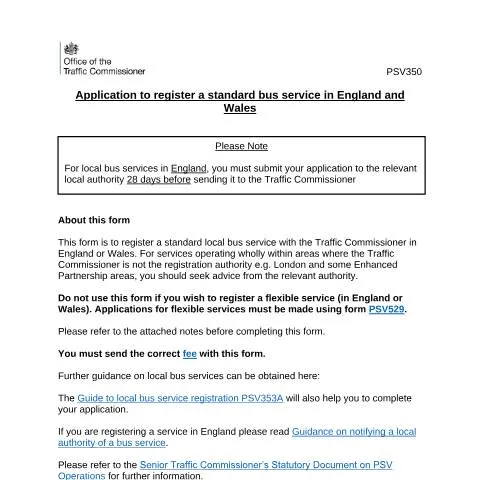
Operating a bus service in England or Wales begins with a fundamental regulatory step that determines whether your transport venture can legally carry passengers on public roads. The PSV350 form serves as the official application to register a standard local bus service with the Traffic Commissioners for Great Britain, transforming a business concept into an authorised public transport operation.
This registration process affects every aspect of your service delivery, from route planning to passenger safety obligations. Unlike many administrative formalities, PSV350 registration directly impacts your ability to generate revenue and serve communities. The Traffic Commissioners hold significant regulatory power over bus operations, making this application a critical business milestone rather than mere paperwork.
The form specifically covers standard local bus services operating in England and Wales, excluding London and certain Enhanced Partnership areas where alternative registration authorities hold jurisdiction. Operators seeking to establish flexible services must use the separate PSV529 application form instead.
Operator Eligibility and Licensing Prerequisites
Before completing PSV350, operators must hold either a PSV operator's licence or community bus permit. These credentials establish your legal foundation to operate passenger-carrying vehicles for hire or reward. The PSV operator's licence demonstrates compliance with fitness requirements, financial standing, and professional competence standards set by the Traffic Commissioners.
Community bus permits serve registered charities and community groups operating non-profit passenger services. These permits carry different obligations but still require PSV350 registration for regular scheduled services. The permit number format differs from standard operator licences, typically following patterns like CB001234 rather than the PB1234567 format used for commercial operators.
Your licensing status directly influences registration requirements and ongoing compliance obligations. Commercial operators face stricter financial monitoring and reporting duties, while community bus operators benefit from reduced administrative burdens but must maintain their charitable status and non-profit service delivery.
Licence Verification and Documentation
The Traffic Commissioners verify operator licence validity against their central database during PSV350 processing. Any discrepancies between the stated licence number and official records will delay or prevent registration approval. Operators must ensure their licence remains valid throughout the application process and subsequent service operation.
Licence conditions and restrictions automatically apply to registered services. If your operator licence limits vehicle capacity or geographical operation, these constraints affect permissible service characteristics. The Traffic Commissioners may refuse registration applications that exceed existing licence parameters.
Navigating the England-Wales Regulatory Split
The PSV350 process varies significantly between England and Wales, reflecting different statutory frameworks and local authority involvement. This distinction affects submission timelines, notification requirements, and approval procedures.
English Services: The 28-Day Local Authority Gateway
Services operating in England must complete a mandatory 28-day local authority consultation before submitting PSV350 to the Traffic Commissioner. This requirement stems from the Transport Act 1985 and subsequent amendments strengthening local authority oversight of bus service planning.
The process involves sending complete application documentation to every English county council, unitary authority, or Passenger Transport Executive (PTE) covering your proposed route. These authorities examine the application for compliance with local transport strategies, infrastructure capacity, and community needs assessment.
| Authority Type | Jurisdiction | Key Concerns |
|---|---|---|
| County Councils | Two-tier areas | Strategic transport planning, infrastructure adequacy |
| Unitary Authorities | Single-tier areas | Local service integration, passenger accessibility |
| PTEs | Metropolitan areas | Network coordination, interchange facilities |
Local authorities may raise objections based on safety concerns, infrastructure limitations, or conflicts with existing transport provision. However, they cannot prevent registration solely to protect commercial competitors unless specific statutory grounds apply.
Welsh Services: Concurrent Notification
Welsh services follow a streamlined approach where local authority notification occurs simultaneously with Traffic Commissioner submission. This reflects Wales' different administrative structure and transport governance arrangements under devolved powers.
Welsh local authorities receive copies of PSV350 applications for information rather than formal consultation. They retain rights to comment on applications but cannot delay the registration process through extended review periods.
Decoding Route Definition and Service Characteristics
The heart of PSV350 lies in precisely defining your proposed service characteristics. This section determines operational parameters that become legally binding once registration is approved.
Route Terminals and Geographic Precision
Questions 6 and 7 require exact terminal locations using NaPTAN codes (National Public Transport Access Nodes). These unique identifiers provide precise geographic references for bus stops, railway stations, and other transport hubs. NaPTAN codes eliminate ambiguity about service start and finish points, ensuring accurate traffic area determination and local authority notification.
Terminal selection affects your operational flexibility and passenger accessibility. Choosing terminals at major transport interchanges maximises passenger convenience but may increase congestion and operating costs. Remote terminals might offer operational advantages but could limit passenger uptake.
Service Frequency and Operating Patterns
Questions 10A through 10C establish your service frequency commitments. These become minimum service levels that you must maintain throughout the registration period. The Traffic Commissioners can take enforcement action if actual service delivery falls significantly below registered frequencies without prior variation approval.
Frequency declarations must consider practical operational constraints including driver hours regulations, vehicle availability, and traffic conditions. Overly ambitious frequency commitments may prove unsustainable and lead to compliance difficulties.
Bank and public holiday operation requires careful consideration as these periods often experience different passenger demand patterns and operational challenges. You may register different frequencies for these periods but must clearly specify the arrangements.
Stopping Patterns and Passenger Accessibility
The distinction between normal stopping services and limited stop operations significantly affects passenger accessibility and service appeal. Normal stopping services must serve all recognised bus stops along the route unless specific safety or operational constraints apply.
Limited stop services offer faster journey times but reduce accessibility for passengers with mobility limitations or those living between designated stops. The Traffic Commissioners scrutinise limited stop proposals to ensure adequate passenger provision exists along the route.
Hail and ride sections allow passenger boarding and alighting at any safe location rather than designated stops. These arrangements suit rural areas with sparse infrastructure but require careful safety assessment and clear operational protocols.
Understanding Traffic Area Jurisdiction and Cross-Boundary Operations
Traffic Areas define the geographic jurisdiction of individual Traffic Commissioners across Great Britain. Your service's Traffic Area classification determines which Commissioner processes your application and maintains ongoing regulatory oversight.
Services operating across multiple Traffic Areas require coordination between Commissioners but typically receive primary oversight from the area containing the service's operational base. This arrangement ensures consistent regulatory approach while respecting geographic boundaries.
Special Jurisdiction Exceptions
London services fall under Transport for London (TfL) authority rather than Traffic Commissioner jurisdiction. The Mayor of London holds bus service registration powers within Greater London boundaries, operating different procedures and requirements.
Enhanced Partnership areas may transfer registration authority from Traffic Commissioners to local transport authorities. These arrangements vary by location and require operators to verify current jurisdiction before submitting applications.
Cross-border services between England, Wales, and Scotland must navigate different regulatory frameworks. Scottish services require separate registration with Traffic Commissioner Scotland, while services crossing the English-Welsh border need careful coordination of notification requirements.
Submission Channels and Processing Timelines
PSV350 accepts both electronic and postal submissions, each offering different advantages and processing characteristics. Electronic submission through [email protected] provides faster acknowledgment and easier document handling but requires careful attention to file formats and attachment limits.
Postal submissions to the Office of the Traffic Commissioner in Leeds suit operators preferring traditional paper-based processes or those with limited electronic capabilities. However, postal applications face longer processing times and potential delays from document handling.
Fee Structure and Payment Methods
Registration fees vary according to service characteristics and complexity. The Traffic Commissioners publish current fee schedules annually, reflecting cost recovery principles for regulatory oversight activities. Fees must accompany applications, with processing suspended until correct payment is received.
Electronic submissions typically accept bank transfers or electronic payment systems, while postal applications may require cheques or postal orders. Payment delays can significantly extend processing timelines, particularly for time-sensitive service launches.
Application Processing and Approval Timelines
Standard processing takes approximately 56 days from receipt of complete applications, though complex cases or incomplete submissions may require extended periods. The Traffic Commissioners prioritise applications with clear documentation and accurate supporting evidence.
Approval generates a formal registration certificate specifying your service number, operating conditions, and compliance obligations. This certificate constitutes legal authority to operate the registered service and must be available for inspection during service operation.
Post-Registration Obligations and Compliance Monitoring
PSV350 registration creates ongoing compliance obligations extending beyond initial approval. These responsibilities ensure continued passenger safety and service reliability throughout the registration period.
Registered operators must maintain accurate service delivery records and respond promptly to passenger complaints or regulatory enquiries. The Traffic Commissioners conduct periodic compliance monitoring through roadside inspections, passenger surveys, and operator reporting requirements.
Service Variation and Amendment Procedures
Significant service changes require formal variation applications rather than simple notification. Route alterations, frequency changes, or terminal modifications typically trigger variation requirements with associated fees and consultation periods.
Minor operational adjustments may proceed through notification procedures, but operators must carefully assess whether proposed changes constitute variations requiring formal approval. Unauthorised service changes may result in enforcement action and potential licence sanctions.
The registration system balances operational flexibility with passenger protection and regulatory oversight. Understanding these boundaries ensures compliant service delivery while maintaining business adaptability to changing market conditions and operational requirements.
Operating Under Different Traffic Commissioner Areas
The United Kingdom is divided into eight distinct Traffic Commissioner areas, each with its own Traffic Commissioner responsible for licensing and regulatory oversight. Understanding which Traffic Commissioner area applies to your operation is crucial when completing form PSV350, as this determines where your application will be processed and which specific regional considerations may apply.
The eight Traffic Commissioner areas are: North Eastern and Scottish, North Western, West Midlands, East Midlands, Eastern, Western, South Eastern and Metropolitan, and Welsh. Your operating centre—the location where your vehicles are normally kept when not in service—determines which Traffic Commissioner has jurisdiction over your application. This is particularly important for operators whose services cross multiple Traffic Commissioner boundaries, as you'll need to register with each relevant authority.
Each Traffic Commissioner may have slightly different processing times and specific local requirements. For instance, operators in London and the South East often face more complex urban routing considerations, whilst those in rural Scottish areas might need to address seasonal accessibility issues. When completing PSV350, ensure you're submitting to the correct Traffic Commissioner office, as applications sent to the wrong area will be returned, causing unnecessary delays.
Cross-boundary services require particular attention. If your proposed route operates across Traffic Commissioner areas—for example, a service running from Birmingham (West Midlands) to Manchester (North Western)—you must register the service with both relevant Traffic Commissioners. Each will assess the portion of the route within their jurisdiction, and both registrations must be approved before you can commence operations.
The Traffic Commissioner system also means that enforcement priorities and interpretation of regulations can vary between regions. Some areas place greater emphasis on punctuality monitoring, whilst others focus more heavily on vehicle maintenance standards or driver conduct. Understanding these regional nuances helps ensure your PSV350 application addresses the specific concerns of your relevant Traffic Commissioner.
Vehicle Specifications and Fleet Composition Requirements
The technical specifications of vehicles intended for your bus service significantly impact how you complete form PSV350. The application requires detailed information about your fleet composition, including vehicle types, passenger capacity, accessibility features, and age profiles. This information helps Traffic Commissioners assess whether your proposed service can be delivered safely and reliably.
Single-deck buses, double-deck vehicles, and midi-buses each have different operational characteristics that affect route planning and service delivery. When specifying your fleet on PSV350, you must indicate the maximum passenger capacity for each vehicle type, including both seated and standing passengers where applicable. This capacity directly influences the service frequency requirements and determines whether your proposed timetable can accommodate expected passenger demand.
Accessibility compliance is mandatory for all new bus registrations. Your PSV350 application must demonstrate that vehicles meet current accessibility standards, including wheelchair accessibility, audio-visual announcements, and appropriate boarding facilities. The Equality Act 2010 sets out specific requirements for bus accessibility, and failure to meet these standards will result in application rejection. Older vehicles may have different compliance requirements, but any vehicle entering service must meet current accessibility legislation.
Vehicle age and condition also factor into the registration process. Whilst there's no absolute age limit for buses entering service, Traffic Commissioners consider vehicle condition when assessing operator competence. Very old vehicles may require additional maintenance documentation or more frequent safety inspections. Your PSV350 application should address how you'll maintain vehicle standards throughout the service period, particularly if operating older vehicles.
Environmental considerations increasingly influence bus service registrations. Low emission zones in major cities may restrict certain vehicle types, and many local authorities now prefer or require low-emission or zero-emission vehicles for new services. When completing PSV350, consider whether your proposed route passes through any environmental restrictions and ensure your fleet specifications comply with current and anticipated future requirements.
The relationship between vehicle specifications and route characteristics is crucial. High-frequency urban services may require different vehicle types compared to rural or inter-urban routes. Your PSV350 application should demonstrate that your chosen vehicles are appropriate for the specific operating conditions of your proposed route, including road infrastructure, passenger volumes, and geographical challenges.
Financial Viability and Business Case Documentation
Traffic Commissioners scrutinise the financial sustainability of proposed bus services to ensure operators can maintain reliable service throughout the registration period. The PSV350 application process requires comprehensive financial documentation demonstrating your ability to fund the service adequately, meet ongoing operational costs, and maintain appropriate financial reserves.
Your financial case must address both capital requirements and ongoing operational costs. Capital requirements include vehicle acquisition or lease costs, depot facilities, maintenance equipment, and initial working capital. Operational costs encompass fuel, driver wages, insurance, maintenance, administration, and regulatory compliance costs. Traffic Commissioners expect realistic cost projections based on current market rates and your specific operational circumstances.
Revenue projections require careful consideration of passenger demand, fare structures, and market competition. Overly optimistic passenger forecasts or unrealistic fare assumptions will undermine your application's credibility. Where possible, base projections on comparable services, local transport studies, or passenger surveys. Consider seasonal variations, economic factors, and competition from existing services when developing revenue forecasts.
Cash flow analysis is particularly important for new operators or services requiring significant upfront investment. Traffic Commissioners want assurance that you can sustain operations through initial low-demand periods and handle unexpected costs or revenue shortfalls. Your PSV350 submission should include monthly cash flow projections for at least the first year of operation, demonstrating positive cash flow or adequate funding to cover projected deficits.
Financial reserves and contingency planning demonstrate operational resilience. Traffic Commissioners typically expect operators to maintain financial reserves equivalent to several months of operating costs. This provides a buffer against unexpected events such as vehicle breakdowns, fuel price increases, or temporary demand reductions. Document your reserve requirements and how you'll maintain adequate funding throughout the service period.
For commercially operated services, demonstrate market viability through passenger research, competition analysis, and demand forecasting. Where services receive public subsidy, provide details of funding arrangements, contract terms, and performance requirements. Subsidised services require different financial documentation but must still demonstrate value for money and sustainable operation within budget constraints.
Banking relationships and credit facilities may be relevant to your financial case. Traffic Commissioners want assurance that you have appropriate financial management systems and can access additional funding if required. Provide evidence of established banking relationships, available credit facilities, and financial management expertise within your organisation.