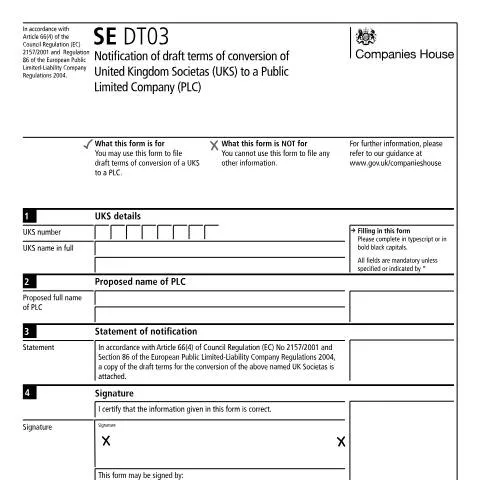
Understanding the SE DT03: A Critical Step for UK Societas Conversions
When a UK Societas (UKS) decides to transition into a Public Limited Company (PLC), ensuring compliance with legal obligations becomes paramount. The SE DT03 form, or the Notification of draft terms of conversion of a UK Societas to a PLC, serves as a pivotal document in this transformation process. It is essential for stakeholders to grasp the nuances of this document to navigate the conversion successfully.
Who Needs to Engage with the SE DT03?
The SE DT03 is primarily geared towards companies that are currently structured as a UK Societas and are aspiring to elevate their status to that of a Public Limited Company. This document becomes essential in various scenarios:
- Companies seeking greater capital through public investment.
- Firms aiming to enhance their public profile and credibility.
- Entities looking to expand their operational scope through increased shareholder participation.
Understanding the motivations and implications of this conversion is crucial for companies contemplating this significant structural shift.
Navigating the Process: Step-by-Step Guidance
Successfully completing the SE DT03 process involves meticulous preparation and adherence to specific steps. Below is a simplified guide to help navigate this critical procedure:
- Draft the Conversion Terms: Before filing the SE DT03, the company must prepare draft terms detailing the conversion of the UKS to a PLC. These terms outline how the company will operate post-conversion.
- Complete the SE DT03 Form: This form requires specific details, including the full name of the UKS, the proposed full name of the PLC, and the UKS number. It's crucial to fill in all mandatory fields.
- Gather Necessary Documentation: Attach a copy of the drafted terms of conversion to the form. This document provides the legal framework for the intended conversion.
- Secure Signatures: Ensure that the form is duly signed by a member of the management or administrative organ of the UKS. This signature affirms the correctness of the information supplied.
- Submit to the Appropriate Address: Depending on the UKS's registration, submit the form to the relevant Companies House address for England and Wales, Scotland, or Northern Ireland.
Common Procedural Inquiries: Clarity Amid Complexity
As companies prepare to submit the SE DT03, several questions frequently arise. Here’s a breakdown of common procedural inquiries:
- What if the UKS name and number do not match? Consistency with the public register is vital. Ensure that the name and number are accurate to avoid processing delays.
- Can I submit the form electronically? Currently, the SE DT03 must be submitted in hard copy. Companies should keep this in mind when planning their submission timeline.
- What happens if I fail to attach the draft terms? Submission without the draft terms will lead to rejection of the application. Be diligent in double-checking attachments.
Interpreting the Limits: What the SE DT03 Does and Does Not Cover
Understanding the scope of the SE DT03 is crucial for its effective application. Here’s what you need to know about its coverage:
- Includes:
- Notification of the intention to convert from a UKS to a PLC.
- Details surrounding the draft terms of conversion.
- Does Not Include:
- Any information pertinent to other types of corporate restructuring.
- Financial statements or detailed business plans—these are separate legal requirements.
Common Misunderstandings: Navigating the Gray Areas
As with many official processes, misunderstandings can lead to avoidable complications. Here are a few common misinterpretations regarding the SE DT03:
- Misunderstanding the role of the draft terms: Some companies believe that the form itself suffices for the entire conversion process. However, the draft terms are critical for detailing the operational changes.
- Assuming a simple name change suffices: Transitioning to a PLC involves more than just changing the name; it requires a comprehensive restructuring as per the Companies Act.
The Role of Companies House in the Conversion Process
Companies House plays a vital role in regulating and facilitating the conversion from UKS to PLC. Understanding their function can aid in smoother transactions:
- Public Record Maintenance: All submitted information is part of the public register, enhancing transparency and accountability.
- Advisory Services: Companies House provides guidance on the conversion process and related documentation through their official channels.
- Processing Submissions: Timely processing is crucial, and understanding their operational timeline can assist companies in planning their transitions more effectively.
Final Considerations: Preparing for Transition
The transition from a UK Societas to a Public Limited Company through the SE DT03 form is a significant step for any business. Here are some final thoughts to keep in mind:
- Compliance is Key: Ensuring that all steps are correctly followed minimizes the risk of delays or rejections.
- Consult Legal Experts: Engaging legal professionals with experience in company law can provide invaluable insights during this transition.
- Stay Informed: Regularly review updates from Companies House and remain aware of any legislative changes that might affect the conversion process.
Conversion to a PLC can yield many benefits, including increased funding opportunities and enhanced public trust. However, thorough preparation and compliance with legal requirements are essential to navigate this complex process successfully. Understanding the SE DT03 form is the first step in transforming a UK Societas into a thriving Public Limited Company.