Navigating the CS Facilitation Fund: A Vital Tool for Rural Communities
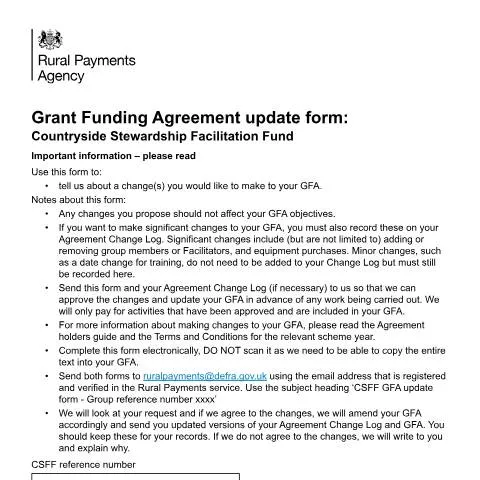
The CS Facilitation Fund: Grant Funding Agreement Update Form epitomises a crucial component for rural communities engaged in environmental stewardship through the Countryside Stewardship Scheme. This form allows existing agreement holders to communicate changes to their Grant Funding Agreements (GFA), ensuring that projects remain aligned with the overarching objectives set out when the agreement was first established. This is not just a bureaucratic formality; it serves as a lifeline for groups pivoting in response to evolving needs, facilitating impactful actions across the countryside.
Understanding the Context and Structure of the Countryside Stewardship Scheme
The Countryside Stewardship Scheme is part of the UK government’s strategy to encourage sustainable farming practices and provide financial assistance for land management that benefits the environment. The CS Facilitation Fund specifically supports groups aiming to deliver collective actions that enhance natural habitats and biodiversity.
Administered by the Rural Payments Agency (RPA), this scheme not only enhances agricultural productivity but also aligns with the government’s goals for net-zero emissions and biodiversity recovery.
The CS Facilitation Fund is structured to encourage collaboration among landowners, farmers, and environmental organisations. Thus, understanding how to update your GFA is essential for maintaining project continuity.
How to Effectively Communicate Changes to Your GFA
When you find that changes need to be made to your existing Grant Funding Agreement, the CS Facilitation Fund update form serves as the official channel for communicating these adjustments. It is essential that the proposed changes do not deviate from the fundamental objectives of your GFA.
Identifying Changes
- Significant Changes: These include alterations such as adding or removing group members, changing facilitators, or making substantial purchases. Such changes must be documented in your Agreement Change Log.
- Minor Changes: Adjustments like date shifts for training activities can be recorded on the update form without necessitating a Change Log entry.
Completing the Update Form
Completing the update form electronically is imperative. The RPA requires the form to remain in a format that allows for easy transfer of information directly into your GFA. This can be completed by following these key steps:
- Fill out the form in a clear and legible manner.
- Be sure to describe the changes in specific terms, particularly how they relate to the delivery plan and overall project objectives.
- Include all relevant financial information, recalculating your overall budget to reflect the requested changes.
Submission Process and Follow-Up
After completing the form, ensure you send it to the RPA at [email protected], using the verified email address registered within the Rural Payments service. Remember to include the subject heading “CSFF GFA update form - Group reference number xxxx.” This allows the agency to track your submission efficiently.
Once submitted, the RPA will review your request. If they agree with the changes, they will amend your GFA and send updated documents back to you. If the request is not approved, you will receive a written explanation detailing the reasons for denial. Therefore, monitoring your email for a response is crucial.
Understanding the Financial Implications of Your Updates
The update form requires a detailed breakdown of your project’s financial structure post-change. This is critical, as it affects the funding application process. Ensure that you accurately recalculate your total funding request, separating costs into specific categories:
| Description | Cost (exclusive of VAT) |
|---|---|
| Group activity costs | £ |
| Facilitation and administration costs | £ |
| VAT (to be reclaimed by RPA) | £ |
| Total funding applied for | £ |
Common Scenarios and Troubleshooting Issues
While the process may seem straightforward, there are potential pitfalls to be aware of when making updates to your GFA. Here are some common scenarios:
Refusals and Clarifications
In cases where an update is refused, understanding the rationale provided by the RPA is essential. Review their feedback carefully and consider whether the proposed changes can be adjusted to meet their criteria. If you believe the refusal is unjustified, you can reach out for further clarification or guidance.
Dealing with Missing Documentation
It’s not uncommon for applicants to overlook the necessity for accompanying documents. Ensure that your Agreement Change Log is updated and included with your update form when significant changes are made. If documentation is incomplete, the RPA may either delay your request or deny it altogether.
Distinguishing the Update Form from Other Official Documents
The CS Facilitation Fund update form is distinct from various other forms that might be associated with funding applications or agreements under the Countryside Stewardship Scheme. Understanding these distinctions helps in ensuring that you are submitting the correct documentation:
- Initial GFA Form: This is the document that outlines the original agreement terms and conditions. It is not to be confused with the update form.
- Agreement Change Log: This is a record-keeping tool that tracks all significant amendments made to your GFA. It complements the update form but serves a different purpose.
The Importance of Accurate Record-Keeping
A critical aspect of managing your GFA is ensuring that your records are precise and up to date. As changes are made, it’s vital to maintain accurate documentation, not only for compliance with the RPA but also for your group’s future funding applications. Familiarise yourself with the Terms and Conditions linked to the scheme for comprehensive guidance on financial management and reporting obligations.
Looking Ahead: Future Developments in Rural Funding
The landscape of rural funding in the UK is ever-evolving, particularly in light of new environmental policies aiming to bolster biodiversity and enhance sustainability in agriculture. Staying informed about upcoming changes to funding mechanisms, including potential new schemes or amendments to existing ones, can have a significant impact on your project’s success.
Participation in training activities or workshops provided by the RPA or other agricultural bodies can also provide valuable insights into best practices and regulatory updates. Remaining proactive can position your group advantageously in the competitive landscape of rural funding.
Final Thoughts: Empowering Rural Communities Through Engagement
The CS Facilitation Fund and its associated update form represent more than just administrative obligations; they are tools for empowerment within rural communities. By understanding how to navigate the complexities of the funding process, groups can ensure their initiatives not only survive but thrive, contributing positively to the environment and local economy.
Ultimately, engaging with the RPA and leveraging the resources available can greatly enhance your project's impact. Ensure that you are prepared to adapt and respond to the needs of your community and the environment, securing the future of the projects that play a vital role in the rural landscape.
Understanding the CS Facilitation Fund: Purpose and Eligibility Criteria
The Countryside Stewardship (CS) Facilitation Fund is designed to support collaborative approaches to managing land, enhancing biodiversity, and improving the overall health of the countryside in England. Organizations applying for these grants must understand their purpose and ensure they meet all eligibility criteria.
At its core, the CS Facilitation Fund aims to encourage groups of land managers, farmers, and foresters to work together to implement sustainable practices. This is particularly important in light of increasing pressures on the environment, such as climate change and biodiversity loss. By pooling resources and knowledge, participants can make a significant positive impact on their local ecosystems.
Eligibility for the CS Facilitation Fund is generally restricted to groups rather than individual applicants. This includes established partnerships, such as clusters of farms, nature reserves, or community groups actively engaged in land management. Each group must demonstrate that their collective efforts will lead to tangible environmental benefits, aligning with the broader goals of the Countryside Stewardship scheme.
Additionally, applicants should be prepared to provide details about their intended project outcomes, how these will be measured, and the specific roles each member of the group will play. The Department for Environment, Food and Rural Affairs (DEFRA) emphasizes that successful applications will clearly articulate their environmental goals and the collaborative spirit of the initiative.
It's worth noting that while the focus is on environmental outcomes, social and economic improvements that arise from collaborative projects can also be highlighted in applications. The successful integration of these elements can strengthen the case for funding, as they demonstrate a holistic approach to rural development.
Navigating Changes in Grant Funding Agreements: What Applicants Need to Know
Changes to the Grant Funding Agreement can arise due to various reasons, including shifts in project scope, budget adjustments, or amendments in legal regulations. Understanding how to navigate these changes is crucial for maintaining compliance and ensuring the continuity of funding.
Firstly, it is essential for applicants to maintain clear communication with the funding body—typically DEFRA. If changes to the project are anticipated, proactive dialogue can help clarify expectations and facilitate smoother transitions. Additionally, all amendments should be documented formally, which may involve completing specific sections of the Grant Funding Agreement update form (also known as the CS Grant Agreement Variation Form).
Once a change occurs, the first step is to fill out the required update form accurately. Details such as the extent of the change, its justification, and how it impacts the overall project must be clearly described. Applicants should be mindful of deadlines for submitting updates, as failure to comply can result in loss of funding or penalties.
Furthermore, it is advisable to have a record of all correspondence related to the amendments. This documentation not only serves as a reference but may also be requested during audits or evaluations. Keeping a well-organized file related to all agreements, changes, and communications with DEFRA will assist in maintaining transparency and accountability.
In some cases, changes can lead to significant impacts on the project's funding amount or timeline. Therefore, conducting a thorough risk assessment when proposing alterations is recommended. Any adjustments should be weighed against potential benefits and risks to the overall project goals.
Common Pitfalls in Grant Applications and How to Avoid Them
Securing funding through the CS Facilitation Fund can be competitive, and applicants must be aware of common pitfalls that could jeopardize their chances of success. Understanding these challenges can empower applicants to submit stronger proposals and improve their chances of receiving funding.
One frequent issue is the lack of clarity in project objectives. Applications that fail to articulate clear, measurable outcomes can easily be rejected. It is vital to define specific goals, such as improving soil health, increasing biodiversity, or enhancing community engagement. Using the SMART criteria (Specific, Measurable, Achievable, Relevant, and Time-bound) can help frame the objectives effectively.
Another common pitfall is insufficient evidence to support claims made in the application. Applicants should back up their proposals with data, whether it be from previous environmental assessments, case studies of similar projects, or relevant research. Providing statistical evidence or testimonials can help establish credibility and demonstrate the potential impact of the project.
Moreover, a lack of stakeholder engagement often undermines grant applications. Applicants should involve all relevant parties, such as local councils and community members, early in the planning process. Demonstrating prior engagement, collaboration, and shared responsibility strengthens the application and showcases the project's community roots.
Budgeting is also a critical area where applicants can falter. A clear, detailed budget should be included, outlining all projected costs and how they align with the proposed project activities. It is important to ensure that the budget is realistic and that all expenses are justified. In many cases, applicants might underestimate costs, leading to funding shortfalls later on.
Lastly, applicants should be wary of missing deadlines. Familiarity with the application timeline, including the submission of the Grant Funding Agreement update form and additional documentation, is crucial. Set internal deadlines a few weeks prior to official due dates to allow time for review and revisions.
By being aware of these common pitfalls and taking the necessary steps to avoid them, applicants can enhance their proposals and improve their chances of securing funding from the CS Facilitation Fund.