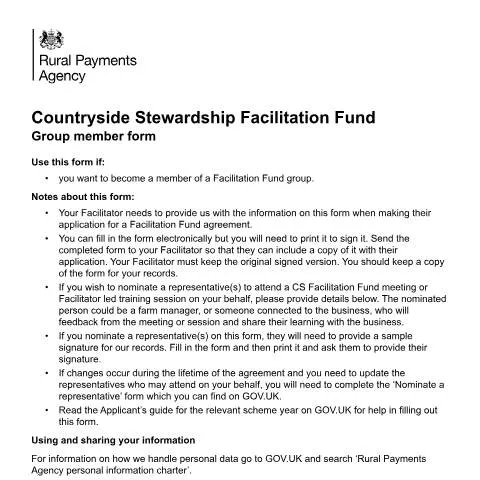
Understanding the Countryside Stewardship Facilitation Fund: Group Member Form
The Countryside Stewardship Facilitation Fund plays a crucial role in enhancing rural communities and promoting sustainable land management practices. The Group Member Form serves as a vital tool for individuals wishing to participate in a Facilitation Fund group. It is essential to grasp not just the mechanics of this document, but also its broader implications for rural stewardship and community engagement.
The Lifecycle of the Group Member Form
For those interested in joining a Facilitation Fund group, the timeline and procedural steps surrounding the Group Member Form are critical. Understanding these phases can help ensure a smoother application process.
- Preparation Phase (Ongoing): Engage with your local facilitator to discuss the possibility of joining a group.
- Submission of the Form: Complete the Group Member Form electronically, ensuring all details are accurate. Print and sign the document.
- Facilitator's Application: Your facilitator submits the form along with their application for Facilitation Fund agreement.
- Notification of Acceptance: Following submission, you will receive communication regarding the status of your application.
- Ongoing Participation: Once accepted, your involvement in group activities continues as outlined in the agreement.
This cycle emphasizes the importance of collaboration and communication with your facilitator throughout the entire process.
Navigating the Details: Completing the Form
Filling out the Group Member Form accurately is essential to avoid any processing delays. Below, we break down the form into its key sections, providing tips to ensure correct completion.
Part A: Group Member Details
This section requires vital identification information. Here’s what you need to provide:
- Group member’s name: Ensure it matches exactly how it appears in the Rural Payments service.
- Email address: Use the email associated with your Rural Payments registration for consistency.
- Business SBI number: This unique identifier is critical for tracking your application.
- Business name: The official name registered with the Rural Payments Agency.
- Telephone number: A reliable contact number for follow-up communications.
Part B: Land Details and Eligibility
In this segment, you’ll need to provide information about your holding and confirm your support for group activities:
- Total area of your holding: Indicate the area in hectares (ha). Accurate measurements are crucial for your eligibility.
- Support for group activities: You must indicate your agreement with the proposed activities.
- Facilitation group agreement confirmation: It is mandatory to sign and confirm your awareness of the group agreement.
Part C: Nomination of a Representative
If you wish to delegate responsibilities, this part allows you to nominate a representative to attend meetings or training sessions on your behalf. Here’s how to proceed:
- Name and job role: Clearly state who your representative is and their position within your organization.
- Contact information: Provide a telephone number and email address for your representative.
- Time period: Indicate the duration for representation to ensure clarity.
- Sample signature: A required signature to validate the nomination.
Should you need to modify your representative later, a separate ‘Nominate a representative’ form must be completed.
Legal and Ethical Obligations: The Declaration Section
Submission of the Group Member Form entails a declaration of accuracy and integrity. Understanding the legal implications of this declaration is crucial.
- Truthfulness: You affirm that all information provided is true to the best of your knowledge. Misrepresentation can lead to prosecution.
- Data Usage: Acknowledge that your information may be shared with public bodies for purposes including fraud detection.
- Signature Requirement: Ensure your signature is present along with the date of signing to validate the declaration.
This section reinforces your responsibility regarding the data submitted and the ethical considerations tied to funding applications.
Critical Timeline Considerations
Understanding the timing involved in submitting the Group Member Form is paramount for successful participation.
| Stage | Timeline | Action Required |
|---|---|---|
| Preparation | Ongoing | Engage with your facilitator and review group agreement. |
| Form Submission | As soon as possible | Complete, sign, and submit the form to your facilitator. |
| Application Decision | 4–6 weeks | Await confirmation regarding the status of your application. |
| Ongoing Engagement | Throughout the funding period | Participate in group activities as per the agreement. |
This timeline highlights critical moments in the process, ensuring you remain proactive and engaged.
Scenarios and Specific Situations: Who Needs to Know
While many will follow a standard path, some individuals may find themselves in unique circumstances that require special attention. Below are common scenarios one might encounter:
International Members
Individuals from outside the UK wishing to join a Facilitation Fund group must consider additional regulations related to their eligibility and documentation. Ensure compliance with data protection laws and consult with your facilitator about any specific requirements.
Complex Business Structures
If your operation is a partnership or involves multiple stakeholders, ensure that all parties are in agreement and properly represented in the application process. Clear communication with your facilitator can prevent misunderstandings.
Emergency Situations
In cases where immediate representation is required (e.g., sudden absence of the nominated representative), promptly fill out the ‘Nominate a representative’ form. Contact your facilitator to keep them informed of changes and seek their guidance on urgent matters.
Facilitator's Role in Your Application Journey
Your facilitator is more than just a point of contact; they are a vital ally throughout the application process. Their responsibilities include:
- Providing Guidance: They will help ensure that you understand the requirements and implications of the Group Member Form.
- Submitting Documentation: Once you submit your completed form, it is your facilitator who will attach it to their application for the Facilitation Fund agreement.
- Maintaining Records: Your facilitator must keep a signed record of your form, safeguarding your data and confirming your involvement.
- Communicating Updates: They will inform you of changes regarding your status within the group or any amendments to the group activities.
Effective collaboration with your facilitator can significantly impact your experience and success in the Countryside Stewardship program.
Final Thoughts on Engagement and Accountability
Your participation as a group member in the Countryside Stewardship Facilitation Fund represents a commitment to sustainable practice and community cooperation. Ensure that you remain engaged not only in the application process but also in the ongoing activities of your group. Accountability, transparency, and enthusiasm for rural stewardship can lead to meaningful contributions to your community and the environment.
Understanding the Countryside Stewardship Facilitation Fund
The Countryside Stewardship Facilitation Fund is designed to support groups of farmers and land managers to work together collaboratively on environmental projects. It aims to enhance the natural environment by encouraging sustainable farming practices, improving habitats, and fostering biodiversity. The fund specifically focuses on facilitating groups that can share knowledge, resources, and best practices, ultimately leading to more significant environmental benefits than individual efforts could achieve.
This initiative is part of the broader Countryside Stewardship scheme, which offers financial support to landowners and farmers in England to help manage land in a way that benefits the environment. The Facilitation Fund invites eligible groups, such as farmer cluster groups, to apply for funding to enable joint projects that have a direct positive impact on the rural landscape.
Eligible activities under this fund may include the establishment of management plans that align with environmental goals, enhancing soil health, improving water quality, and conserving threatened species. Groups are encouraged to engage with local communities and stakeholders to ensure a holistic approach is taken toward environmental management.
Application Process for Group Members
When applying for the Countryside Stewardship Facilitation Fund as a group member, it is essential to follow a structured process to ensure that your application is comprehensive and meets all required criteria. The first step is to join an eligible facilitation group that is already working under the Countryside Stewardship scheme. This group should have an appointed facilitator who is experienced in managing group projects and liaising with the Rural Payments Agency (RPA).
Once you become a member of a group, your facilitator will guide you through the specific application process outlined by the RPA. Group members must provide information about their land, including its size, management practices, and any existing environmental initiatives. It's crucial to demonstrate how your involvement will contribute to the group’s objectives and the overall aims of the Countryside Stewardship.
The application form may require details such as your National Insurance number, the type of farming practices you engage in, and your experience with environmental stewardship projects. You should also be prepared to detail how the funding will be used collaboratively among group members, showcasing a united approach to achieving shared goals. This documentation will help ensure that your application reflects the collective commitment to environmental stewardship.
Monitoring and Evaluation of Group Projects
Effective monitoring and evaluation are key components of the Countryside Stewardship Facilitation Fund. Once funding is awarded, groups must establish clear benchmarks to assess the success of their projects. The RPA places great emphasis on accountability, and groups are expected to report on the progress of their projects regularly.
Group facilitators will play a vital role in coordinating these evaluations, collecting data on environmental improvements, and ensuring that all group members contribute to the monitoring process. This may involve collecting information on wildlife populations, soil health indicators, or water quality metrics, depending on the group’s objectives. Regular reporting not only satisfies funding requirements but also helps in demonstrating the impact of collaborative efforts on the local environment.
Furthermore, lessons learned from monitoring activities should be shared among group members and the wider community. This sharing of knowledge will not only enhance individual member practices but also strengthen the overall efficacy of future group projects. Engaging with local stakeholders, including conservation organisations and academic institutions, can provide invaluable insights and foster a culture of continuous improvement.