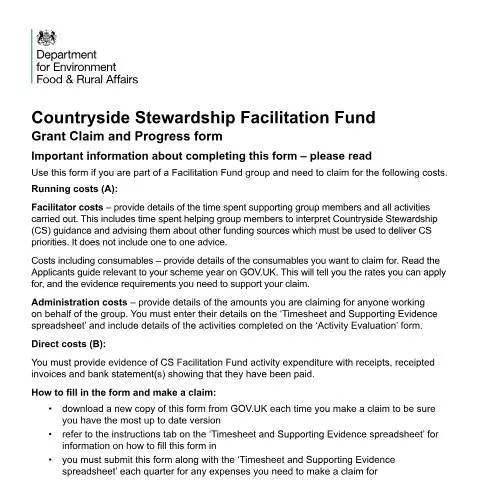
Navigating the Countryside Stewardship Facilitation Fund: A Comprehensive Guide
For individuals and groups engaged in agricultural and environmental stewardship, accessing funding can be a pivotal factor in advancing sustainable practices. The Countryside Stewardship Facilitation Fund: Grant Claim and Progress form is an essential tool for groups looking to claim expenses related to their stewardship activities. This document is not merely a form; it's a navigational compass aiding facilitators in managing and reporting grant progress effectively.
Understanding the Context: Why This Form Matters
The Countryside Stewardship (CS) programme is part of the UK government's commitment to support farmers and land managers in improving the natural environment. Since its inception, the Facilitating Fund has aimed to enhance collaboration among landowners and stakeholders, thus fostering a community-oriented approach to managing rural landscapes. By filling out this form, groups tap into financial support that enables activities crucial for biodiversity, habitat restoration, and sustainable farming practices.
The Regulatory Framework
The facilitation fund aligns with the UK’s broader environmental goals, encapsulated in various regulations and directives that stress the importance of sustainable land management. The Environmental Protection Act 1990 and the Natural Environment and Rural Communities Act 2006 are foundational laws guiding such initiatives. These statutes establish the legal basis for providing financial support to activities that contribute positively to the ecology of rural areas.
Profile of Claimants: Who Benefits from This Fund?
This grant is primarily intended for groups involved in rural stewardship, including:
- Farmers collaborating in community-led initiatives.
- Conservation groups focused on enhancing biodiversity.
- Local authorities working on rural development plans.
Understanding the specific circumstances of each claimant is critical. For example:
- Farmers: They might be looking to collaborate on agri-environment schemes and require funds for facilitator costs and consumables.
- Conservation groups: These groups may need to claim for specific training activities aimed at improving members’ skills in land management.
- Local authorities: They often have distinct reporting requirements which necessitate a detailed breakdown of expenses incurred during stewardship activities.
Preparing Supporting Documentation: The Backbone of Your Claim
Completing the Grant Claim and Progress form requires meticulous attention to supporting documentation. This includes:
- Timesheet and Supporting Evidence spreadsheet: This pivotal document details all time and expenses claimed under running costs and direct costs.
- Activity Evaluation form: To substantiate claims about activities conducted during the period.
- Invoices and Receipts: Clear documentation demonstrating expenditure, which must be itemised to match entries in the Timesheet.
Document Preparation Strategies
To ensure a smooth claim process, start preparing your documentation well in advance:
- Download the latest version of the form from the official GOV.UK website.
- Maintain meticulous records in the Timesheet, updating it regularly to reflect actual expenses incurred.
- Gather receipts and invoices promptly, ensuring they are clearly itemised and easily accessible.
The Submission Process: From Form Completion to Approval
Once your documentation is prepared, the next step is submission. This process involves several key actions, including:
- Submitting the Grant Claim and Progress Form alongside the Timesheet and Supporting Evidence spreadsheet.
- Ensuring that you send these documents to the appropriate email address, specifically [email protected], using a verified email associated with your SBI.
- Including the subject line ‘CS Facilitation Fund claim’ along with your SBI and CS Facilitation Fund agreement number for efficient processing.
It's crucial to maintain an organised filing system of all claims and correspondence; this will be invaluable if any follow-ups are necessary.
Following Up on Your Claim
After submission, the waiting period begins. Understanding how to monitor the status of your claim is essential:
- Be aware that the processing time can vary, but the Rural Payments Agency (RPA) aims to communicate any issues swiftly.
- If problems arise, your caseworker will reach out for clarification or documentation adjustments.
- Maintain communication with your stakeholders and group members to keep them informed on claim status and any necessary adjustments.
Timing Matters: Key Dates in the Claim Process
Successfully navigating the grant claim process relies heavily on adhering to specified timelines. Important dates to remember include:
- Quarterly Submission Deadlines: Claims must be submitted quarterly, aligning your activities and expenditures to these timelines.
- Renewal of Grant Funding Agreements: Should any significant changes to your planned activities occur, these must be documented and could require updates to the GFA.
Post-Submission Procedures
Once your claim is processed, what happens next? Understanding the outcome and ensuing steps is crucial:
- If approved, funding will be disbursed based on the validated amounts in your claim.
- Should claims be partially approved or rejected, clarity on the reasons will be provided, allowing for resubmission if necessary.
- Keep track of all funded activities to ensure compliance and ease the reporting process for future claims.
Potential Challenges and How to Overcome Them
While the process is straightforward, various challenges may arise. Awareness and proactive management can mitigate these issues:
- Document Discrepancies: Stay vigilant in ensuring that all claims match the actual expenditures. Regular audits of financial documents can help.
- Changing Regulations: As government policies evolve, stay informed through the RPA’s updates to ensure compliance with current requirements.
- Group Dynamics: Effective communication within your group is essential for managing claims collectively. Regular meetings can help align expectations and clarify responsibilities.
Leveraging Resources for Success
The RPA and other affiliated groups provide numerous resources designed to assist facilitators in filling out the Grant Claim and Progress Form correctly:
- Utilise the Agreement holder’s guide available on GOV.UK, which details the intricacies of the application and submission processes.
- Engage with local agricultural advice providers for tailored support, especially if new to funding claims.
Overall, being prepared is essential to successfully navigating the grant claiming process, ensuring that your organisation can continue its vital work in rural stewardship.
Understanding the Eligibility Criteria for the Countryside Stewardship Facilitation Fund
The Countryside Stewardship Facilitation Fund (CSFF) aims to promote collaborative working among farmers and land managers. However, to benefit from this grant, applicants must meet certain eligibility criteria. These criteria ensure that the fund supports initiatives that have a positive impact on the environment and promote sustainable land management practices.
Firstly, applicants must be part of a group of farmers or land managers who are prepared to work together on shared objectives. This collective approach is essential as it enhances the overall effectiveness of the stewardship initiatives. Additionally, these groups must demonstrate their commitment to improving their local environment and biodiversity, which may include plans to enhance habitats, improve water quality, or manage flood risks more effectively.
It's crucial for groups to be formed before applying, as individual applications are not eligible. Furthermore, applicants need to be registered with the Rural Payments Agency (RPA) and hold valid agricultural land management status. Understanding the local environmental priorities set by Natural England or the relevant local authority can also be beneficial, as it aligns the group's objectives with regional sustainability goals.
For specific agricultural practices, the group members should operate within the parameters of the Countryside Stewardship scheme, which includes various options like woodland creation, organic farming, and habitat restoration. Each group's proposal must clearly outline how their collaborative efforts will lead to tangible environmental benefits and how they intend to engage with the broader community regarding their sustainable practices.
Lastly, it is essential to note that the application should include a detailed description of the group's structure, how decisions will be made, and the strategy for involving all members in the stewardship activities. Ensuring that each member understands their roles and responsibilities can significantly influence the success of the grant claim process.
Application Process for the Countryside Stewardship Facilitation Fund
The application process for the Countryside Stewardship Facilitation Fund can appear complex, but breaking it down into manageable steps can help streamline the experience. The initial stage involves forming a group and identifying the common goals you wish to achieve through collaboration. Once your group is established, you should begin gathering the necessary documentation required for the application.
Applications can be submitted online via the Rural Payments service. Ensure that all group members have registered for the Rural Payments Agency’s online system since this is where you will complete the application. You will need relevant information about the group, including details about each member's land holdings, their current agricultural practices, and any previous environmental stewardship agreements.
As part of the application, you must provide a project outline detailing how the group intends to use the funding. This should include a clear timeline of activities, desired outcomes, and how progress will be evaluated. It may be advisable to consult with a local advisor or access resources provided by Natural England to refine your proposal and ensure it aligns with the necessary guidelines.
After submission, you will receive an acknowledgement from the RPA confirming receipt of your application. If your application is successful, you will be notified of the funding amount and the conditions attached to the grant. Regular progress reports will be required to demonstrate how the funds are being utilized and what environmental improvements are being achieved. These reports help maintain transparency and accountability throughout the grant period.
Bear in mind that certain deadlines apply throughout the application process, so it is advisable to stay informed about any updates from the RPA and Natural England to avoid missing crucial dates.
Managing Funds and Reporting Progress on the Countryside Stewardship Facilitation Fund
Once the grant has been awarded, effective fund management is vital to ensure compliance with the terms set by the Rural Payments Agency. Each group must establish clear financial procedures to track spending accurately. This includes keeping detailed records of all expenditures related to the project, such as equipment purchases, service contracts, and materials. Regularly updated budgets will help in monitoring the financial health of the initiative.
Groups are also required to submit progress reports at intervals specified by the RPA. These reports should highlight the activities carried out, the progress made towards meeting the outlined goals, and any challenges encountered along the way. It’s essential to document all outcomes, including qualitative and quantitative data that reflect the environmental benefits achieved through the stewardship activities. For instance, if your group undertook a planting initiative, data on the number of trees planted and the survival rate of those trees over time would be invaluable.
Additionally, groups should be prepared for site visits from representatives of the RPA or Natural England, who may assess whether the project is progressing as planned and if the environmental benefits are being realized. This can also serve as an opportunity to receive guidance and support from experts who can provide advice on best practices and ways to enhance the project’s impact.
In case of any discrepancies or changes in the project scope, it is crucial to communicate with the RPA promptly. Keeping an open line of communication can prevent misunderstandings and ensure continued support for the project. Ultimately, effective management of the grant and consistent reporting of progress not only strengthens the group's standing with the funding body but also fosters a culture of transparency and accountability amongst members, further enhancing collaborative efforts towards sustainable land management.