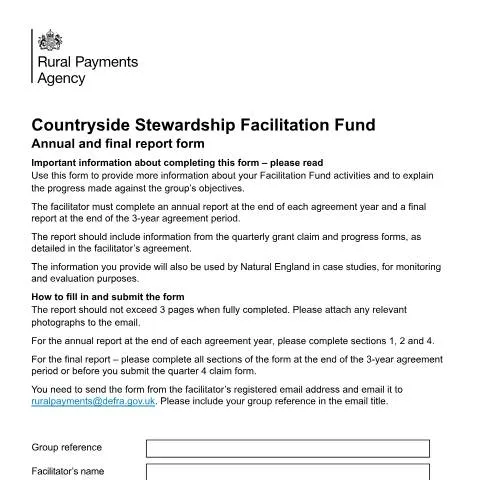
Navigating the Countryside Stewardship Facilitation Fund Report: A Comprehensive Guide
The Countryside Stewardship Facilitation Fund (CSFF) plays a pivotal role in promoting environmental stewardship and collaboration among land managers in England. As a facilitator, your responsibilities extend beyond mere financial oversight; you are tasked with reporting on the progress of your group’s activities in a structured manner. Understanding the nuances of the Annual and Final Report Form is essential for effective communication with the Rural Payments Agency (RPA) and Natural England.
The Essence of the Report: Why It Matters
Your report serves as a critical touchpoint for assessing the impact of the activities funded through the CSFF. This document not only reflects your group's achievements over the agreement period but also highlights areas that may need further attention. The data you provide contributes to a larger narrative that informs policy decisions and funding allocations for future programs.
Connecting Activities to Objectives
Each report must align group activities with the specific objectives outlined in your Grant Funding Agreement. It’s vital to articulate how your actions have led to measurable outcomes. For instance, if your group organized training sessions aimed at improving biodiversity on your land, detail the specific improvements observed as a result.
- Clear Reporting: Outline each objective and corresponding activity.
- Success Metrics: Specify how you measure success, whether through qualitative assessments or quantitative data.
Who Should File the Report?
The annual and final reports are the responsibility of the designated facilitator within your group. This individual must be registered with the RPA and possess a valid email address associated with the group’s funding agreement. This ensures that all communication remains streamlined and official.
Identifying Your Role as a Facilitator
As a facilitator, your role extends to both coordination and accountability. You are not merely a point of contact but also a leader who drives the collective efforts of your group. Some responsibilities include:
- Compiling inputs from group members.
- Documenting activities comprehensively.
- Submitting reports by the stipulated deadlines.
Completing the Report: Step by Step
While the form is relatively concise, there are key areas to focus on for an impactful submission. The report is not to exceed three pages, so clarity and conciseness are paramount.
Sections to Fill Out
Each report consists of four primary sections:
| Section | Description | When to Complete |
|---|---|---|
| Section 1 | New agreements or funding details. | Annual and Final Report |
| Section 2 | Objectives and activities undertaken. | Annual Report |
| Section 3 | End-of-agreement summary and overall achievements. | Final Report |
| Section 4 | Facilitator’s name and contact information. | Both Reports |
Key Details for Each Section
In Section 1, list any new funding such as Countryside Stewardship Higher Tier agreements. Section 2 is crucial for discussing objectives. Be candid about any shortcomings and outline plans to address them. Section 3, reserved for the final report, requires a comprehensive reflection of the entire agreement period, including setbacks and future directions.
Submission Process: Timing and Accuracy
Once the report is completed, it’s essential to send it correctly. The submission must come from the facilitator’s registered email and be directed to [email protected]. Ensure to include the group reference in the email subject line for efficient processing.
Timing is Critical
For the annual report, the deadline aligns with the end of each agreement year, specifically by 31 January. The final report must be submitted before the quarter 4 claim form. Missing these deadlines can significantly impact your funding and the group’s ability to meet its objectives.
Understanding the Regulatory Framework
The CSFF operates under a broader legal framework designed to promote sustainable land management and conservation in rural areas. This framework includes the principles outlined in the Data Protection Act 2018 and the UK GDPR, which govern the processing of personal data in relation to your activities.
How the Regulations Affect Reporting
As you compile your report, be mindful of data privacy regulations. Ensure that any personal information included in the report complies with legal standards. This includes anonymizing data where necessary and understanding your obligations as a data handler.
Dealing with Challenges: What If Things Go Wrong?
Despite your best efforts, challenges may arise during the reporting process. This could include missing information, errors on the form, or even a rejection of your submission. Here’s how you can effectively navigate these issues.
Steps to Take in Case of Errors
- Double-Check Your Submission: Before sending, ensure all sections are filled correctly. A second pair of eyes can be invaluable.
- Communicate Promptly: If you discover an error post-submission, contact the RPA immediately to rectify the issue.
- Document Everything: Keep records of all communications and submissions for reference.
Handling Rejections
In case your report is rejected, you will typically receive feedback outlining the reasons. Take this feedback seriously and make the necessary adjustments before resubmitting. Failure to address the concerns raised could jeopardize future funding opportunities.
The Unique Role of the CSFF Report in the Funding Ecosystem
This report is distinct from other forms related to rural payments. While other forms might focus on specific projects or payments, the CSFF report encompasses a holistic view of group activities and their effectiveness in meeting environmental goals.
Comparative Analysis with Other Reports
| Form | Focus Area | Frequency |
|---|---|---|
| CSFF Annual Report | Group activities and objectives | Annual |
| CSFF Final Report | Overall achievements across the agreement | Every three years |
| Farm Payment Claim Form | Specific payment claims | Quarterly |
While the CSFF reports emphasize collaboration and sustainability, other forms may focus more narrowly on financial transactions or compliance with specific program requirements.
Future Considerations: Planning Ahead
The completion of the Annual and Final Report Form is not just about accountability; it also sets the stage for future projects. Reflecting on your group's achievements can aid in securing further funding and ensuring that your group remains a pivotal player in environmental stewardship.
Building on Success
As you finalize your report, consider how to leverage the achievements documented. Engaging stakeholders and showcasing your group's successes can pave the way for new partnerships and additional funding opportunities. Remember, your narrative matters.
Final Thoughts: Embracing the Responsibility
Completing the Countryside Stewardship Facilitation Fund: Annual and Final Report Form is an essential responsibility for facilitators. It’s not merely about compliance but about demonstrating the value of collaborative efforts in rural land management. By meticulously documenting your activities and aligning them with stated objectives, you contribute to a larger goal of sustaining England's rural landscapes.
In this way, your role as a facilitator becomes not just a task to complete but a vital contribution to the ongoing dialogue about environmental stewardship and resource management.
Understanding the Countryside Stewardship Facilitation Fund
The Countryside Stewardship Facilitation Fund is designed to promote collaborative approaches to land management among farmers and landowners in England. This funding mechanism enables groups to come together to deliver environmental benefits and improve their local countryside. The Facilitation Fund aims to support innovative projects that help enhance biodiversity, protect natural resources, and ensure sustainable farming practices. Such initiatives can lead to better water management, soil health improvement, and increased habitat connectivity, all of which are crucial in the face of increasing environmental challenges.
Farmers and landowners can apply for grants that cover costs associated with collaboration, such as facilitating meetings, training sessions, and developing partnerships with local stakeholders. The overarching goal of the Facilitation Fund is not just immediate environmental improvement, but also the establishment of lasting relationships and networks that can drive ongoing stewardship and care for the landscape. Successful applicants must demonstrate how they will work with others to achieve shared outcomes, which is a core requirement of the application process.
Completing the Annual and Final Report Form: Best Practices
The Annual and Final Report Form for the Countryside Stewardship Facilitation Fund is a vital component of demonstrating accountability and effectiveness. This form serves as a mechanism for reporting progress against the objectives set out in the initial application and for ensuring that the funds are used appropriately. It is crucial that applicants understand the detailed requirements of the form to avoid common pitfalls that can lead to funding complications or future ineligibility.
When filling out the form, it is essential to provide clear and detailed information. Here are some best practices:
- Be Specific: Clearly outline what activities were carried out during the reporting period. Use measurable outcomes where possible, such as the number of meetings held, the number of new partnerships formed, or the area of land managed collaboratively.
- Reflect on Challenges: If there were any challenges or changes in circumstances that affected the project, be honest and transparent. This not only builds trust but also provides valuable insights for future funding decisions.
- Use Evidence: Provide supporting documentation such as minutes from meetings, photographs of events, or feedback from participants to substantiate claims made in the report. Evidence-based reporting can greatly enhance the credibility of the submitted information.
- Review and Revise: Before submitting the form, review it thoroughly for clarity and completeness. It may be beneficial to have a peer or colleague read through the report to catch any errors or unclear sections that could detract from the overall quality of the submission.
Moreover, remember that the timeline for submitting the report is critical. The Annual Report must typically be submitted within a defined timeframe after the end of the funding year, while the Final Report follows the completion of the project. Missing these deadlines can lead to delays in future funding or even requests for repayment of funds already granted.
Impact of Data Protection Regulations on Reporting
As organizations engage with the Countryside Stewardship Facilitation Fund, it is important to be aware of the implications of the Data Protection Act 2018 and the UK GDPR on the handling of personal data. Given that many projects involve collecting data from participants, including farmers, landowners, and community members, compliance with these regulations is not just a legal obligation but also a best practice for building community trust.
When preparing the Annual and Final Report Form, it is essential to ensure that any personal data collected during the project is processed in accordance with the data privacy principles outlined in the regulations. Here are some key considerations:
- Purpose Limitation: Only collect personal data that is necessary for the specified project objectives. This means being clear about what data you need and why, ensuring it aligns with the goals of the Countryside Stewardship project.
- Data Minimization: Limit the amount of personal data collected to what is strictly necessary for the purposes of the project. Avoid over-collection that could lead to unnecessary complications in data management.
- Consent: Ensure that participants are aware of how their data will be used and obtain their consent, where required. This consent should be informed and given freely, without any coercion or undue pressure.
- Data Security: Implement appropriate security measures to protect personal data from unauthorized access, loss, or disclosure. This could include secure data storage solutions and limited access to sensitive information.
- Retention Policies: Establish clear policies for how long personal data will be retained and ensure it is disposed of properly when it is no longer needed.
By adhering to these data protection principles, organizations not only fulfill their legal obligations but also enhance their credibility and foster positive relationships with stakeholders involved in the Countryside Stewardship projects.