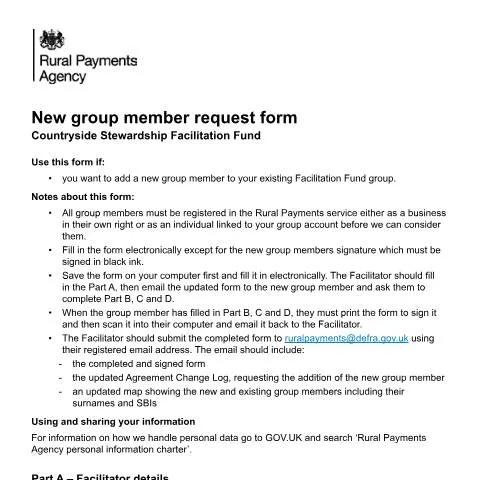
Understanding the Countryside Stewardship Facilitation Fund New Group Member Form
The Countryside Stewardship Facilitation Fund provides essential support for groups focused on environmental stewardship and sustainable farming practices. To participate in this initiative, a new group member must complete the specific form designated for adding individuals to an existing group. This step is vital for enhancing collaborative efforts and achieving collective environmental goals.
Key Participants & Their Roles
Before delving into the intricacies of the form, it’s crucial to understand who is involved in this process:
- Facilitator: The existing group leader or coordinator responsible for managing the group. This individual plays a pivotal role in guiding the new member through the form completion process and submitting it to the Rural Payments Agency (RPA).
- New Group Member: The individual wishing to join the group, who must be registered in the Rural Payments service either as a business or an individual.
- Rural Payments Agency (RPA): The governmental body that oversees the processing of applications and disbursement of funds related to environmental stewardship initiatives.
The Application Timeline: When to Act
Timing is critical in the submission of the New Group Member Form. While the form can be prepared at any time, it’s wise for both the facilitator and the new member to consider the following timeline:
- Form Preparation: Begin as soon as the decision to add a new member has been made. This includes gathering necessary information and ensuring that the member is registered with the RPA.
- Submission Deadline: Once completed, the form should be submitted as soon as possible. Delays could affect the group’s eligibility for funding and support.
- Post-Submission Follow-up: Anticipate a processing period during which the RPA reviews the application. Regular communication with the RPA is recommended to check on the status.
Completing the Form: Step-by-Step Guide
The New Group Member Form is divided into several parts that must be completed meticulously to ensure acceptance. Here’s a detailed breakdown:
Part A: Facilitator Information
The facilitator must fill in their details, including:
- Full Name
- CSFF Reference Number
- Date of New Member's Addition
This section is critical as it links the new member to the existing group activities.
Part B: New Member Details
In this section, the new member provides essential personal and business information:
- Name as registered in the Rural Payments service
- Email Address
- Business SBI Number
- Business Name
- Telephone Number
It’s essential that the email address matches the one registered with the RPA for seamless communication.
Part C: Land Details and Eligibility
This section focuses on the new member's landholding and commitment to group activities. The applicant must answer queries regarding:
- Total area of the holding (in hectares)
- Support for proposed group activities (checkbox)
- Confirmation of having signed the Facilitation group agreement form (checkbox)
- Membership in other facilitation groups (if applicable)
This information is vital to ascertain the new member's eligibility for the fund.
Part D: Declaration
The final part of the form involves a declaration confirming that:
- All information provided is truthful
- Consent is given for data use by public bodies
- Understanding of potential sharing of information for fraud prevention
It is critical that the new member signs this section in black ink, as electronic signatures will not be accepted.
Submission Process: Finalizing the Addition
Upon completing the form, the facilitator must follow a structured submission process:
- Ensure that the new member has printed, signed, and scanned their parts of the form.
- The facilitator should compile the following documents for submission to the RPA:
- The completed and signed New Group Member Form
- An updated Agreement Change Log
- A map indicating both existing and new group members, along with their surnames and SBI numbers
- Submit all documents via email to [email protected] using the facilitator’s registered email address.
Dealing with Challenges: Errors or Refusal to Process
Occasionally, an application may face challenges such as errors or refusal by the RPA. Understanding the protocol in these cases is essential:
- If Errors Occur: Review the application for inaccuracies. The facilitator and new member should cross-check all entries before resubmission.
- In Case of Refusal: The RPA will provide reasons for refusal, and the facilitator should communicate these to the new group member. Address any concerns highlighted and rectify the issues before reapplying.
- Missing Documentation: If the application is deemed incomplete, promptly gather the required documents and re-submit with a cover note explaining the resubmission.
Tracking Your Application: Staying Informed
Once your application is submitted, the facilitator should maintain open lines of communication with the RPA. Here's how to effectively track the progress:
- Regularly check the email account used for submission for updates from the RPA.
- Maintain a record of communication attempts and responses to ensure follow-ups are timely.
- Consider setting reminders for follow-up dates, especially if there has been no communication from the RPA after a reasonable processing period.
Unique Circumstances: Special Considerations
Certain scenarios may necessitate additional considerations when applying to the Countryside Stewardship Facilitation Fund:
For Non-Residents or Foreign Nationals
Individuals who do not hold UK residency may face additional scrutiny. It is advisable for these applicants to:
- Ensure their business is registered with the appropriate UK authorities.
- Be prepared to provide additional documentation demonstrating their eligibility and commitment to UK environmental standards.
Mismatched Information
In instances where details do not align with RPA records, immediate clarification is necessary. New members should:
- Verify their registration details with the RPA to ensure accuracy.
- Promptly notify the facilitator to amend any discrepancies in the submitted form.
Emergency Applications
If there is an urgent need to process an application—perhaps due to time-sensitive funding opportunities—following these steps is critical:
- Reach out directly to the RPA's customer service to explain the urgency.
- Emphasize the necessity for a swift response when submitting the form.
Document any communications to ensure clarity and accountability.
Conclusion: Navigating the Application Landscape
Successfully adding a new member to a Countryside Stewardship Facilitation Fund group is a collaborative effort requiring diligence and attention to detail. From understanding the structure of the application to navigating challenges effectively, every step plays a critical role in supporting environmental stewardship initiatives across the UK.
For further guidance on managing personal data within the context of this application, it’s advisable to review the Rural Payments Agency personal information charter available on the GOV.UK website.
Understanding the Countryside Stewardship Facilitation Fund
The Countryside Stewardship Facilitation Fund is an innovative initiative aimed at supporting collaborative approaches to environmental management in rural areas. This fund is designed to enable groups of farmers and land managers to work together to deliver environmental benefits, enhance biodiversity, and improve the resilience of the countryside. By pooling resources and sharing knowledge, participating groups can implement far-reaching strategies that align with national policies on conservation and land management.
One of the key advantages of this funding mechanism is its emphasis on facilitation—encouraging connections between stakeholders such as local communities, wildlife groups, and government agencies. Groups can form to tackle issues such as soil health, water quality, and wildlife habitats collectively. The ultimate goal is not just to receive funding, but to foster a sustainable, integrated approach to land use that benefits both the environment and the local economy.
Groups applying to the Countryside Stewardship Facilitation Fund should have clear objectives, a robust plan for collaboration, and a strategy for long-term sustainability. Applicants are encouraged to demonstrate how their proposed project will achieve measurable environmental improvements and contribute to local priorities. Each application is assessed against these criteria to ensure that funds are allocated to projects that will deliver significant benefits across the landscape.
Eligibility Criteria for New Group Members
New group members looking to join an existing initiative under the Countryside Stewardship Facilitation Fund must meet specific eligibility criteria. Generally, any farmer, land manager, or stakeholder with a vested interest in countryside stewardship can apply. However, potential applicants must demonstrate a commitment to environmental stewardship and the ability to contribute to group objectives effectively.
Eligibility criteria often include:
- Land Ownership: Members must either own, lease, or manage agricultural land that is relevant to the group’s objectives. This typically includes farms, woodlands, and other rural landholdings.
- Willingness to Collaborate: New members need to show a readiness to work collaboratively with other group members, actively participating in planning, meetings, and on-ground activities.
- Relevance of Expertise: Having a background or expertise in environmental management or agriculture is highly beneficial. This could range from knowledge of sustainable farming practices to experience in wildlife conservation.
Additionally, new members must agree to abide by the group's governance and operational structure, which is crucial for maintaining cohesion and achieving collective goals. Prospective applicants should consult existing group members to understand the group's focus areas, ongoing projects, and expected contributions from new entrants.
Application Process for New Members
The application process for joining an existing group under the Countryside Stewardship Facilitation Fund is structured yet straightforward, aiming to ensure transparency and clarity. Interested individuals should start by reaching out to the group facilitator or coordinator to express their interest and obtain relevant information about the group.
The following steps outline the typical application process:
- Initial Contact: Make contact with the group facilitator to discuss your interest in joining. They can provide insight into the group’s objectives, current projects, and the specific needs that new members could fill.
- Completion of Application Form: New members are usually required to fill out a membership application form. This form will ask for details about your agricultural practices, experience, and how you plan to contribute to the group.
- Interview or Meeting: In many cases, an informal meeting or interview with existing members may be required. This helps assess compatibility and ensures that both parties understand expectations and commitments.
- Decision and Onboarding: Once the application has been reviewed, and you’ve been accepted, the group will typically conduct an onboarding process. This includes familiarizing you with group operations, current projects, and collaboration tools that facilitate communication and collective effort.
It’s essential for new members to actively engage during this onboarding period. This initial engagement is a key phase for establishing relationships and understanding how to align personal goals with the wider objectives of the group. Remember, successful collaboration in environmental stewardship requires continuous dialogue and commitment.