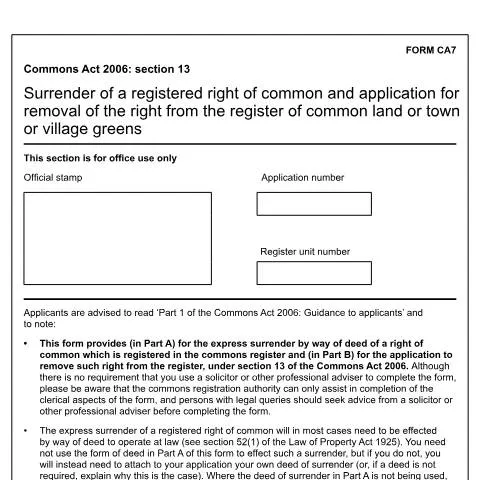
Understanding the Surrender Process for Common Land Rights
The process of surrendering a registered right of common involves a legal framework that many landowners may find complex. Within this framework, the Common land: surrender and extinguish a right of common (CA7) form plays a crucial role. This document serves as the official vehicle for individuals or entities wishing to relinquish their rights associated with common land. It is essential to grasp the significance of this form, especially for those whose rights are registered and who wish to navigate the complexities of the Commons Act 2006.
The Role of the CA7 Form in the Surrender Process
The CA7 form is pivotal for individuals who want to formally surrender their rights over common land. This document comprises two main sections: Part A is the Deed of Surrender, while Part B contains the application to remove the right from the register. The surrendering rightsholder will typically utilize Part A to effectuate the legal act of surrender, while Part B is essential for the official removal of the common right from the commons register.
Who Needs to Complete the CA7 Form?
To utilize the CA7 form, specific criteria must be met. Individuals who are classified as either:
- Surrendering Rightsholder: The individual or entity holding the right in gross.
- Servient Landowner: The owner of the land where the right is exercised.
It is integral that these parties ensure they are eligible to surrender rights as outlined in the Commons Act 2006.
Timeline for Submission and Approval
The timeline for surrendering a right of common using the CA7 form can vary based on several factors, including the complexity of the individual application and any potential objections from other stakeholders. After submission, the registration authority will review the application. If approved, the right will subsequently be removed from the commons register, typically within a timeframe ranging from 8 to 12 weeks.
Key Dates to Keep in Mind
| Action | Deadline |
|---|---|
| Submission of CA7 Form | As soon as possible following decision to surrender |
| Expected Review Period | 8 to 12 weeks |
| Notification of Decision | Immediate after review |
Distinct Features of the CA7 Form
The CA7 form is often compared to other applications concerning land rights, yet it has unique characteristics. For instance, unlike forms that apply for rights of common, the CA7 focuses specifically on surrender. This distinction is critical for applicants to understand, as it shapes the documentation and legal considerations involved in the process.
Comparison with Other Common Land Forms
| Form | Purpose | Key Distinction |
|---|---|---|
| CA7 | Surrender of a registered right | Focus on extinguishment |
| CA1 | Application to register a new right | Focus on establishment of rights |
| CA2 | Amend existing rights | Focus on modification rather than removal |
Pre-Submission Preparations: Justifying Your Application
Before submitting the CA7 form, thorough preparation is essential. Applicants should gather various documents to support their surrender application effectively. This ensures that all necessary information is at hand, which can facilitate a smoother review process.
Recommended Documentation
- Existing Title Deeds: Proof of ownership of the land in question.
- Commons Registration Details: Confirmation of the registered rights you intend to surrender.
- Deed of Surrender: If applicable, a legally executed deed demonstrating the surrender.
- Identification Documents: To verify the identity of the surrendering parties.
What to Do if Issues Arise
Despite careful preparation, complications can arise during the application process. Understanding how to address these issues can save applicants significant time and stress.
Common Challenges and Resolutions
- Application Refusal: If your application is denied, it is advisable to request feedback from the registration authority. This information can be pivotal in understanding the reasons behind the refusal and preparing a stronger application in the future.
- Missing Documentation: If the registration authority informs you that documents are missing, promptly gather the required items. A comprehensive checklist can guide this process.
- Errors in the Application: If errors are identified post-submission, contact the registration authority immediately to rectify the information.
Conclusion: Navigating the Surrender Landscape
Navigating the nuances of the surrender process via the CA7 form can seem daunting. However, with proper understanding and preparation, individuals and landowners can effectively manage their common land rights. By familiarizing oneself with the expectations and requirements outlined in the Commons Act 2006 and ensuring all documentation is in order, applicants can significantly streamline their journey towards relinquishing their rights over common land.
Arming yourself with knowledge and resources is an invaluable strategy as you move through the surrender process. Whether you are a surrendering rightsholder or a servient landowner, the successful completion of this form can lead to significant changes in your land use and rights.
Understanding Common Land Rights in the UK
Common land in the UK refers to land owned collectively or by multiple individuals that grants specific rights to its users. Rights of common can include grazing livestock, taking wood, or harvesting crops. Each right has its own rules and regulations, often defined by historical precedents and local customs. Understanding the nuances of these rights is essential for anyone involved in land usage or rural land management.
The importance of common land cannot be overstated, as it plays a significant role in biodiversity and local ecosystems. It serves as a habitat for various wildlife species and provides a space for traditional farming practices. However, these rights can sometimes conflict with landowners’ interests, leading to disputes that may require legal resolutions. Therefore, it is crucial to have a solid understanding of both legal rights and local customs when navigating common land issues.
Procedure for Surrendering a Right of Common
Surrendering a right of common is a formal process that entails relinquishing the rights granted to an individual or group under common law. This procedure can vary depending on the specific rights attached to the land. Typically, an interested party must approach the relevant authority or landowner to initiate the surrender.
The first step is to check the specific terms under which the right of common was granted. It’s advisable to consult with the local planning authority or a legal advisor who specializes in land rights. In many cases, the Natural England and local authorities can provide necessary guidance about the process.
Once the legal groundwork is established, the next step usually involves drafting a formal surrender document. This document should clearly outline the rights being surrendered and include signatures from all relevant parties. Following this, it must be submitted to the appropriate registry, often the Land Registry, for formal acknowledgment. Note that this process can take time, depending on the administrative workload and any possible disputes that may arise.
It is also essential to understand the implications of surrendering a right of common, as it may affect future land usage, ecological balance, and community interests. Individuals contemplating surrender should weigh the pros and cons carefully, considering both immediate benefits and long-term consequences.
Legal Framework Governing Common Land and Rights of Common
The management and regulation of common land in the UK are primarily governed by the Commons Act 1985 and the Commons Act 2006. These acts aim to regulate the use of common land, protect the rights of commoners, and ensure that the land is preserved for future generations. They provide a legal framework through which rights of common can be established, altered, or extinguished.
Under the Commons Act 2006, any proposal to extinguish a right of common must be justified with clear reasoning. The application must demonstrate that the extinguishment serves an interest that outweighs the benefits of the existing right. This may include considerations such as environmental concerns, land management practices, or public interest. The relevant local authority is responsible for assessing these applications, which often involves public consultations and potentially lengthy review processes.
Moreover, the Data Protection Act 2018 and UK GDPR highlight the importance of safeguarding personal data during any formal procedures involving common land. The information shared during the surrender process must be handled with care to protect individuals' rights and privacy. This safeguards against misuse of data while ensuring that the legal process maintains transparency.
Individuals and entities seeking to navigate the complex landscape of common land rights should consider professional legal advice to understand the implications fully and ensure compliance with the current legal standards. Understanding these frameworks not only helps in individual cases but serves to educate the community about their rights and responsibilities regarding common land.