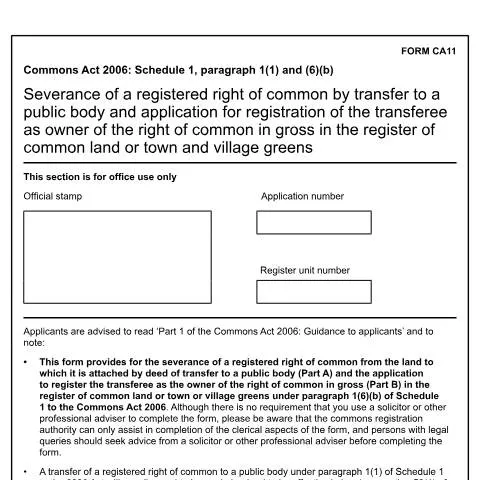
The Intricacies of Form CA11: Transfer of Common Land Rights
When it comes to managing land rights in the UK, understanding the nuances of legal documents can be daunting. One such critical document is Form CA11, which pertains to the severance of a registered right of common by transferring it to a public body. This document serves as a formal request to register the transferee as the owner of the right of common in gross. Below, we dissect the sections of this official form, explore its significance, and provide guidance on the completion and submission process.
Unpacking the Form: A Detailed Look at Each Section
The CA11 form is divided into key sections that need careful attention. Each part has specific requirements that can impact the success of your application.
Part A: Deed of Transfer
This section requires detailed information about the transferor and transferee, which is vital for establishing the legal framework of the transfer.
- Transferor: Here, you must provide the name and postal address of the owner of the dominant land from which the right is being severed. Ensure to list all relevant names and company registration numbers, if applicable.
- Transferee: This is the public body or entity that will receive the right of common. Accuracy in naming and addressing is crucial to avoid delays.
- Additional Parties: Any other parties involved in the transfer must be listed, which ensures all stakeholders are accounted for.
Understanding the Right of Common
The right of common refers to specific entitlements attached to land. This section requires a precise description of what is being severed. Common pitfalls include:
- Not specifying the register unit number and rights section entry number—both are essential for clarity.
- Failing to accurately describe the right being transferred, which can lead to legal complications.
Dominant Land Description
In this part, you must detail the dominant land to which the right is attached. This includes:
- Name of the Land: The commonly used name of the land helps identify it.
- Location: Providing a postal address, Ordnance Survey grid reference, or Land Registry title number is crucial. A common error is neglecting to include a grid reference, which could hinder the processing of your application.
Preparation and Supporting Documents: What You Need
Submitting Form CA11 is not just about filling in the sections correctly; you must also compile supporting documentation. This may include:
- Deed of Transfer: Ensure that the deed is attached as it formalizes the transfer.
- Maps: An Ordnance map is required, clearly showing the dominant land edged in blue. This visual aid is crucial for the authorities to understand the context of your application.
- Consent Letters: If additional parties are involved, their consent to the transfer must be documented.
Submission Process: Navigating the Red Tape
Once you have completed the form and gathered the necessary documents, the next step is submission. You must consider the following:
- Where to Send: Applications should be sent to the relevant department within the Department for Environment, Food & Rural Affairs (DEFRA). Ensure you have the correct address to avoid delays.
- Fees: Be prepared to pay a fee for your application. Check with DEFRA for the current rates as they can vary depending on the specifics of your application.
- Processing Timeline: Understanding the expected timeline can help manage your expectations. Applications can take several weeks or even months, depending on the complexity of the case.
What Happens Next: From Submission to Decision
After submitting your application, it's essential to know what to anticipate:
- Initial Review: The application will undergo an initial review to ensure that all required information and documentation are present.
- Further Information Requests: Be prepared for potential requests for additional information. Timely responses to these requests are crucial.
- Final Decision: Once the review is complete, a decision will be made. You will be notified in writing, detailing whether your application has been successful or if further action is needed.
Handling Refusals and Corrections
Sometimes applications can be refused, or mistakes may arise during processing. Knowing how to handle these scenarios is vital:
- Reasons for Refusal: Understanding common reasons for refusal, such as incomplete documentation or failure to meet legal requirements, can help you avoid pitfalls in future applications.
- Correcting Errors: If you identify an error in your application after submission, contact DEFRA immediately to discuss the best course of action.
- Appeals Process: If your application is refused, you may have the option to appeal. Familiarize yourself with the appeals process outlined by DEFRA, including timelines and documentation required.
Conclusion: Ensuring a Smooth Process
Form CA11 serves a vital function in the management of common land rights in the UK. By understanding the intricacies of this form, preparing the necessary documents, and navigating the submission process with diligence, applicants can significantly enhance their chances of a successful outcome. The importance of meticulous attention to detail and proactive communication with DEFRA cannot be overstated, as these factors can make a substantial difference in the handling of your application.
Understanding the Concept of Common Land and Greens in the UK
Common land and greens have a significant historical and social context in the United Kingdom. They provide spaces for both communities and wildlife while offering access to recreational areas. Common land is defined as land that is owned by one party but over which other individuals have certain traditional rights, known as rights of common. These rights may include activities such as grazing livestock, collecting firewood, or fishing. The most notable legislation governing common land and greens is the Commons Act 2006, which aims to consolidate and simplify the management of these areas.
Common lands are different from greens, which often serve as informal parks or open spaces within towns and villages that are accessible to all members of the community. They may not carry the same rights as common land but are equally important in terms of providing open spaces and supporting biodiversity. Traditional usage of these lands can often be contentious, especially when ownership changes or when new developments threaten to infringe upon these rights. Understanding the history, rights, and responsibilities associated with common land and greens lays the groundwork for grasping the implications of severing rights of common.
The Severance Process: Detailed Insights and Implications
Severance of a right of common occurs when the right associated with a parcel of land is divided from the land itself, often through the transfer of that right to a public body. This process can seem convoluted due to the legal and bureaucratic steps involved.
To initiate a severance, the relevant authorities, such as the local council or a dedicated land management body, must be consulted. They will examine the specific rights of common that are to be severed, determining whether they can be transferred without infringing upon the rights of other commoners or the integrity of the land itself.
The procedural steps typically involve the submission of an application to the relevant authority, including detailed maps and documentation demonstrating existing rights and proposed changes. The application process is governed by the Commons Act 2006, which also allows for objections from stakeholders who may have vested interests in the common land. Any objection must be substantiated, and the authority will consider these claims before making a decision.
A critical factor in this process is public consultation. The authority must ensure that any proposed severance is subject to transparent public scrutiny. This can be achieved through notices in local newspapers or community meetings, providing an opportunity for individuals to express their views and concerns. The outcome of this process not only hinges on the legality of the transfer but also on the community's response and the potential impact on local customs and practices.
Legal Recourse and Challenges Faced During Severance
Legal challenges arising from the severance of rights of common can be complex and varied. Stakeholders, including local communities and existing commoners, may feel that their rights are being undermined. Thus, it’s essential to understand the legal recourse available in such situations.
If an application for severance is rejected, or if stakeholders believe the severance has been improperly granted, they may engage in a formal appeal process. This typically involves escalating the matter to the High Court, where the legality of the decision can be challenged under both administrative law and common law principles. Courts often look closely at whether proper procedures were followed and whether all relevant factors were considered.
Additionally, the Human Rights Act 1998 may come into play, particularly concerning property rights and the right to peaceful enjoyment of possessions. This can add layers of complexity to any legal proceedings, requiring legal counsel familiar with both common law and statutory regulations surrounding common lands.
Furthermore, the involvement of environmental assessments can complicate the situation. Many common lands have ecological significance, and any severance process must take into account potential impacts on local biodiversity and conservation. This may require additional studies or reports to be conducted, adding time and cost to the severance process.
In cases where the severance has significant implications for the community or the environment, legal challenges can result in a protracted dispute. It’s crucial for any party engaged in the severance process to seek legal advice early on to navigate the complexities and ensure compliance with all relevant laws.