Understanding Bankruptcy Search Requirements in Property Transactions
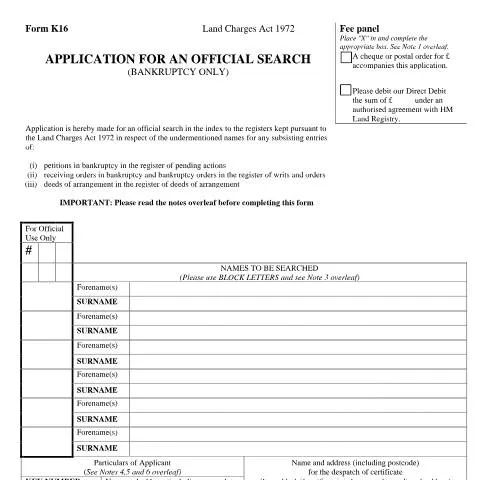
When purchasing property or conducting due diligence on an individual's financial standing, discovering potential bankruptcy proceedings becomes crucial for protecting your interests. The K16 application form serves as your gateway to accessing HM Land Registry's comprehensive bankruptcy records, revealing whether someone has faced insolvency proceedings that could affect their ability to deal with property.
This specialised search targets three distinct categories of bankruptcy-related entries: pending bankruptcy petitions listed in the register of pending actions, actual receiving orders and bankruptcy orders recorded in the register of writs and orders, and voluntary deeds of arrangement found in the register of deeds of arrangement. Each category provides different insights into an individual's financial history and current legal standing.
Unlike general property searches, the K16 focuses exclusively on personal insolvency matters governed by the Land Charges Act 1972. This narrow scope makes it particularly valuable for solicitors, lenders, and property professionals who need to verify whether bankruptcy proceedings might compromise a transaction or create hidden liabilities.
Professional Applications and Commercial Context
Property transactions frequently stall when bankruptcy searches reveal unexpected insolvency proceedings. Mortgage lenders typically require these searches before approving loans, particularly when dealing with joint applications or guarantors. The search becomes even more critical in commercial property deals where directors' personal guarantees might be compromised by undisclosed bankruptcy proceedings.
Professional customers, including solicitors and licensed conveyancers, often maintain key numbers with HM Land Registry to streamline their search processes. This system allows firms to submit multiple applications efficiently while maintaining proper audit trails for client billing. The key number also enables Direct Debit payment arrangements, reducing administrative overhead for firms conducting regular searches.
Estate agents increasingly use bankruptcy searches when vetting potential purchasers, particularly in competitive markets where proof of financial standing becomes essential. The search results help sellers' solicitors assess whether proceeding with a particular buyer poses unnecessary risks, potentially saving weeks of abortive transaction costs.
Completing the Search Application Accurately
The form demands meticulous attention to name formatting, requiring block letters throughout to ensure accurate database matching. Each individual requires separate entry of forenames and surname on designated lines, with the system treating variations in spelling or formatting as potentially different people. This precision becomes crucial when searching for individuals with common names or those who might use different name variations.
Payment arrangements vary significantly depending on your relationship with HM Land Registry. Professional customers with established accounts can utilise Direct Debit facilities, while occasional users must provide cheques or postal orders payable to "HM Land Registry". The fee structure charges per name searched, making bulk searches potentially expensive for comprehensive due diligence exercises.
| Payment Method | Suitable For | Processing Requirements |
|---|---|---|
| Direct Debit | Professional customers with key numbers | Authorised agreement required |
| Cheque | Occasional users | Must accompany application |
| Postal Order | Individuals without bank accounts | Payable to HM Land Registry |
Navigating Multiple Name Scenarios
Complex searches often involve individuals who have used different names throughout their lives, creating potential gaps in search coverage. Married individuals, particularly women who have changed surnames, require searches under both maiden and married names to ensure comprehensive coverage. The form accommodates six names per application, but larger searches require additional forms with careful cross-referencing to avoid duplication charges.
Professional searchers often encounter challenges when dealing with individuals who have used multiple variations of their names. Someone known as "Robert Smith" might have official records under "Rob Smith", "Bob Smith", or even "R. Smith", each potentially requiring separate searches to ensure complete coverage. This multiplicity becomes particularly relevant when searching directors of companies or individuals involved in complex property structures.
Foreign nationals present additional complications, as their names might appear differently in UK bankruptcy records compared to their home country documentation. Previous anglicisation of names or alternative transliterations can create search gaps that only emerge during detailed transaction reviews, potentially derailing time-sensitive deals.
Submission Routes and Processing Expectations
The Land Charges Department in Plymouth processes all K16 applications through their dedicated Search Section, with postal applications remaining the primary submission method. The form's design accommodates standard window envelopes, streamlining dispatch for professional users handling multiple applications. However, this postal-only approach means electronic submission is not available, unlike many other HM Land Registry services.
Professional customers often maintain dedicated reference systems for tracking their applications, with the form accommodating up to 25 characters for internal references. This limitation requires careful consideration when designing reference codes that remain meaningful while fitting within the character constraints. Firms typically develop abbreviated systems incorporating client codes, matter numbers, and search dates to maintain proper audit trails.
The Plymouth processing centre operates on business day schedules, meaning applications submitted on Fridays typically receive attention the following Monday. Rush applications are not available for bankruptcy searches, making early submission crucial for time-sensitive transactions. Professional customers often build search timing into their transaction timetables, particularly when dealing with complex multi-party property deals.
Certificate Interpretation and Limitations
The official certificate resulting from your search carries important statutory limitations that affect its use in different legal contexts. Most significantly, the certificate provides no statutory effect regarding registered land under the Land Registration Act 1925 and Land Charges Act 1972. This limitation means that while the search provides valuable intelligence about potential bankruptcy proceedings, it cannot serve as definitive proof of someone's ability to deal with registered property.
Clear certificates confirm no relevant entries exist in the searched registers at the time of the search, but this negative result requires careful interpretation. The search only covers the specific registers maintained under the Land Charges Act 1972, not other potential sources of bankruptcy information such as the Individual Insolvency Register maintained by the Insolvency Service. Professional users often combine K16 searches with additional insolvency checks to achieve comprehensive coverage.
Positive results revealing bankruptcy entries require immediate legal assessment, as the implications vary significantly depending on the type and timing of proceedings. Historical bankruptcy orders that have been discharged carry different implications compared to pending petitions or current bankruptcy orders. The certificate provides factual information about register entries but does not interpret their current legal effect or impact on property transactions.
Strategic Timing and Transaction Planning
Effective use of bankruptcy searches requires careful integration into broader transaction timelines, particularly given the postal-only submission process and processing delays. Experienced property professionals typically initiate these searches early in the due diligence process, allowing time for follow-up investigations if positive results emerge. This front-loaded approach prevents last-minute surprises that could derail exchange deadlines or completion dates.
The search's effectiveness depends heavily on timing relative to potential bankruptcy proceedings. Recent applications for bankruptcy orders might not appear in the registers immediately, creating a gap between filing and registration that could affect search accuracy. Professional users often combine initial searches with follow-up checks closer to completion dates, particularly in high-value transactions where comprehensive due diligence justifies additional costs.
Chain transactions present particular challenges, as bankruptcy issues affecting any party in the chain can impact the entire sequence of property deals. Early identification of potential problems allows solicitors to structure transactions with appropriate protections or seek alternative arrangements before substantial costs accumulate. The K16 search becomes one component of a broader risk assessment strategy rather than a standalone verification tool.
Professional Standards and Risk Management
Legal professionals face increasing scrutiny regarding their due diligence standards, making comprehensive bankruptcy searches essential for maintaining professional indemnity insurance coverage. The Solicitors Regulation Authority expects reasonable investigations into parties' financial standing, particularly when red flags suggest potential insolvency issues. Failure to conduct appropriate searches can expose firms to negligence claims and regulatory sanctions.
The form's design reflects decades of professional practice, with specific provisions for key number holders and reference systems that support modern legal practice management. However, the continued reliance on postal submission creates operational challenges for firms seeking to digitise their processes completely. Many professional users maintain hybrid systems that accommodate the K16's postal requirements within otherwise electronic workflows.
Risk management strategies often incorporate regular training on bankruptcy search procedures, ensuring that all staff understand the form's limitations and appropriate use cases. The interplay between Land Charges Act provisions and modern insolvency law requires ongoing professional development, particularly as legislative changes affect the relevance and interpretation of different register entries.
Understanding Search Results and Their Legal Implications
When you receive your K16 search results from the Insolvency Service, understanding what the information means and its legal standing is crucial for making informed decisions. The search results will clearly indicate whether any bankruptcy orders, debt relief orders, or individual voluntary arrangements are registered against the searched name and address details.
A 'clear' search result means no insolvency records have been found matching your search criteria. However, this doesn't provide absolute certainty that the individual has never been subject to insolvency proceedings. Records may exist under slightly different name spellings, alternative addresses, or may have been removed from the register after the statutory disclosure period has expired.
Positive search results will display specific details including the case number, the court that made the order, the date of the bankruptcy order or arrangement, and the official receiver or trustee details. For bankruptcy orders, you'll see whether the bankruptcy remains current or has been discharged. The discharge date is particularly significant as it marks when most restrictions on the bankrupt individual are lifted, though certain disqualifications may persist longer.
Individual Voluntary Arrangements (IVAs) appear differently on search results, showing the arrangement's status - whether it's ongoing, successfully completed, or has failed. A completed IVA indicates the debtor has fulfilled their obligations under the arrangement, whilst a failed IVA often leads to subsequent bankruptcy proceedings.
Debt Relief Orders (DROs) will show the order date and current status. DROs typically last twelve months, after which debts included in the order are written off if the debtor's circumstances haven't improved significantly. Understanding these distinctions helps you assess the current financial standing and legal capacity of the individual you're investigating.
The legal weight of official search results varies depending on your purpose. For lending decisions, employment screening, or business partnerships, these results provide strong evidence of an individual's insolvency history. However, courts and legal proceedings may require additional verification or more recent searches, particularly if significant time has passed since your initial search.
Remember that bankruptcy search results reflect the position at the time of the search. If you're making ongoing business decisions or the matter involves substantial sums, consider whether periodic updated searches might be necessary to ensure the information remains current.
Common Complications and How to Navigate Them
Bankruptcy searches can encounter various complications that may affect the accuracy or completeness of your results. Understanding these potential issues helps you interpret results more effectively and take appropriate follow-up action when necessary.
Name variations present one of the most frequent challenges. Individuals may have been made bankrupt under different versions of their name - perhaps using a middle name, maiden name, or common nickname. The Individual Insolvency Register searches for exact matches, so "Robert Smith" and "Bob Smith" would generate separate searches. If you're uncertain about name variations, consider conducting multiple searches using different combinations, particularly for common names or where you know the individual has used alternative names professionally or personally.
Address complications can also affect search accuracy. People often move between bankruptcy proceedings and your search, or may have been made bankrupt whilst living at a previous address. The register maintains historical address information, but incomplete or outdated address details in your search criteria might miss relevant records. When possible, include previous known addresses in separate searches, particularly if the individual has relocated recently or frequently.
Timing issues can create apparent discrepancies in search results. There can be delays between a bankruptcy order being made and appearing on the searchable register, typically a few working days but occasionally longer during busy periods. If you have reason to believe recent proceedings may have been commenced, consider contacting the relevant court directly or repeating your search after a short interval.
Joint bankruptcy orders present another complexity. When married couples or business partners are made bankrupt together, their cases may be linked but could appear as separate entries on the register. If you're investigating someone who might have been involved in joint proceedings, search for their spouse or known business associates to ensure you capture the complete picture.
Historical records can sometimes contain inconsistencies or gaps, particularly for older cases or where court records have been transferred between different systems over the years. If you encounter unusual results or suspect information might be missing, the Insolvency Service's enquiry team can provide guidance on accessing older records or clarifying apparent anomalies.
Technical issues with the online search system, whilst rare, can occasionally produce incomplete results or system errors. If search results seem inconsistent with your expectations or you encounter error messages, try conducting the search again or contact the Insolvency Service for assistance. They maintain backup systems and can often resolve technical issues quickly.
For searches involving individuals with common names, you may receive multiple results that require careful analysis to identify the correct person. Cross-reference dates of birth, addresses, and any other identifying information you possess to ensure you're reviewing records for the right individual. When in doubt, err on the side of caution and seek additional verification.
Integration with Broader Due Diligence Processes
Bankruptcy searches form part of comprehensive due diligence procedures, and understanding how to integrate K16 results with other investigative tools maximises their effectiveness. Professional due diligence typically combines multiple information sources to build a complete picture of an individual's financial standing and legal capacity.
Credit reference agencies provide complementary information to bankruptcy searches, offering details about current credit arrangements, payment history, and financial associations. However, bankruptcy information on credit files may not always be as current or complete as the official Individual Insolvency Register, making K16 searches the gold standard for insolvency verification. Cross-referencing both sources helps identify any discrepancies that might require further investigation.
Companies House searches become relevant when investigating individuals who hold or have held company directorships. Bankruptcy automatically disqualifies individuals from acting as company directors unless they obtain court permission, so comparing bankruptcy search results with directorship records can reveal potential breaches or identify when proper permissions have been sought. The disqualification period typically lasts throughout the bankruptcy and may extend beyond discharge in certain circumstances.
Professional regulatory body searches add another layer when dealing with individuals in regulated professions. Many professional bodies - including those governing solicitors, accountants, financial advisers, and healthcare professionals - have specific rules about members who become bankrupt. Some professions require immediate disclosure, others may suspend or restrict practising certificates, and a few may initiate disciplinary proceedings. Understanding these professional implications helps assess whether bankruptcy affects the individual's ability to fulfil their intended role.
Land Registry searches can provide valuable context, particularly when investigating property transactions or security arrangements. Bankruptcy typically triggers automatic restrictions on property dealings, and trustees in bankruptcy may have registered interests in properties owned by the bankrupt. These registrations remain visible on title documents and can affect property transactions long after the bankruptcy itself has been resolved.
Court judgment searches through the Register of Judgments, Orders and Fines offer insights into legal proceedings that might have preceded or accompanied bankruptcy. County Court Judgments (CCJs) often accumulate before individuals resort to bankruptcy, and understanding this progression helps assess the timeline and severity of financial difficulties. However, note that bankruptcy typically supersedes and extinguishes most prior court judgments against the debtor.
When conducting due diligence for employment purposes, particularly for senior roles or positions involving financial responsibility, bankruptcy searches should be considered alongside DBS checks and professional reference verification. The Rehabilitation of Offenders Act 1974 provides some protection for spent convictions, but bankruptcy information remains publicly accessible throughout the disclosure period, making it a legitimate consideration for relevant employment decisions.
International considerations become important when dealing with individuals who have lived or conducted business overseas. UK bankruptcy searches won't capture foreign insolvency proceedings, and reciprocal enforcement arrangements vary between jurisdictions. If international exposure exists, consider whether additional searches in relevant foreign jurisdictions might be necessary to ensure comprehensive coverage.
Timing coordination across different search types optimises both cost-effectiveness and accuracy. Conducting all searches simultaneously ensures consistency in the information gathered and avoids potential discrepancies that might arise from searching at different times. However, balance this against the need for updated information - if decision-making timelines are extended, consider whether refreshed searches might be warranted before final commitments are made.