Navigating Commercial Animal Testing Through APHA Weybridge's Specialist Gateway
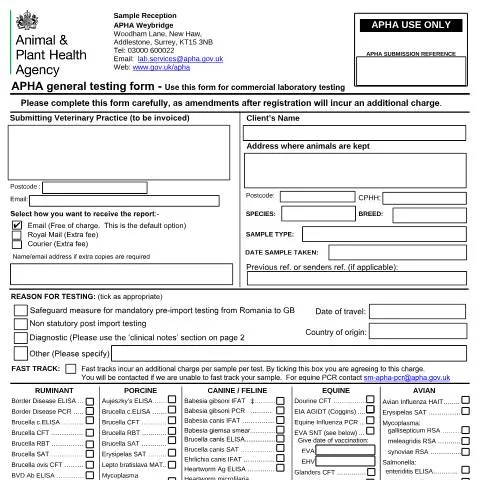
When veterinary practices need comprehensive laboratory testing for animal health investigations, the APHA general testing form (LSW008) serves as the critical bridge between clinical suspicion and definitive diagnosis. This specialised submission form, managed by the Animal and Plant Health Agency's Weybridge facility in Surrey, handles everything from routine post-import screening to complex diagnostic workups that require the expertise of government laboratories.
The form's significance extends well beyond simple sample submission. It functions as a commercial testing gateway for veterinary practices requiring access to APHA's extensive range of laboratory services, including tests that may not be readily available through private laboratories. Whether investigating exotic disease outbreaks, conducting mandatory pre-import testing from specific countries like Romania, or pursuing diagnostic clarity on challenging cases, this form ensures proper sample tracking and regulatory compliance throughout the testing process.
Understanding the Veterinary Practice-Client Triangle
The LSW008 form operates within a three-way relationship that distinguishes it from direct client submissions to other government agencies. The submitting veterinary practice acts as the professional intermediary, taking responsibility for sample collection, clinical assessment, and test selection. This arrangement ensures that complex laboratory requests are filtered through qualified veterinary judgement.
The client information section captures not just basic contact details, but critically important location data for the animals being tested. The address where animals are kept field becomes particularly significant for disease surveillance purposes, as APHA may need to conduct follow-up investigations or implement movement restrictions based on test results. This geographical data also helps identify potential disease clusters or environmental factors that might influence test interpretation.
Veterinary practices must carefully consider their invoicing arrangements, as the form clearly states the practice to be invoiced rather than assuming direct client billing. This professional responsibility model ensures that test selection and interpretation remain within veterinary oversight, preventing inappropriate testing requests or misinterpretation of complex results by animal owners.
Decoding the Extensive Testing Menu
The form's most striking feature is its comprehensive testing checklist, spanning multiple pages and covering diseases from Brucella to Erysipelas. This extensive menu reflects APHA Weybridge's role as a reference laboratory capable of conducting specialised tests that private laboratories may not offer. The tests are organised by pathogen type and methodology, with many requiring specific sample types and handling procedures.
| Test Category | Example Tests | Common Applications |
|---|---|---|
| Border Disease Screening | ELISA, PCR | Pre-import requirements, flock health monitoring |
| Brucella Testing | Multiple methodologies including CFT | Export certification, herd health schemes |
| Avian Diagnostics | Influenza testing, Newcastle disease | Poultry health surveillance, export requirements |
| Parasitology | Coccidia, worm egg counts | Treatment monitoring, resistance testing |
The fast track option appears prominently with clear warnings about additional charges. This premium service acknowledges that some situations—such as export deadlines or acute disease outbreaks—require expedited processing. However, the form cautions that not all samples can be fast-tracked, and veterinary practices should contact APHA directly for equine PCR requests, highlighting the complexity of certain testing protocols.
Specialised Testing Protocols
Several tests carry specific submission requirements that aren't immediately obvious from the checklist. For instance, rabies testing requires the dedicated VLARAB1 submission form, indicating that some high-risk or specialised tests operate under separate protocols. The notation about test subcontracting (marked with ‡) alerts practices that some results may come from external laboratories, potentially affecting turnaround times and quality assurance procedures.
Sample Identification and Traceability Systems
The second page of the form reveals APHA's sophisticated sample tracking system. Each sample requires dual identification: the official animal ID (eartag or microchip number) and a separate sample ID that can be assigned by the submitting practice. This dual system ensures traceability back to individual animals while allowing practices to maintain their own internal reference systems.
The requirement for animal age, sex, and sample type creates a comprehensive database that supports epidemiological investigations. When disease patterns emerge, APHA can quickly identify affected demographics, geographical clusters, or temporal trends. The APHA use only sample reference number column indicates that the agency assigns its own internal tracking numbers, creating an additional layer of traceability within their laboratory information management system.
Clinical notes and vaccination history occupy a substantial text field, recognising that laboratory results often require clinical context for proper interpretation. Vaccination timing can significantly affect serological test results, while clinical observations help laboratory staff prioritise testing and flag potential differential diagnoses.
Regulatory Compliance and Data Protection Frameworks
The form's data protection statement references the Animal and Plant Health Agency Personal Information Charter, accessible through GOV.UK, demonstrating compliance with the Data Protection Act 2018 and UK GDPR. This is particularly significant given that animal health data can have commercial implications for farms and may be used in government surveillance programmes.
A crucial checkbox allows sample submitters to opt out of anonymous surveillance or test validation purposes. This provision recognises that some commercial testing clients may not wish their samples to contribute to broader research or surveillance activities, though most routine submissions would benefit the wider animal health community through such programmes.
The requirement for written confirmation before third-party invoicing reflects strict financial controls within government laboratories. This prevents unauthorised testing charges and ensures clear accountability for commercial testing costs, which can be substantial for comprehensive diagnostic panels.
Professional Responsibility and Certification
The form concludes with a formal declaration: "I have taken these samples from the animals described above." This statement places legal responsibility on the person signing the form, typically the attending veterinarian. The signature must be accompanied by a clearly printed name and date, creating an audit trail for sample provenance that could be crucial in legal proceedings or regulatory investigations.
Strategic Timing and Import Testing Considerations
The reason for testing section highlights several specific scenarios that drive APHA submissions. Mandatory pre-import testing from Romania to Great Britain reflects post-Brexit arrangements and specific disease risks associated with certain European Union countries. These requirements can change rapidly based on disease outbreaks or trade negotiations, making it essential for practices to verify current requirements before sample submission.
Non-statutory post-import testing represents voluntary surveillance that many importers conduct to demonstrate animal health status to buyers or insurers. While not legally required, such testing can provide commercial advantages and peace of mind, particularly for high-value breeding animals or those entering disease-free herds.
The diagnostic testing option opens access to APHA's reference laboratory capabilities for complex cases where private laboratory results have been inconclusive or where rare diseases are suspected. The instruction to use the clinical notes section for diagnostic submissions emphasises the importance of providing comprehensive case histories for these investigations.
Delivery Methods and Result Distribution
APHA offers multiple result delivery options, with email as the default free method. This electronic delivery system speeds up result transmission and reduces postal costs, though the form warns that Royal Mail and courier options incur extra fees. For practices requiring multiple copies or specific distribution arrangements, the additional contact details field allows for customised reporting arrangements.
The postal address system requires both standard postcode and County Parish Holding (CPH) number fields, reflecting the agricultural focus of many submissions. CPH numbers are unique identifiers for agricultural premises that help APHA track disease patterns and implement movement controls when necessary.
Sample dating becomes critical for test interpretation, as many serological tests are affected by the time elapsed since infection or vaccination. The previous reference or senders reference field allows practices to link current submissions to earlier testing, enabling APHA staff to access historical data that might influence result interpretation or identify trends in individual animals or premises.
Specialised Testing Categories and Laboratory Capabilities
The APHA Weybridge laboratory complex operates across multiple specialised divisions, each requiring distinct sections within the LSW008 form depending on your testing requirements. The Virology Department handles exotic disease investigations including foot-and-mouth disease, swine vesicular disease, and classical swine fever - submissions for these high-containment pathogens require additional biosecurity declarations and specific sample transport protocols outlined in section 4b of the form.
For bacteriology testing, particularly Salmonella and Campylobacter investigations, you'll need to complete the antimicrobial resistance testing section if your samples relate to food production animals. This involves declaring any recent antibiotic treatments and specifying whether you require minimum inhibitory concentration (MIC) testing or disc diffusion susceptibility results. The Bacteriology Section processes over 50,000 samples annually, with turnaround times varying significantly based on the complexity of identification required.
The Parasitology Unit focuses on both internal and external parasites, requiring specific sample types depending on your investigation. Faecal samples for worm egg counts need different preservation methods compared to blood samples for Babesia or Theileria testing. When completing section 6 of LSW008, ensure you specify the exact parasite species suspected, as this determines the diagnostic methodology employed - whether traditional microscopy, PCR-based detection, or antigen capture techniques.
Histopathology services require particular attention to fixation protocols. Samples must be fixed in 10% neutral buffered formalin at a ratio of 1:10 (tissue to fixative), and the form requires confirmation of fixation time before submission. The Pathology Department can process routine histopathology, immunohistochemistry for specific disease markers, and electron microscopy for ultrastructural examination of tissues showing unusual pathological changes.
Emergency Submissions and Notifiable Disease Protocols
When dealing with suspected notifiable diseases, the LSW008 form triggers specific emergency protocols that bypass standard processing procedures. For suspected exotic diseases such as African swine fever, bluetongue, or highly pathogenic avian influenza, you must telephone the APHA Emergency Operations Centre on 03000 200 301 before submitting samples. The form includes an emergency declaration section that must be completed by a veterinary surgeon, including their RCVS registration number and a clinical assessment of the disease suspicion level.
Emergency submissions follow the WOAH (World Organisation for Animal Health) guidelines for sample collection and transport. This means using triple packaging systems with UN3373 biological substance classification, and the LSW008 form must include detailed GPS coordinates of the premises where samples were collected. For marine species suspected of viral haemorrhagic septicaemia or infectious salmon anaemia, additional environmental data including water temperature, salinity levels, and recent mortality patterns must be documented in section 8 of the form.
The laboratory operates a 24-hour emergency diagnostic service for Category A pathogens, with results typically available within 4-6 hours of sample receipt. However, this service requires pre-authorisation through the APHA Veterinary Investigation Officer network, and the LSW008 form must include the authorising VIO's unique reference number. Emergency testing incurs additional charges beyond standard tariff rates, typically ranging from £150-£400 per sample depending on the complexity of testing required.
For suspected zoonotic diseases with public health implications, the form requires notification details for local Public Health England teams. This includes confirming whether human exposure has occurred and providing contact details for the responsible local authority environmental health department. The laboratory maintains direct communication links with PHE Colindale for rapid sharing of results that may impact human health protection measures.
Data Protection and Result Distribution Protocols
Under the Data Protection Act 2018 and UK GDPR, the LSW008 form serves as both a testing request and a data processing consent document. Section 12 of the form requires explicit consent for data sharing beyond the immediate testing purpose, including epidemiological surveillance programmes and research initiatives. You can specify restricted data sharing if client confidentiality is paramount, though this may limit the contribution of results to national disease monitoring systems.
APHA Weybridge maintains accreditation under ISO/IEC 17025:2017 for testing and calibration laboratories, meaning all data generated from LSW008 submissions becomes part of a quality-assured chain of custody. Results are distributed through the APHA Laboratory Information Management System (LIMS), which generates automatic notifications to submitters via secure email. The system can accommodate multiple result recipients, useful when private veterinary practitioners, farm owners, and insurance companies all require access to the same diagnostic data.
For commercial livestock operations, the form allows designation of results for inclusion in health scheme databases such as the Cattle Health Certification Standards (CHeCS) or the Premium Cattle Health Scheme. This requires completing additional identification fields including herd/flock numbers, movement document references, and confirmation of the animal's eligibility for the specific health scheme. Results contributing to official health status declarations carry additional legal weight and are subject to enhanced data retention requirements.
International result sharing for export certification purposes requires specific authorisation within the LSW008 form. This is particularly relevant for breeding stock exports where destination countries require testing by UK-approved laboratories. The form must include the specific international health certificate reference and the importing country's competent authority details. APHA Weybridge maintains recognition agreements with testing authorities in over 40 countries, facilitating seamless acceptance of diagnostic results for trade purposes.
Retention periods for diagnostic data vary according to the type of testing performed and the species involved. Routine diagnostic results are retained for seven years, while notifiable disease investigations are maintained permanently as part of the UK's animal health surveillance archive. The LSW008 form includes options for extended data retention beyond statutory minimums, which can be valuable for longitudinal health monitoring in breeding programmes or research applications involving long-term follow-up studies.