When livestock show concerning symptoms: navigating APHA's diagnostic testing pathway
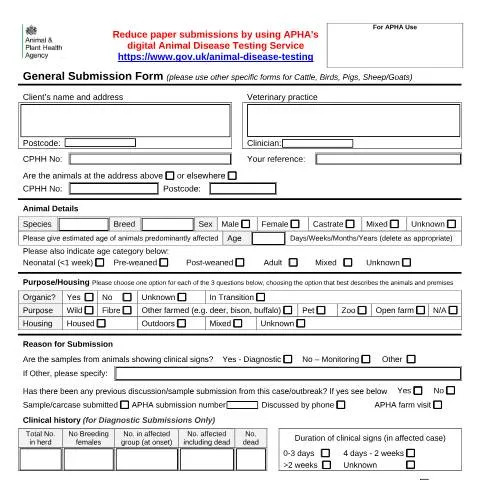
When animals on your farm develop unusual clinical signs, determining the cause quickly can make the difference between containing a minor issue and facing a major disease outbreak. The Animal and Plant Health Agency's General Submission Form serves as the gateway to the UK's veterinary diagnostic network, connecting farmers, veterinarians, and government laboratories in the crucial work of animal disease surveillance and diagnosis.
This two-page document, referenced as APHA3_General (Rev.06/25), handles submissions for general diagnostic testing across multiple species, though notably excludes specific livestock categories that require their own dedicated forms. The form's scope covers everything from routine health monitoring to emergency disease investigations, making it one of the most frequently used documents in British veterinary diagnostics.
Decoding the client and veterinary practice requirements
The opening section demands precision in identifying all parties involved in the diagnostic process. The client's name and address must reflect the legal owner or keeper of the animals, not necessarily the person submitting samples. This distinction becomes critical when dealing with contract farming arrangements, livestock markets, or situations where animals are kept at multiple locations.
The County Parish Holding (CPH) number serves as the cornerstone identifier for the premises where animals are kept. Every holding in England, Wales, and Scotland must possess a unique CPH number, which links directly to the Rural Payments Agency database. If animals are located at a different address from the client's registered address, you must complete the secondary location fields, including the separate CPH number and postcode for that site.
Veterinary practice details require the full practice name and address, not just the individual clinician's information. The clinician field should contain the name of the veterinarian who examined the animals or collected samples, while the reference field allows practices to insert their own case numbers for internal tracking purposes.
Animal identification: beyond basic demographics
The animal details section demands careful consideration of how you categorise your livestock. Species identification might seem straightforward, but the form accommodates mixed submissions where multiple species are affected by the same condition. The breed field becomes particularly important for genetic disease investigations or when breed-specific conditions are suspected.
Age estimation requires thoughtful approach to accuracy. Rather than guessing, the form provides multiple time units - days, weeks, months, or years - allowing you to select the most appropriate measure. For young animals, precise age in days or weeks can be diagnostically significant, whilst adult animals typically require only approximate ages in years.
| Age Category | Definition | Diagnostic Significance |
|---|---|---|
| Neonatal | Less than 1 week | Birth-related conditions, maternal antibody interference |
| Pre-weaned | Before weaning | Nutritional diseases, passive immunity assessment |
| Post-weaned | After weaning | Management-related stress conditions |
| Adult | Fully mature | Reproductive disorders, age-related diseases |
The sex distribution across your submission helps laboratory staff understand potential hormonal influences or gender-specific conditions. Mixed groups often indicate infectious diseases spreading through a population, whilst single-sex submissions might point to reproductive or management issues.
Production system classification and its diagnostic implications
The purpose and housing section requires careful consideration of three interconnected questions that paint a picture of your farming system. Organic status affects both treatment options and potential causes of disease, as organic systems face restrictions on conventional medicines and may experience different disease pressures.
Production purpose classification extends beyond simple categories. Wild animals include those managed for conservation or sporting purposes, whilst fibre production encompasses sheep kept primarily for wool. The other farmed category captures alternative livestock such as deer, bison, or buffalo, which require specialist diagnostic approaches.
Housing arrangements significantly influence disease transmission patterns and diagnostic priorities. Housed animals face different respiratory challenges compared to those kept outdoors, whilst mixed systems create complex epidemiological scenarios requiring careful investigation.
Clinical presentation: documenting symptoms systematically
The reason for submission section distinguishes between three fundamental approaches to veterinary diagnostics. Diagnostic submissions address animals showing clinical signs where the cause remains unknown. Monitoring submissions track known conditions or assess treatment effectiveness. Other submissions might include regulatory testing or research investigations.
Previous discussions or sample submissions from the same outbreak create important epidemiological links. The APHA submission number from previous cases allows laboratory staff to review earlier findings and build a comprehensive picture of disease progression across your holding.
Clinical history documentation demands precise numerical data. The breeding female count, affected animals, and dead animals provide crucial epidemiological ratios that help determine disease severity and transmission patterns. Duration of clinical signs helps differentiate between acute infectious diseases and chronic conditions.
The clinical signs checklist covers the most common presentations in farm animals, ranked by importance. Abortion takes priority as a notifiable condition in many circumstances, followed by stillbirth and reproductive disorders. Gastrointestinal signs including diarrhoea and malaise often indicate infectious diseases requiring urgent investigation.
Laboratory test selection: matching diagnostics to clinical suspicion
The comprehensive test menu on page two reflects APHA's role as the UK's reference laboratory for animal diseases. Enteric disease testing includes both bacterial culture for Salmonella and molecular detection of Johnes disease, whilst parasitology offers worm egg counts essential for grazing management decisions.
Microbiology sections distinguish between aerobic and anaerobic bacterial culture, with specific provisions for Clostridium perfringens toxin detection in cases of sudden death. Sensitivity testing accompanies bacterial isolation to guide treatment decisions and monitor antimicrobial resistance patterns.
Virology testing encompasses both traditional virus isolation and modern PCR-based detection methods. Blood and serum samples allow retrospective diagnosis through antibody detection, whilst tissue samples enable direct pathogen identification.
The other test requirements section accommodates emerging diagnostic needs or specialist investigations not covered by standard panels. This flexibility ensures the form remains relevant as diagnostic capabilities evolve and new diseases emerge.
Sample management and identification protocols
Accurate sample identification prevents diagnostic delays and ensures results reach the correct recipient. The official animal ID should match ear tag numbers, passport details, or other permanent identification systems used on your holding. Each sample requires its own unique identifier, typically incorporating the animal ID plus a sample type or sequence number.
Sample type documentation must specify both the material collected and the quantity submitted. Blood samples require volume measurements, whilst tissue samples need anatomical location details. Faecal samples should indicate whether they represent individual animals or pooled submissions from multiple animals.
The date of sample collection affects interpretation of results, particularly for infectious diseases where timing relative to clinical signs influences diagnostic accuracy. Time-sensitive samples like those for virus isolation must reach the laboratory within strict timeframes to maintain viability.
Data protection and surveillance considerations
The anonymous surveillance checkbox at the bottom of the form offers an important option for routine monitoring programmes. Ticking this box allows APHA to use your samples for disease surveillance purposes whilst removing personal identifiers from the data.
Data protection provisions reference both the Animal and Plant Health Agency's Personal Information Charter and the broader framework of UK GDPR compliance. Your personal information connects to national disease surveillance systems that track patterns across regions and species, contributing to early warning systems for emerging diseases.
APHA's role as an Executive Agency of Defra, plus its work with devolved governments, means diagnostic data may be shared across UK administrations for disease control purposes. This sharing supports coordinated responses to cross-border disease incidents and maintains the integrity of national surveillance programmes.
The form's revision date (06/25) indicates regular updates to reflect changing diagnostic capabilities and regulatory requirements. Veterinary practices should ensure they use current versions to avoid delays in sample processing or results reporting.
Understanding Different Test Categories and Their Submission Requirements
The NHS diagnostic testing framework encompasses several distinct categories, each with specific submission protocols that healthcare professionals must navigate carefully. Laboratory-based tests typically require completion of pathology request forms alongside patient demographic data, clinical history, and specific test justifications. These submissions often utilise electronic ordering systems integrated with local NHS Trust networks, though paper-based alternatives remain available for urgent or exceptional circumstances.
Imaging diagnostics follow a different submission pathway entirely. Radiological investigations—including X-rays, CT scans, MRI procedures, and ultrasound examinations—require detailed clinical referrals that justify the imaging modality requested. The Royal College of Radiologists' iRefer guidelines heavily influence acceptance criteria, meaning submission forms must demonstrate clear clinical indication and rule out less invasive alternatives where appropriate.
Point-of-care testing represents another submission category with streamlined requirements. Rapid diagnostic tests performed in GP surgeries, community clinics, or hospital wards often utilise simplified forms focusing on immediate clinical decision-making rather than comprehensive patient histories. However, quality assurance protocols still mandate proper documentation of test performance, operator certification, and equipment calibration status.
Genetic and molecular diagnostics carry additional complexity due to their specialised nature and potential hereditary implications. Submissions for these tests typically require enhanced consent documentation, family history details, and genetic counselling considerations. Regional Molecular Genetics Laboratories maintain their own submission protocols, often involving pre-test discussions and specific consent forms addressing potential psychological and familial impacts of test results.
Microbiology submissions demand particular attention to specimen quality and transport conditions. Forms must specify collection methodology, transport medium utilisation, and time elapsed between collection and laboratory receipt. Antimicrobial susceptibility testing requests require additional clinical context, including current antibiotic therapy and previous resistance patterns where known.
Digital Submission Platforms and Integration Challenges
Modern diagnostic test submissions increasingly rely on digital platforms, though implementation varies significantly across different NHS organisations and geographic regions. Electronic requesting systems such as ICE (Integrated Clinical Environment) and TrakCare facilitate direct submission from clinical workstations, automatically populating patient demographics from existing records and reducing transcription errors.
However, interoperability remains a persistent challenge. Different NHS Trusts often utilise incompatible systems, creating submission complications for patients receiving care across organisational boundaries. Healthcare professionals may encounter situations requiring manual form completion even when electronic systems exist, particularly when requesting tests from external laboratories or specialist centres operating different platforms.
NHS Digital's initiatives aim to standardise submission processes through programmes like the NHS App integration and shared care records. These developments enable patients to access their test results directly whilst maintaining appropriate clinical oversight. However, submission protocols must account for varying levels of digital literacy among both healthcare professionals and patients, necessitating parallel paper-based systems.
Data security considerations significantly impact digital submission design. The Data Protection Act 2018 and UK GDPR requirements mandate robust encryption, access controls, and audit trails for all diagnostic test submissions containing personal health information. Healthcare organisations must demonstrate compliance through regular security assessments and staff training programmes addressing appropriate data handling practices.
Mobile and remote submission capabilities have expanded particularly following the COVID-19 pandemic response. Community healthcare workers can now submit diagnostic requests directly from patient homes using secure mobile applications, though these systems typically require additional authentication steps and may have limitations regarding complex test requests requiring detailed clinical justification.
Technical failures and system downtime create significant operational challenges requiring robust contingency planning. Healthcare organisations must maintain paper-based submission capabilities as backup systems, train staff in alternative submission methods, and establish clear escalation procedures for urgent diagnostic requests when electronic systems become unavailable.
Quality Assurance and Regulatory Compliance Framework
Diagnostic test submissions operate within a comprehensive quality assurance framework overseen by multiple regulatory bodies. The Care Quality Commission (CQC) maintains oversight of diagnostic services quality, regularly inspecting submission processes as part of broader healthcare quality assessments. Their inspection criteria examine documentation completeness, staff competency, and patient safety protocols surrounding test ordering and result management.
Clinical Pathology Accreditation (CPA) standards specifically address laboratory-based diagnostic submissions, requiring healthcare organisations to demonstrate systematic approaches to test requesting, sample handling, and result interpretation. These standards mandate regular audits of submission accuracy, turnaround times, and clinical appropriateness of test requests.
The Medicines and Healthcare products Regulatory Agency (MHRA) oversees diagnostic device regulation, impacting submission requirements for point-of-care testing and novel diagnostic technologies. Healthcare organisations must ensure submission forms capture appropriate device identification, operator training verification, and quality control measures for regulated diagnostic equipment.
Information governance frameworks require detailed documentation of data flows, consent mechanisms, and access controls throughout the submission process. NHS organisations must maintain comprehensive records demonstrating compliance with Caldicott principles, particularly regarding information sharing between different healthcare providers and external diagnostic services.
Professional body guidance significantly influences submission best practices. The Royal College of Pathologists, Royal College of Radiologists, and other specialist societies publish regular updates addressing appropriate test utilisation, submission requirements, and clinical interpretation guidelines. Healthcare professionals must stay current with these evolving standards to ensure submission compliance.
Incident reporting and learning systems capture submission-related errors and near-misses, feeding back into continuous improvement processes. The NHS National Reporting and Learning System collects data on diagnostic submission failures, enabling identification of systemic issues and development of preventive measures across healthcare organisations.
External quality assurance programmes require healthcare organisations to participate in proficiency testing and comparative audits addressing submission accuracy and clinical appropriateness. These programmes often reveal variations in practice between different organisations, driving standardisation initiatives and shared learning opportunities.