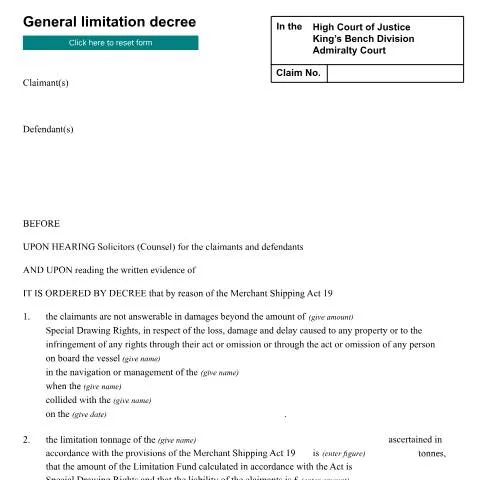
Navigating the Complexities of the General Limitation Decree: Form ADM19
The General Limitation Decree (Form ADM19) plays a pivotal role in maritime law within the United Kingdom, providing a structured approach for handling claims arising from incidents at sea. This form is essential for claimants and defendants involved in limitations of liability under the Merchant Shipping Act. Understanding the intricacies of this decree is critical for any party engaged in maritime disputes.
The Stakeholders: Who Engages with Form ADM19?
Form ADM19 is predominantly utilized by claimants and defendants in maritime disputes where limitation of liability is sought. The primary stakeholders include:
- Claimants: Individuals or entities seeking to limit their liability regarding damages or losses incurred during a maritime incident.
- Defendants: Parties against whom claims are made, often seeking to establish a limitation on their liability based on the claims submitted.
- Legal Representatives: Solicitors and barristers representing claimants or defendants, guiding them through the legal processes and paperwork involved.
It's important to note that specific cases, such as those involving collisions, grounding, or oil spills, may require unique considerations. Depending on the nature of the incident, different regulations and procedures could apply, affecting how Form ADM19 is completed and submitted.
Understanding the Legal Framework: The Merchant Shipping Act
The General Limitation Decree is framed within the regulatory structure established by the Merchant Shipping Act. This legislation governs how maritime claims are to be handled and outlines the conditions under which a shipowner may limit their liability.
The Act itself stipulates the allowable limits based on the tonnage of the vessel involved, which can significantly impact the amount of compensation available to claimants. The key sections relevant for Form ADM19 include:
- Limitation of Liability: Establishes the upper limits of liability based on the ship’s tonnage.
- Creation of Limitation Funds: Details the process for depositing funds into the court to secure limits on liability.
- Claims Process: Outlines the procedural steps required to file claims against the limitation fund.
In essence, the General Limitation Decree serves as a mechanism to enforce the provisions of the Merchant Shipping Act, ensuring that claims are processed in a manner consistent with established legal precedents.
Completing Form ADM19: Breaking Down the Sections
Filling out Form ADM19 requires careful attention to detail, as inaccuracies can lead to delays or complications in the claims process. Here's a detailed look at the various sections of the form:
Claim Information Section
This initial section requires the entry of crucial details regarding the claim:
- Claim Number: This unique identifier is assigned by the court and must be referenced accurately.
- Claimants and Defendants: Clearly state the names and addresses of all parties involved. It’s important to ensure that these details match official documentation to prevent any disputes.
- Date of Incident: The date on which the maritime incident occurred is critical, as it determines applicable laws and regulations.
Limitation Fund Details
This part of the form focuses on the financial implications of the claim:
- Limitation Tonnage: Calculate and enter the tonnage of the vessel involved as per the Merchant Shipping Act. This figure is essential in determining the maximum liability.
- Amount of Limitation Fund: The total amount required to be deposited into court to establish the limitation fund must be calculated and specified accurately.
- Distribution of Funds: This section outlines how the funds will be distributed among claimants once claims are validated.
Administrative Procedures and Notices
In this section, you will specify any necessary administrative actions:
- Notification Requirements: Claimants must advertise the decree in specified newspapers and state the timeframe for filing additional claims.
- Duration for Claims Submission: Clearly indicate the timeframe during which other claimants may submit claims against the fund.
Pay close attention to the legal requirements regarding notices to ensure compliance and prevent future liability issues.
Methods to Submit Form ADM19: Online, Paper, or In-Person
Submitting Form ADM19 can be done through various methods, each with its advantages and disadvantages:
| Method | Advantages | Disadvantages |
|---|---|---|
| Online Submission | Fast processing, easy tracking, reduced paperwork. | Requires reliable internet access; possible technical issues. |
| Paper Submission | Preferred by some for record-keeping; no tech issues. | Longer processing times; potential for lost documents. |
| In-Person Submission | Immediate confirmation of receipt; can address questions directly. | Time-consuming; may require travel to court. |
Regardless of the method chosen, be aware of the submission deadlines and ensure that the form is correctly filled out to prevent unnecessary delays.
Tracking Your Claim: What Happens After Submission?
Once Form ADM19 is submitted, a series of administrative actions take place:
- Verification Process: The court will verify the details provided in the form, checking for accuracy and compliance with the Merchant Shipping Act.
- Case Management Conference: A date will be set for a conference to discuss the future conduct of the proceedings. This is a crucial step where directions may be issued for the next stages in the claim process.
- Distribution of the Limitation Fund: The court will determine how the funds are to be distributed to valid claimants based on the details provided in the ADM19.
Tracking your claim can be done via the court’s online services or by contacting the Admiralty Registrar for updates. Keeping records of all correspondence and documentation is advisable for reference throughout the process.
Timelines: Key Dates and Next Steps
The timeline for handling claims involving Form ADM19 includes several critical dates and milestones:
- Date of Incident: The starting point for all subsequent timelines and deadlines.
- Submission Deadline: Form ADM19 must be submitted promptly to meet all legal deadlines as outlined in the Merchant Shipping Act.
- Publication of Notices: The requirements for newspaper notices must be fulfilled within specific time limits set by the court.
- Case Management Conference: This will typically occur within weeks of filing the ADM19, where directions will be provided for the next steps in the legal proceedings.
Understanding these timelines will help claimants and defendants prepare adequately for each step of the process, ensuring that they remain compliant with legal requirements and deadlines.
The Path Forward: Navigating Potential Challenges
While the process involving the General Limitation Decree can seem straightforward, there are common challenges and complexities that may arise:
- Disputes Over Claim Validity: Differences in interpretation of the events leading to the claim can complicate proceedings. It is essential to gather comprehensive evidence and legal support for your position.
- Compliance with Legal Formalities: Ensuring that all procedural requirements are met, including accurate completion of the form and timely submissions, is crucial to avoid delays or rejections.
- Negotiation and Settlement Options: Parties might consider negotiating settlements outside of court, which can resolve disputes more efficiently. Legal guidance in these negotiations is invaluable.
Staying informed about the process and potential pitfalls can significantly enhance the chances of a successful outcome for both claimants and defendants in maritime disputes.
Understanding the General Limitation Decree and Its Implications
The General Limitation Decree, often referenced in legal contexts, pertains to the time limits enforced on initiating legal proceedings. Under UK law, time limits vary according to the type of claim and the jurisdiction involved, thus it's essential for individuals and entities to understand the relevant statutes when considering legal action. Form ADM19 is specifically related to applications under the Limitation Act, allowing parties to seek declarations regarding the limitation period for certain actions.
Generally, the Limitation Act 1980 governs the time limits for different types of claims. For example, personal injury claims typically must be brought within three years of the date of the injury, while claims for breach of contract generally have a six-year limitation period. Additionally, there are unique exceptions; for instance, if the claimant was a minor or of unsound mind, the limitation period may be extended.
When completing Form ADM19, applicants must clearly outline the specific nature of their claim and the reasons for seeking an extension or clarification of the limitation period. The application process includes detailing the circumstances which may justify the court's discretion to allow proceedings outside the typical time limits, necessitating a detailed understanding of the case specifics and a robust presentation of evidence.
Common Challenges in Filing Form ADM19
Filing Form ADM19 can present various challenges, particularly around the gathering of necessary information and complying with procedural requirements. One of the most significant hurdles is ensuring that all supporting documentation and evidence are adequately prepared and submitted within the deadlines specified by the court. This includes verifying that the claim is indeed relevant to the limitation decree and providing compelling reasons for any delays in filing.
Another challenge often encountered is navigating the complexity of legal language and the requirements imposed by the court. Applicants may find it beneficial to engage legal counsel who is adept in limitation disputes. A lawyer can assist in appropriately framing the argument for an extension of the limitation period, highlighting any extenuating circumstances that may apply to the case.
Moreover, applicants must remain acutely aware of the potential for adverse outcomes should their application be denied. The court will thoroughly scrutinise the application, and if it finds the grounds insufficient, it may permanently bar the claim, leaving the claimant without recourse. Therefore, ensuring that the application is comprehensive and meticulously prepared is paramount.
Practical Steps for Completing Form ADM19 Successfully
To successfully navigate the process of completing Form ADM19, applicants should follow a structured approach. Here are some practical steps to consider:
- Thoroughly Review the Limitation Act: Understand the specific time limits applicable to your type of claim. This knowledge is crucial in arguing why an extension may be justified.
- Gather Evidence: Compile all relevant documents that demonstrate the basis of your claim and any factors that contributed to the delay in initiating proceedings. This may include medical reports, correspondence, or any other pertinent data.
- Consult Legal Advice: Given the complexities surrounding limitation decrees, obtaining professional legal advice can significantly enhance the quality of your application. Lawyers familiar with the nuances of limitation periods can provide invaluable assistance in framing arguments and ensuring compliance with court requirements.
- Complete the Form Accurately: Fill out Form ADM19 with precision. Ensure that all sections are addressed in detail, particularly those that require justification for seeking an extension. Be clear and logical in your explanations.
- Timely Submission: Pay attention to the deadlines for submission. Late applications can result in automatic rejection, so it’s important to submit the form well in advance of any court deadlines.
- Prepare for Potential Hearing: In some cases, the court may require a hearing to consider your application. Be prepared to present your case succinctly and answer any questions the judge may have.
By adhering to these steps, applicants can improve their chances of successfully navigating the complexities of the General Limitation Decree and the filing of Form ADM19.