Understanding Your Position as a Creditor in Insolvency Proceedings
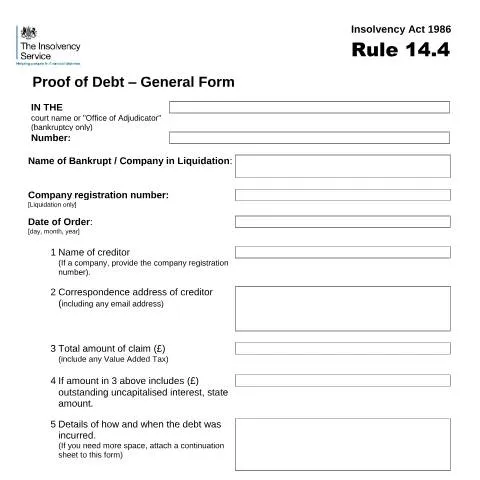
When a business collapses or an individual faces bankruptcy, creditors often find themselves navigating unfamiliar territory. The Rule 14.4 proof of debt (general form) represents your formal claim for money owed by the insolvent debtor, serving as your ticket to participate in the distribution of whatever assets remain. This document transforms an informal debt relationship into a legally recognised claim within the insolvency framework governed by The Insolvency Service.
Unlike standard debt recovery procedures, insolvency proceedings operate under strict statutory rules where creditors must prove their entitlement to payment through this standardised form. The proof of debt establishes not only the existence of your debt but also your right to vote on key decisions affecting the insolvency and your potential to receive dividend payments from the estate.
The timing of submission can be critical. Whilst there's typically no absolute deadline for lodging a proof of debt, late submissions may miss dividend distributions already declared. More importantly, failing to submit this form means forfeiting your voice in creditors' meetings where crucial decisions about the debtor's assets and the conduct of the insolvency are made.
Navigating the Dual Pathways: Corporate Liquidation versus Personal Bankruptcy
The Rule 14.4 form serves both corporate liquidations and personal bankruptcies, though the practical implications differ significantly between these two insolvency routes. Understanding which pathway applies to your debtor determines not only how you complete certain sections of the form but also what you can realistically expect from the process.
Corporate Liquidation Specifics
In company liquidations, creditors deal with a liquidator appointed to realise the company's assets and distribute proceeds according to statutory priority rules. The form requires the company registration number, enabling the liquidator to verify the debtor's corporate identity and trading history. Corporate debts often involve more complex documentation, including purchase orders, delivery notes, and invoicing systems that span multiple accounting periods.
Trade creditors typically form the largest group in corporate insolvencies, followed by HMRC for unpaid taxes and employee claims for wages and redundancy. The company's assets might include stock, property, plant and machinery, and book debts, though recovery rates for unsecured creditors rarely exceed 10-15 pence in the pound.
Personal Bankruptcy Considerations
Bankruptcy proceedings involve a trustee in bankruptcy who takes control of the bankrupt's assets, excluding certain protected items like basic household goods and tools of trade up to specified values. Personal debts often include credit cards, personal loans, mortgage shortfalls, and professional fees, typically supported by simpler documentation than corporate claims.
Individual bankrupts may have fewer realisable assets, but the process can be more straightforward for creditors. The trustee focuses on the bankrupt's property, income above reasonable living expenses, and any assets transferred before bankruptcy that might constitute transactions at undervalue or preferences.
Crafting Your Claim: Essential Details That Strengthen Your Position
Section 5 of the form, requesting details of how and when the debt was incurred, often determines whether your claim succeeds or fails. Vague descriptions invite challenges from the office holder or other creditors, whilst comprehensive detail supported by proper documentation establishes credibility.
Substantiating Debt Origins
Effective debt descriptions include specific dates, invoice numbers, purchase order references, and clear explanations of the goods supplied or services rendered. For ongoing trading relationships, detail the period covered and reference key transactions that comprise the total debt. If the debt arose from a loan agreement, specify the original advance date, terms, and any variations agreed subsequently.
Professional services debts require particular care, detailing the scope of work undertaken, time periods covered, and charging basis. Construction industry claims should reference specific projects, contract terms, and any retention amounts held. Landlords claiming rent arrears must specify the property, lease terms, and exact periods of non-payment.
Handling Interest and Additional Charges
Section 4 addresses outstanding uncapitalised interest, requiring separate identification of interest elements within your total claim. Contractual interest continues accruing until the relevant date (typically the date of the winding-up order or bankruptcy order), but statutory interest under section 328 of the Insolvency Act 1986 only applies if sufficient funds remain after paying all proven debts.
Include late payment charges and collection costs only if clearly provided for in your original agreement with the debtor. The office holder will scrutinise such additions, particularly if they appear disproportionate to the underlying debt.
Security Interests and Asset Protection Mechanisms
Section 6's requirement to detail any security held can significantly impact your recovery prospects, potentially elevating you from unsecured creditor status to secured creditor with preferential treatment in asset distributions.
| Security Type | Asset Coverage | Registration Requirements | Recovery Priority |
|---|---|---|---|
| Fixed Charge | Specific identified assets | Companies House filing | First ranking over charged assets |
| Floating Charge | Changing pool of assets | Companies House filing | After fixed charges and preferential debts |
| Retention of Title | Supplied goods not paid for | Contract terms sufficient | Recovery of specific goods if identifiable |
| Personal Guarantee | Guarantor's personal assets | Written agreement required | Separate claim against guarantor |
Retention of Title Claims
Section 7 specifically addresses reservation of title claims, where suppliers attempt to recover unpaid goods supplied under retention of title clauses. Success depends on proving both the existence of valid retention terms and the ability to identify your specific goods within the debtor's premises.
Effective retention of title clauses must be incorporated into your standard terms and conditions, clearly communicated to customers, and extend to products manufactured using your materials or proceeds of sale. However, practical recovery often proves difficult if goods have been processed, sold, or mixed with other materials.
Set-off Rights
Mutual debts between you and the insolvent debtor may be subject to mandatory set-off under Rule 14.25 of the Insolvency Rules. If you owe money to the debtor whilst claiming as a creditor, the office holder will typically set off these amounts automatically, reducing both your claim and your liability.
Set-off operates by law rather than choice, applying to mutual debts existing at the relevant date. This can work in your favour if you owe less than you're owed, or against you if the reverse applies.
Documentary Evidence and Substantiation Requirements
Section 8's request for details of any document by reference to which the debt can be substantiated acknowledges that whilst you need not attach supporting documents initially, you must be prepared to produce them if requested by the office holder or creditors' meeting chairman.
Building a Comprehensive Evidence File
Maintain copies of all relevant documentation including original contracts or purchase orders, delivery notes proving goods were supplied, invoices showing amounts due, and correspondence demonstrating the debtor's acknowledgment of the debt. For service-based claims, retain time records, project documentation, and any client approvals or sign-offs.
Bank statements showing payments made and received help establish the trading relationship pattern and identify any recent payments that might constitute preferences recoverable by the office holder. Email chains often provide valuable evidence of agreed variations to original terms or acknowledgments of outstanding amounts.
Dealing with Missing Documentation
Where original documentation has been lost or destroyed, prepare witness statements from personnel involved in the original transactions. Reconstruct transaction histories from available records such as bank statements, accounting records, and delivery schedules.
If the debtor held the only copies of key documents, request these from the office holder who may have recovered business records during the insolvency process. However, be prepared for situations where inadequate records prevent full substantiation of your claim.
Submission Protocols and Authentication Methods
The form's notes specify that email submission is acceptable provided proper authentication protocols are followed. This modern approach recognises the practical difficulties of coordinating postal submissions during insolvency proceedings where time-sensitive decisions frequently arise.
Electronic Submission Standards
Email submissions require the form to be sent as an attachment from an email address that clearly identifies you or has been previously notified to the office holder. Simply entering your name in block capitals provides sufficient electronic signature for these purposes, though some office holders may request additional verification for substantial claims.
When submitting on behalf of a company, clearly state your relationship to the company and ensure you have proper authority to act. Directors, company secretaries, and authorised employees can typically submit proofs, but external parties require specific written authority.
Postal Submission Alternatives
Traditional postal submission remains valid, requiring original signatures and clear identification of the signatory's authority. Posted forms should be sent to the office holder's correspondence address, typically provided in the initial notice to creditors or available from The Insolvency Service's records.
Consider using recorded delivery for valuable claims to ensure receipt can be proven, particularly if approaching any deadline for creditors' meetings or dividend declarations.
Office Holder Assessment and Creditor Rights
Once submitted, your proof of debt undergoes assessment by the office holder (trustee in bankruptcy or liquidator) who must determine whether to admit your claim for voting purposes and dividend entitlement. This process involves more than simple arithmetic verification, extending to legal analysis of your entitlement and supporting evidence quality.
The Admission Process
The office holder examines each proof against the available evidence, considering factors such as debt validity, quantum accuracy, and compliance with insolvency law requirements. Claims may be admitted in full, admitted for a lesser amount, or rejected entirely depending on this assessment.
Admitted claims receive two separate treatments: admission for voting purposes in creditors' meetings, and admission for dividend purposes when distributions are declared. These amounts may differ if the office holder accepts the debt's existence but questions the precise quantum claimed.
Challenge and Appeal Mechanisms
If your proof is rejected or admitted for less than claimed, you retain rights to challenge this decision. The office holder must provide reasons for rejection, enabling you to address specific concerns or provide additional evidence.
Formal appeal procedures allow application to court for review of the office holder's decision, though this involves additional costs that must be weighed against potential recovery amounts. Alternative dispute resolution through insolvency practitioners' professional bodies sometimes provides more cost-effective solutions for disputed proofs.
Strategic Considerations for Different Creditor Categories
Your position within the insolvency depends significantly on your creditor category, which determines both recovery priority and practical influence over proceedings. Understanding these distinctions helps set realistic expectations and informs strategic decisions about proof submission and ongoing participation.
Preferential Creditors
Certain debts receive preferential treatment under Schedule 6 of the Insolvency Act 1986, including employee wages up to £800, holiday pay, and pension scheme contributions. HMRC lost its preferential status for most taxes in 2003, though this was partially restored in 2020 for certain taxes including VAT, PAYE, and employee National Insurance contributions.
Preferential creditors rank ahead of floating charge holders and unsecured creditors, significantly improving recovery prospects. If you qualify for preferential status, ensure your proof clearly identifies this classification and the statutory basis for preferential treatment.
Secured Creditors
Holders of fixed charges over specific assets typically recover the full value of their security, subject to realisation costs. However, floating charge holders rank behind preferential creditors and may face additional deductions including prescribed part provisions that ring-fence funds for unsecured creditors.
Security holders can choose to rely on their security rights or surrender security and prove for the full debt as unsecured creditors. This decision requires careful analysis of security values versus potential unsecured recovery rates.
Unsecured Creditor Dynamics
Unsecured creditors typically represent the largest group by number but often recover minimal amounts from insolvency proceedings. However, they retain important voting rights in creditors' meetings, potentially influencing decisions about asset realisations, office holder remuneration, and investigation pursuits.
Large unsecured creditors sometimes form informal committees to coordinate positions and share information costs. Smaller creditors may benefit from aligning with such groups rather than pursuing individual strategies that duplicate effort and expense.