When veterinary testing meets export requirements: APHA's critical submission form
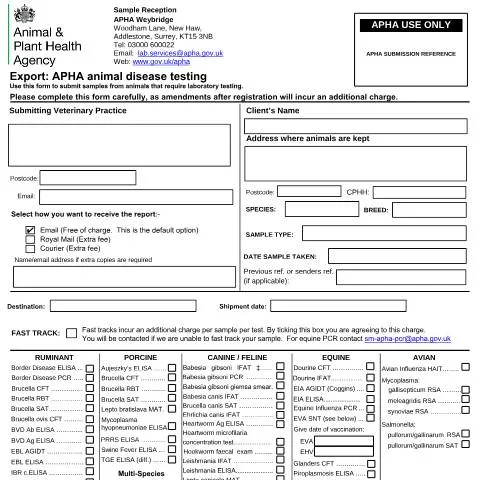
The moment a UK veterinary practice receives samples requiring disease testing for animals destined for export, a complex regulatory framework springs into action. The Animal and Plant Health Agency (APHA) operates as the UK's gatekeeper for animal health certification, and their animal disease testing submission form represents a crucial checkpoint in the export process. Unlike routine domestic veterinary work, export-bound animals face heightened scrutiny under international trade agreements and bilateral health protocols.
This submission form bridges the gap between clinical veterinary practice and official government certification. When a racehorse needs clearance for competition in Dubai, when breeding cattle are bound for European farms, or when exotic birds require health certificates for international zoos, this document initiates the formal testing process that underpins the UK's reputation for rigorous animal health standards.
The regulatory framework driving export animal testing
The UK's departure from the European Union fundamentally reshaped animal export procedures, elevating APHA's role as the sole competent authority for health certification. Under the Animal Health Act 1981 and subsequent regulations, all animals leaving the UK must comply with destination country requirements, which invariably demand proof of freedom from specific diseases.
APHA operates under strict international guidelines established by the World Organisation for Animal Health (OIE), now known as the World Organisation for Animal Health. These standards require traceability from sample collection through to final certification. The form's reference number system—visible in the "APHA USE ONLY" section—creates an audit trail that satisfies both UK and importing country authorities.
The legal obligation extends beyond mere testing. Under the Trade in Animals and Related Products Regulations 2011, exporters must demonstrate that samples were collected by authorised personnel, transported under controlled conditions, and tested by approved laboratories. The form's detailed identification requirements reflect these stringent traceability demands.
Post-Brexit implications for testing protocols
Since January 2021, the UK has operated as a "third country" for EU exports, triggering enhanced documentation requirements. The form's emphasis on official animal identification—specifically referencing ear tags and microchips—aligns with EU requirements for individual animal traceability. The vaccination history section has gained particular significance, as many EU member states now require evidence of specific vaccination protocols that differ from previous intra-EU standards.
Decoding the comprehensive testing menu
The form's extensive disease testing options reflect the diverse pathogen landscape that concerns importing countries. The testing categories—Ruminant, Porcine, Canine/Feline, Equine, and Avian—represent distinct epidemiological profiles and associated trade restrictions.
| Species Category | Key Export Diseases | Typical Destinations Requiring Testing |
|---|---|---|
| Ruminant | Brucellosis, Bovine TB, Border Disease | EU, USA, Australia, New Zealand |
| Equine | Equine Influenza, EIA, Dourine | UAE, Hong Kong, USA, EU |
| Porcine | Aujeszky's Disease, Brucellosis | EU, Canada, Singapore |
| Avian | Avian Influenza, Newcastle Disease | Middle East, Asia-Pacific, EU |
The "Multi-Species" section addresses mixed consignments or facilities housing multiple species. Pool testing (1-6 samples) offers cost-effective screening for large groups, particularly relevant for commercial poultry operations or livestock farms with uniform health status.
Understanding the ELISA and PCR distinction
The form distinguishes between ELISA (enzyme-linked immunosorbent assay) and PCR (polymerase chain reaction) testing methodologies. ELISA tests detect antibodies, indicating previous exposure or vaccination response, while PCR identifies genetic material from active infections. For export purposes, the choice often depends on the importing country's specific requirements and the animal's vaccination history.
The reference to "[email protected]" for equine PCR reflects APHA's specialised approach to high-value animal exports. Equine testing often involves urgent timeframes due to competition schedules or breeding programmes, requiring dedicated communication channels.
Navigating the submission mechanics
The form's dual nature—accommodating both veterinary practices and individual animal owners—creates complexity in completion requirements. The "Submitting Veterinary Practice" section must be completed even when private owners submit samples, establishing the chain of professional oversight required under veterinary medicines regulations.
The postcode fields for both the submitting practice and the animal holding location serve a specific epidemiological purpose. APHA uses geographic data to assess regional disease risks and may apply additional scrutiny to submissions from areas with recent disease outbreaks or enhanced surveillance zones.
The critical importance of sample dating
The "DATE SAMPLE TAKEN" field carries legal significance beyond mere record-keeping. Many export health certificates specify maximum intervals between sampling and export, typically ranging from 7 to 30 days depending on the disease and destination. Incorrectly dated samples can invalidate entire export consignments, potentially costing thousands of pounds in delayed shipments or cancelled transactions.
The "Previous ref. or senders ref." field enables tracking of related submissions, particularly important for animals requiring multiple tests over time or follow-up testing after initial inconclusive results.
Delivery options and their strategic implications
The form offers three report delivery methods, each with distinct cost and timing implications. Email delivery, marked as the default option and free of charge, typically provides results within standard laboratory processing times. However, the form's warning about extra charges for Royal Mail and courier delivery reflects APHA's move towards digital-first service delivery.
The requirement for multiple email addresses when extra copies are needed accommodates complex export arrangements involving multiple stakeholders—exporters, importing agents, destination veterinarians, and transport companies all may require immediate access to test results.
Fast track services and cost considerations
The "FAST TRACK" option acknowledges the commercial reality of time-sensitive exports. Breeding animals with narrow fertility windows, competition horses with fixed event schedules, or livestock with booked transport arrangements may justify the additional per-sample charges. The form's warning about contacting submitters when fast-tracking isn't possible reflects APHA's commitment to managing expectations in urgent situations.
Sample identification and traceability protocols
The detailed sample identification table on page two represents one of the form's most critical sections. The requirement for both official animal identification (ear tags or microchips) and sample identification creates a dual verification system that satisfies international traceability standards.
The "SEX" and "AGE" columns serve specific epidemiological purposes. Certain diseases show age or gender predispositions, and some importing countries apply different testing requirements based on these factors. Young animals may have maternal antibodies that complicate serological testing, while breeding animals face enhanced scrutiny for reproductive diseases.
Managing multi-animal submissions
The form accommodates up to 23 individual animals or samples, reflecting typical commercial consignment sizes. However, the table's design allows for efficient processing of smaller submissions—family pets relocating internationally, individual breeding animals, or small-scale commercial exports.
The "APHA USE ONLY" sample reference column maintains the government's internal tracking system, essential for laboratory workflow management and result reporting. This reference becomes crucial if queries arise about specific samples or if additional testing is required.
Data protection and third-party considerations
The form's data protection section reflects APHA's compliance with UK GDPR requirements under the Data Protection Act 2018. The reference to the Animal and Plant Health Agency Personal Information Charter acknowledges that animal health data often contains commercially sensitive information about breeding programmes, health status, and trade relationships.
The third-party invoicing provision addresses complex commercial arrangements where testing costs are borne by parties other than the submitting veterinary practice. This might include exporters, insurance companies, or destination country importers. The requirement for written confirmation protects all parties and ensures clear financial responsibility.
Anonymous surveillance and research applications
The checkbox regarding anonymous surveillance or test validation purposes reflects APHA's dual role as both a service provider and a research organisation. Data from routine export testing contributes to national disease surveillance programmes and helps validate new testing methodologies. Submitters can opt out of this secondary use while still receiving their required test results.
The declaration "I have taken these samples from the animals described above" creates legal accountability for sample integrity. This statement, combined with the signature requirement, establishes the chain of custody essential for regulatory compliance and potential legal proceedings related to animal health certification.
Integration with broader certification processes
This testing submission represents just one component of the comprehensive export health certification process. Results feed into official health certificates issued under APHA's authority, which must align with bilateral agreements between the UK and destination countries. The form's reference to current price lists acknowledges that testing fees may vary based on diplomatic negotiations and reciprocal arrangements.
The VLARB1 form reference for rabies testing highlights the specialised nature of certain export requirements. Rabies testing often involves different laboratories, extended processing times, and additional documentation requirements, necessitating separate submission procedures.
Understanding this form's role within the broader export framework helps submitters plan effectively, ensuring that testing timelines align with certification requirements, transport arrangements, and destination country import procedures. The seemingly simple act of requesting animal disease testing ultimately supports the UK's position as a trusted partner in international animal trade.
Regional Variations in APHA Testing Requirements Across the UK
While APHA operates as the primary animal health authority for England, understanding the devolved responsibilities across the UK is crucial for exporters dealing with animals or animal products from different regions. In Scotland, Animal and Plant Health Agency Scotland works closely with the Scottish Government's Rural Payments and Inspections Division, whilst Wales has its own arrangements through the Welsh Government's animal health team. Northern Ireland operates under different EU-aligned regulations due to the Northern Ireland Protocol arrangements.
For exports originating from Scotland, you'll typically submit applications through the same APHA systems, but certain livestock movements may require additional certification from Scottish Government veterinarians. Welsh exporters often encounter specific requirements for sheep and cattle exports, particularly regarding scrapie monitoring programmes that differ slightly from English protocols. The Welsh Government maintains its own database of approved premises for pre-export isolation, which must be cross-referenced with APHA records.
Northern Ireland presents unique complexities due to its continued alignment with EU animal health regulations. Exports from Northern Ireland to Great Britain may require different testing protocols than movements within England, Scotland, and Wales. Conversely, exports from Northern Ireland to EU countries often follow streamlined procedures that bypass some traditional third-country requirements, though this remains subject to ongoing political and trade negotiations.
Cross-border movements within the UK can affect your export timeline significantly. If you're consolidating animals from multiple UK regions for a single export consignment, each regional authority must validate their portion of the health certification. This process can add 5-10 working days to standard timelines, particularly during peak export seasons or when dealing with high-risk species classifications.
APHA maintains regional laboratories in Addlestone, Carmarthen, Lasswade, and Stormont, each with specific testing capabilities and capacity limitations. Understanding which laboratory will process your samples can help predict processing times more accurately. For instance, the Carmarthen laboratory specialises in certain sheep disease testing, whilst Addlestone handles the majority of equine export health screening.
Electronic Systems Integration and Digital Documentation Management
APHA's digital transformation has introduced several electronic platforms that streamline the export certification process, though navigating these systems requires understanding their interconnected nature. The Export Health Certificate Online (EHCO) system serves as the primary portal for most animal export applications, but it interfaces with multiple other databases including the Animal and Plant Health Information System (APHIS) and the Trade Control and Expert System (TRACES).
When submitting applications through EHCO, your business registration must be linked to a Government Gateway account with appropriate permissions. This registration process can take up to 10 working days for new businesses, as APHA verifies your legal entity status and assigns the correct user permissions. Existing businesses adding new users should allow 3-5 working days for account activation, particularly if the new user requires signing authority for export certificates.
The system automatically cross-references your animal identification numbers against national databases such as the Cattle Tracing System (CTS) for bovines or the Sheep and Goat Inventory for small ruminants. Any discrepancies in animal identification or movement history will flag your application for manual review, potentially adding weeks to the approval process. Ensuring your animal records are current and accurate across all relevant databases before submitting export applications is therefore essential.
Digital document management within APHA systems requires specific file formats and naming conventions. Laboratory test results must be uploaded as PDF files not exceeding 10MB, with filenames following the format "TestType_AnimalID_Date_LabReference". Vaccination certificates require similar formatting, and the system will reject uploads that don't conform to these technical specifications. Many exporters encounter delays simply due to incorrect file formatting, so establishing standardised procedures for document preparation is worthwhile.
TRACES integration allows for seamless communication with EU destination countries, but this system operates on different technical standards than UK domestic databases. Export certificates generated through EHCO are automatically formatted for TRACES compatibility, but any manual amendments or additional documentation must follow EU formatting requirements. This dual-standard requirement often catches exporters off-guard, particularly when destination countries request supplementary information not captured in standard UK export certificates.
The system maintains audit trails for all activities, which proves valuable during inspections or if questions arise about certification processes. However, accessing these audit logs requires specific user permissions, and APHA typically only grants such access to designated compliance officers within exporting businesses. Understanding who within your organisation has access to different system functions can prevent delays when troubleshooting applications or responding to official inquiries.
Specialised Testing Protocols for High-Risk Species and Emerging Diseases
APHA maintains enhanced surveillance and testing protocols for species classified as high-risk for disease transmission, with requirements that extend far beyond standard export health screening. Primates, for instance, require comprehensive testing panels including simian immunodeficiency virus, simian T-lymphotropic virus, and various herpes viruses, with some tests requiring 28-day observation periods in APHA-approved quarantine facilities before blood sampling can commence.
Cervids (deer species) face particularly stringent requirements due to chronic wasting disease concerns. Export protocols typically require genetic testing for susceptibility markers, alongside traditional disease screening. The genetic testing must be conducted by APHA-approved laboratories using specific primer sequences approved by destination country authorities. This genetic component can add 3-4 weeks to standard processing times, as samples often require batch processing to maintain cost-effectiveness.
Aquatic species present unique challenges, as water quality parameters become integral to health certification. APHA requires detailed water chemistry analyses covering pH, dissolved oxygen, ammonia, nitrite, and nitrate levels, alongside pathogen screening. These environmental factors must remain within specified ranges throughout the pre-export isolation period, with daily monitoring records submitted as part of the export application. Any parameter excursions require investigation and may necessitate extended isolation periods or additional health screening.
Emerging disease protocols adapt rapidly to global health threats, with APHA maintaining flexible testing frameworks that can incorporate new pathogens within weeks of identification. Recent examples include enhanced screening for African swine fever in suids and additional respiratory pathogen panels for various species following global disease outbreaks. These emerging protocols often lack standardised commercial testing options, requiring APHA to develop in-house testing capabilities or approve alternative methodologies on a case-by-case basis.
Species-specific behavioural considerations affect sampling procedures significantly. Large carnivores require immobilisation protocols approved by both APHA veterinarians and destination country authorities, with specific drug combinations and dosages predetermined based on species, age, and body condition. The immobilisation records become part of the export documentation, and any deviations from approved protocols can invalidate the entire certification process.
Reproductive status adds another layer of complexity, particularly for pregnant females or breeding males. Pregnancy testing using species-appropriate methodologies becomes mandatory for many destinations, alongside hormonal profiling to confirm reproductive status. Male breeding animals often require semen quality assessments and genetic screening beyond standard health requirements, with testing protocols varying significantly between species and intended use in destination countries.
APHA maintains specialised facilities for housing high-risk species during pre-export isolation, but capacity limitations mean booking isolation space well in advance is essential. The Pirbright Institute and selected private facilities operate under APHA oversight to provide appropriate containment levels for different risk categories. Understanding which facilities can accommodate your specific species and risk classification helps avoid last-minute logistical complications that could derail export timelines.