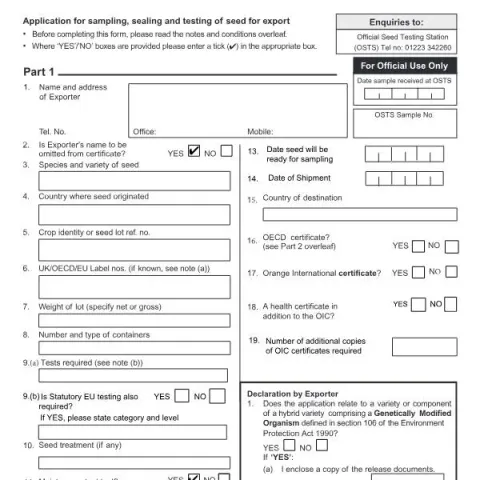
Understanding the Seeds for Export Application Process
The export of seeds is a crucial process governed by strict regulations to ensure the quality and safety of the seeds being moved across borders. The Seeds for Export: Application for Sampling and Testing form, commonly referred to as CERT 9, serves as a pivotal document in this procedure. This article offers an in-depth examination of the steps involved in completing and submitting the CERT 9 form, outlining its significance in the larger framework of export regulations.
The Role of the CERT 9 Form in Seed Export
The CERT 9 form is essential for exporters seeking to comply with the regulations set by the Animal and Plant Health Agency (APHA). It facilitates the sampling and testing of seed lots intended for export. Here’s why it’s important:
- Regulatory Compliance: This form ensures that the seeds meet the necessary health and safety standards required by the importing country.
- Quality Assurance: Testing for purity and germination guarantees that only high-quality seeds are exported.
- Traceability: The documentation created through the CERT 9 process allows for tracking the seed lots, thereby ensuring that they adhere to international standards.
Step-by-Step Completion of the CERT 9 Form
Filling out the CERT 9 form accurately is crucial for a seamless export process. Below is a detailed breakdown of the form's sections and the information required:
1. Exporter's Information
The first section requires you to provide the name and address of the exporter, along with contact numbers. It’s essential to ensure that this information is up-to-date to facilitate communication.
2. Certificate Preferences
This section asks whether the exporter’s name should be omitted from the certificate. It’s advisable to consider the implications of this choice, particularly regarding transparency and trust with the importing party.
3. Seed Details
Here, you must specify the species and variety of seeds, the country of origin, and the crop identity or seed lot reference number. It’s vital to double-check these details against your records to avoid discrepancies.
4. Testing Requirements
Outlining the tests required is a crucial part of the process. You must indicate whether moisture content testing is necessary and identify any special tests, like those for noxious weeds. Clearly stating these requirements streamlines the evaluation process.
5. Declaration by Exporter
This declaration serves as a legal affirmation that the information provided is accurate and that you agree to comply with associated conditions. Neglecting this section could lead to the rejection of your application.
Key Considerations for Exporters
When preparing to submit the CERT 9 form, there are several critical factors to keep in mind:
- Understanding Fees: Be aware that there may be charges associated with sampling and testing, as outlined by the APHA.
- Access to Containers: Ensure that all seed containers are easily accessible for sampling, as samplers will not proceed if this condition is not met.
- Timeliness: The application should be submitted well in advance of the intended shipment date to accommodate for testing and certification processes.
After Submission: What Happens Next?
Once you’ve submitted the CERT 9 form, it enters a specific workflow for processing:
- Initial Review: The Official Seed Testing Station (OSTS) will review the application to confirm that all necessary information is included.
- Sampling: An official sampler will be dispatched to collect samples according to the specifications outlined in your application.
- Testing: The samples will undergo rigorous testing to evaluate purity, germination rates, and compliance with specific regulations.
- Certification: Upon successful testing, a certificate will be issued, confirming that the seeds meet all necessary export standards.
Potential Pitfalls and How to Avoid Them
Exporters must be mindful of common errors that can lead to delays or rejections:
- Inaccurate Information: Errors in the seed details or exporter’s information can lead to significant delays. Cross-reference all data against official records.
- Incomplete Applications: Ensure that every section of the form is filled out completely. Missing information can halt processing.
- Neglecting Deadlines: Adhering to deadlines for submission is essential. Familiarize yourself with the timelines for sampling and testing to avoid rush fees or delays.
The Broader Context of Seed Export Regulations
The certification process and the CERT 9 form are part of a larger regulatory framework aimed at protecting plant health. This framework is influenced by both domestic legislation and international agreements. Understanding this context is critical for exporters:
- Legislation: The Environment Protection Act 1990 and other related regulations provide the foundation for seed testing and certification.
- International Standards: Compliance with OECD (Organisation for Economic Co-operation and Development) guidelines ensures that UK exports are accepted globally.
- Trade Agreements: Various trade agreements may impose additional requirements or facilitate smoother processes for seed exports.
Monitoring the Status of Your Application
Following up on your CERT 9 submission is essential for maintaining momentum in the export process. Here’s how to effectively monitor your application:
- Contacting OSTS: The Official Seed Testing Station can provide updates on the progress of your application. Utilize the contact number provided on the form.
- Document Tracking: Keep a record of your submission and any correspondence related to your application. This will be invaluable if discrepancies arise.
- Proactive Communication: If delays occur, don’t hesitate to reach out to the APHA or the Official Sampler for clarification on the status of your application.
Distinguishing CERT 9 from Other Related Forms
It's important to understand how the CERT 9 form differentiates itself from similar documents in the realm of agricultural exports. While related forms exist, each serves a unique purpose:
| Form | Purpose | Key Differences |
|---|---|---|
| CERT 9 | Application for sampling and testing of seeds for export | Focuses solely on seed certification |
| CERT 9A | Additional testing requests | Used in conjunction with CERT 9 for extra testing needs |
| Phytosanitary Certificate | Confirms that the seeds are free from pests and diseases | Required for certain exports but not specifically focused on seed quality |
Understanding these distinctions ensures that exporters are equipped with the right documentation for their specific needs, thereby avoiding confusion and potential compliance issues.
Final Thoughts on the Export of Seeds
Successfully navigating the export process for seeds is not merely about filling out forms; it involves a comprehensive understanding of the laws, regulations, and standards that govern the industry. The CERT 9 form plays a pivotal role in this, serving as a key document that facilitates the legal and safe movement of seeds across borders. By paying close attention to detail, being proactive in communication, and understanding the broader regulatory landscape, exporters can ensure that their seed export ventures are successful and compliant.
Understanding the Seeds for Export Regulations in the UK
The export of seeds from the UK is governed by a series of regulations aimed at ensuring that all exported seeds meet specific quality and health standards. The key legislation includes the Seeds Act 1966 and other European Union directives, which emphasize the importance of plant health and seed certification.
To comply with these regulations, exporters must ensure that the seeds are sourced from approved suppliers and are accompanied by the necessary documentation. The Animal and Plant Health Agency (APHA) plays a crucial role in this process, responsible for the inspection and enforcement of seed quality standards. An essential step in the export process is obtaining a Phytosanitary Certificate, which verifies that the seeds were inspected and deemed free from pests and diseases.
Additionally, the seeds must be tested for germination and varietal purity. The UK offers various accredited laboratories where exporters can send their samples for testing. It is vital to check the accreditation of the testing laboratory to ensure compliance with UK and international standards. Understanding these regulations not only facilitates smoother export procedures but also reinforces the credibility of UK agricultural products in the global market.
The Application Process for Seed Sampling and Testing
When applying for seed sampling and testing for export, exporters need to follow a structured application process. Initially, it is recommended to contact the APHA to understand specific requirements based on the type of seed being exported. The application process generally includes the following steps:
Application Submission: Exporters must complete an application form designated for seed sampling and testing, which should include details such as the type and quantity of seeds, the destination country, and any previous testing results, if available. The forms can typically be accessed through the APHA's official website.
Payment of Fees: Once the application is submitted, the APHA will provide a fee schedule related to the sampling and testing services. Fees may vary depending on the type of seed, the volume, and the specific tests required. It is essential for exporters to budget for these fees, as they are vital for the processing of their application.
Fill in your form directly online
No printing: type your details into the boxes of the official form, tick, then download the PDF ready to send.
- 1Type into the form boxes
- 2Tick in one click
- 3Save and download the PDF
Sampling Appointment: After the application is approved and payment is processed, a sampling appointment will be scheduled. An APHA inspector will visit the exporter’s premises to collect samples. It is crucial for exporters to prepare adequately by ensuring that the seeds are easily accessible and that all relevant records are available for review.
Testing and Reporting: Following the collection of samples, they will be sent to an accredited laboratory for testing. The laboratory will conduct tests per the agreed-upon protocols, focusing on germination rates, purity levels, and any potential contaminants. Exporters can expect to receive a report within a specified timeframe, which generally ranges from a few days to several weeks, depending on the complexity of the tests.
Issuance of Certificates: If the seeds pass all required testing, the APHA issues the necessary Phytosanitary Certificate and other relevant documents needed for export. This certificate is crucial for customs clearance in the destination country. Exporters should ensure that they have all documentation in order before initiating the export process to avoid delays at customs.
Common Challenges in Seed Exporting and How to Overcome Them
Exporting seeds can present various challenges that exporters must navigate to ensure compliance and successful shipments. Some of the most common issues include:
Regulatory Changes: The export landscape is subject to frequent changes in regulations, especially in light of ongoing adaptations post-Brexit. Exporters are encouraged to stay informed about any changes to seed export regulations, which can be monitored through the APHA and the Department for Environment, Food & Rural Affairs (DEFRA). Joining relevant industry associations can also provide insights and updates.
Documentation Errors: Incorrect or incomplete documentation is a frequent cause of delays and can lead to significant financial losses. Exporters should double-check their applications and certificates for accuracy before submission. It is advisable to maintain a checklist of required documents to ensure nothing is overlooked.
Testing Delays: The testing phase can sometimes be prolonged due to high demand on laboratories or unexpected issues during testing. Exporters should plan ahead by allowing ample time for testing and obtaining results before the intended shipment date. Building a relationship with laboratories can also help in managing timelines more effectively.
Market-Specific Requirements: Different countries have unique import regulations for seeds that can be more stringent than UK regulations. Conducting thorough research into the destination country’s requirements is vital. Exporters may need to adapt their products or testing protocols accordingly to meet these standards.
Pest and Disease Management: The risk of pest or disease outbreaks is a significant concern for seed exporters. To mitigate this risk, exporters should implement rigorous quality assurance protocols at every stage of production and storage. Regular inspections and maintaining robust records of plant health can help in ensuring compliance and reducing the likelihood of issues arising during export.
By understanding and addressing these challenges, seed exporters can enhance their operations and contribute positively to the UK’s agricultural export market while ensuring compliance with all necessary regulations.